


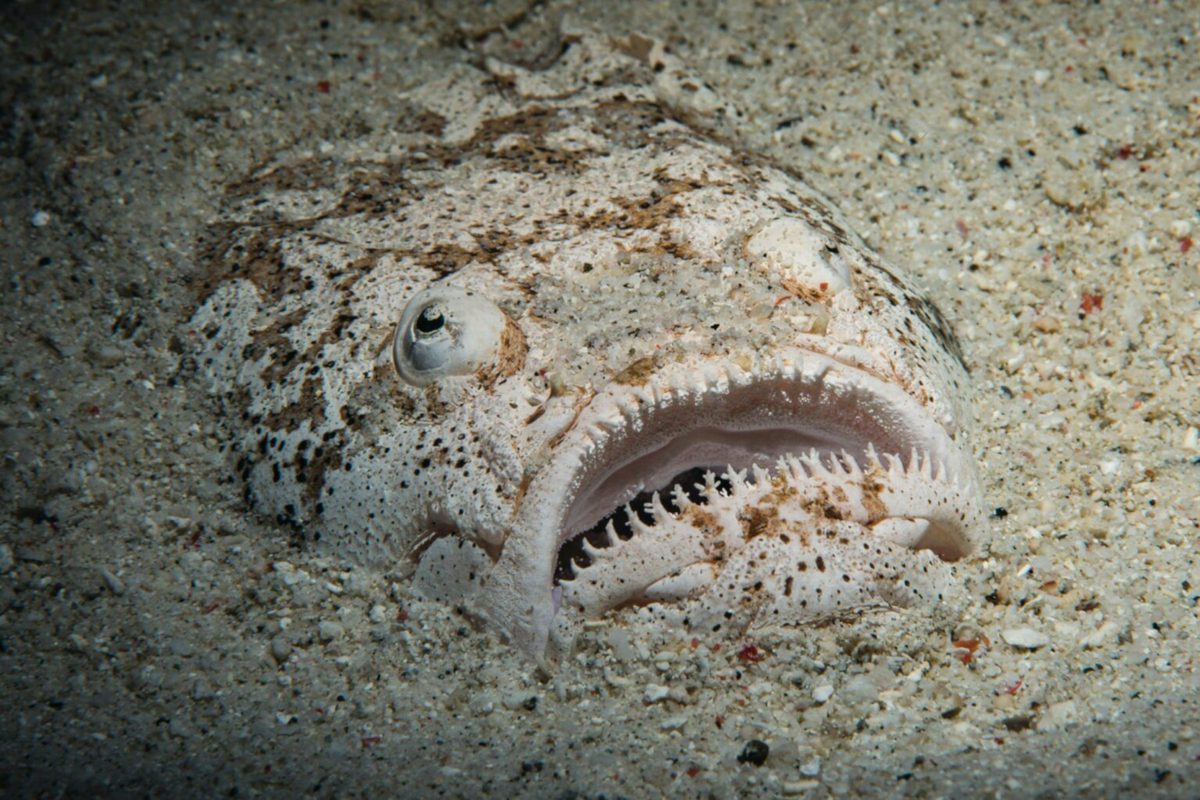
Take a look at the White Margin Stargazer (Uranoscopus sulphureus), whose striking features—a large, menacing mouth filled with frightening teeth and prominent eyes gazing upwards—are sure to deter any curious intruders.
They resemble eerie, small humans half-buried in sand, looking undeniably irate.
In fact, many marine enthusiasts prefer to avoid encounters with these creatures. The stargazer is a highly effective ambush predator, adept at subduing its prey.
Stargazers bury most of their bodies in the sandy ocean substrate, using their broad pectoral fins to shift sand aside, leaving just their eyes exposed while waiting for unsuspecting prey.
If any potential meals are slow to appear, stargazers can use a clever baiting technique.
A skin-like appendage resembling a feather extends from its mouth, attracting curious fish and crabs that mistake it for a wriggling insect. However, once they venture near, they meet a far more formidable foe.
In an instant, stargazers create a powerful vacuum by rapidly sucking in water through their wide mouths, quickly ensnaring their unsuspecting prey.
Moreover, White Margin Stargazers are well-equipped for defense, with venomous spines that deliver a painful sting to any potential threats.
This stunning species can grow up to 45 cm (approximately 18 inches) and inhabits the warm waters of the Indian and Pacific Oceans, ranging from the Red Sea to Fiji and Tonga.
There are approximately 50 other stargazer species worldwide, all possessing venom, making encounters potentially painful. A stargazer’s spine embedded in your leg can be excruciating, but it’s typically not fatal.
But that’s not all these fish have up their sleeve! The White Margin Stargazer can generate electric shocks using specialized cells located between its eyes.
These remarkable fish defy the common-sense warning against mixing water and electricity—water conducts electricity at least a billion times more efficiently than air.
Electricity has independently evolved in at least six fish groups, serving various purposes.
The most infamous is the electric eel (despite not being a true eel) found in the Amazon, capable of delivering a stunning 200-volt jolt to incapacitate prey.
Conversely, elephant fish utilize weak electrical currents to navigate murky waters, much like bats use sonar.
White Margin Stargazers deploy electric shocks as a defense mechanism, typically strong enough to deter larger predators, but not powerful enough to incapacitate prey.
Like all electric fish, stargazers have evolved muscle cells that enable them to pump charged ions across their membranes, allowing them to store electrical energy for quick release when needed.
How they do this without electrocuting themselves remains a fascinating mystery.
If you have any questions, please email us at: [email protected] or send us a message Facebook, Twitter or Instagram (please include your name and location).
Explore our ultimate fun facts and discover more amazing science content.
Read more:
Source: www.sciencefocus.com