


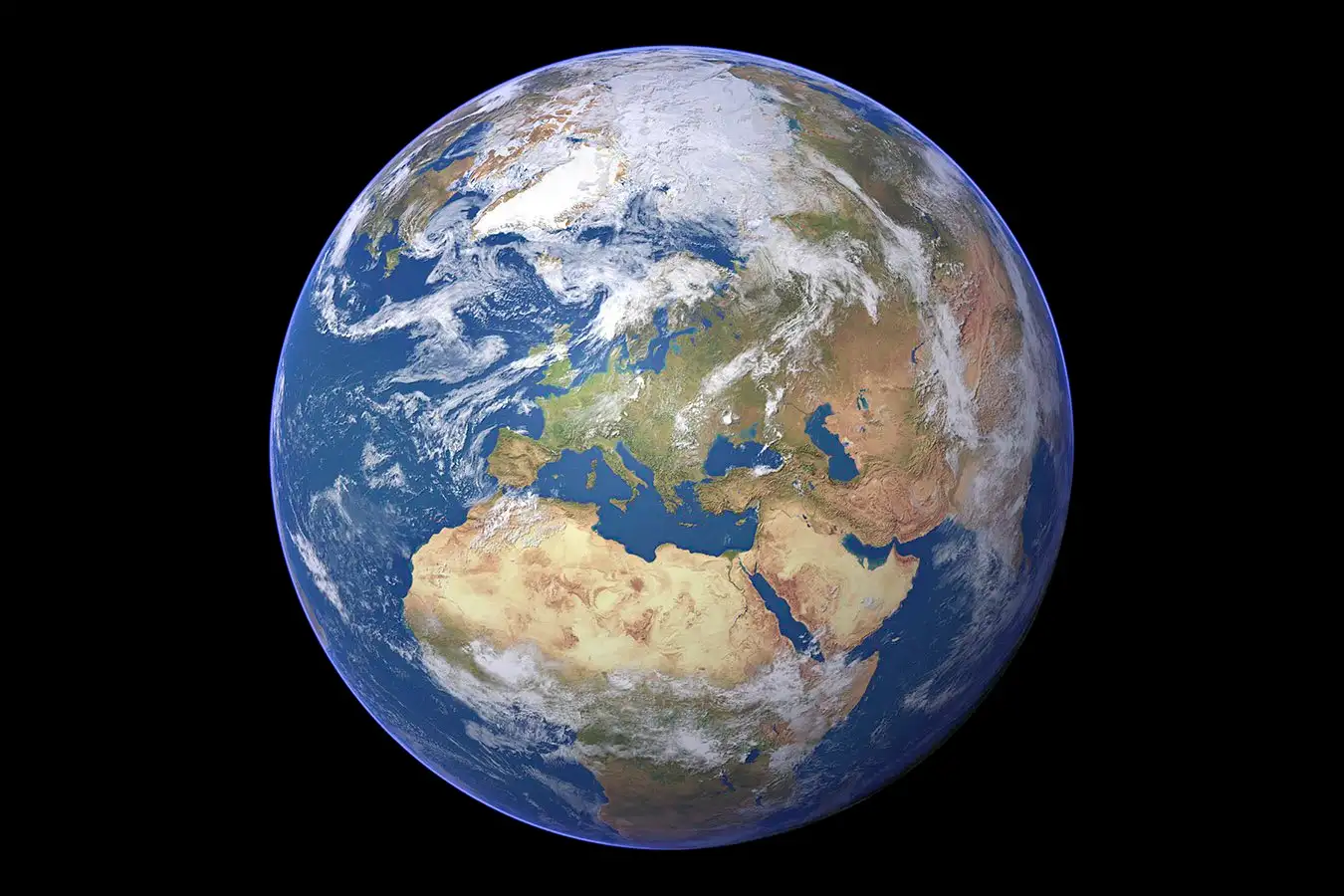

The 27 degrees east meridian divides the Earth into two equally reflective halves, running through Europe and Africa.
Planetary Visions Limited/Science Photo Library
A critical line traversing Africa, Europe, Alaska, and both poles separates the Earth into two halves, each reflecting an equal amount of light. This newly discovered symmetry may significantly influence Earth’s climate.
Historically, it has been recognized that the albedo, or reflectivity, of the northern and southern hemispheres is nearly the same. Jiang Hao and researchers from the National Oceanic and Atmospheric Administration have identified an additional symmetry line at 27 degrees east longitude and 153 degrees west longitude.
This line delineates hemispheres that are approximately equivalent in three key metrics: clear sky albedo, cloud reflectance, and ice-free ocean coverage. This symmetry has endured over the 25 years of satellite data examined by Zhang et al.
Initially skeptical, Zhang became convinced of the significant nature of this East-West symmetry due to its uniqueness, persistence, and triple symmetry characteristics. “One might expect to find a single split with equal total reflection, but the presence of a distinct and stable east-west split that also balances land and ocean distribution along with clear and cloudy sky reflections is remarkable, especially considering cloud variability,” he explains.
Over 25 years of satellite data, the east-west symmetry remains centered around 27 degrees east. However, the precise line shifts incrementally each year, with researchers finding these fluctuations closely tied to the phases of the El Niño Southern Oscillation (ENSO), a global climate phenomenon linked to changes in Pacific Ocean sea surface temperatures.
“In essence, this symmetry may not merely be a geometric coincidence,” Zhang asserts. “It could play a crucial role in one of the most significant modes of climate change on Earth. ENSO may function as a large-scale mechanism that helps sustain long-term east-west symmetry centered around 27 degrees east longitude.”
Ovind Hodnebrok, a researcher from the International Center for Climate Research in Oslo, Norway, expressed initial doubt about the findings.
“I was somewhat skeptical regarding the east-west symmetry separated by roughly 27 degrees east longitude,” says Hodnebrok. “Intuitively, it seems less obvious compared to the equator, leading me to believe it might just be coincidental.”
However, he now acknowledges the potential robustness of this feature, deeming it an intriguing property of Earth.
Connections to ENSO may also bear significance. Unlike the diminishing north-south symmetry due to climate change effects on sea ice and clouds, the east-west symmetry currently maintains stability, although predictive models indicate it may weaken in the future. “Emerging asymmetries could indicate shifts in atmospheric circulation,” he warns.
Martin Uecker, a researcher at the University of New South Wales in Sydney, argues that the east-west symmetry may indeed be coincidental.
“Earth’s weather and climate transmit easily across longitudes,” Uecker notes. “The Earth’s rotation generates easterly and westerly wind bands that circle the planet, and atmospheric disturbances tend to travel east-west.”
Zhang suggests that understanding mechanisms preserving east-west symmetry could be relevant for geoengineering endeavors. For instance, efforts to enhance albedo in one hemisphere might be counteracted by global feedback loops.
“Before confidently claiming the effects of geoengineering, we require a deeper understanding of how clouds, circulation, precipitation, and planetary reflectance interact within the Earth system,” Chan concludes.
Topics:
Source: www.newscientist.com