


Close Menu
HitechubHitechub
    What's Hot
    Technology

    Anthropic Warns Small AI Models Could Self-Replicate Through IoT Devices

    Technology

    Best MacBook to Buy in 2026: Find the Right Laptop for You

    Science

    AI Conferences Impose Submission Caps Amid Record Demand

    Important Pages:
    • About Us
    • Privacy Policy
    • Terms & Conditions
    Facebook X (Twitter) Instagram Pinterest
    Facebook X (Twitter) Instagram
    HitechubHitechub
    Friday, November 27
    • Shop
      • Fashion
        • Mens
        • Womens
        • Accessories
          • Handbags
          • Keychain
          • Masks
          • Money clicps
          • Neck Pillow
          • Rings
          • Towels
          • Wallets
        • Jewelry
        • Watches
        • T-shirts
        • Hawaiian shirts
        • Vests
        • Swim trunks
        • Swimsuits
      • Fun
        • Magic cubes
        • Magnifiers
        • Misc
        • Photo books
        • Puzzles
        • Toys
      • Home
        • Cleaning/Care
        • Mailbox covers
        • Mugs
        • Pot Holders
        • Spoon
      • Office and Electronics
        • Chairs
        • Office Supplies
        • IPad cases
        • Laptop stickers
        • Mouse pads
        • Notebooks
        • Pencil bags
        • Pens
        • Phone cases
      • Personalized
      • Pets
      • Sports
        • Cycling
          • Balaclava Mask
          • Bike Bell
          • Bike Computer
          • Bike Fender
          • Bike Grips
          • Bike Kickstand
          • Bike Light
          • Bike Locks
          • Bike Mitts
          • Bike Pumps
          • Bike Repair Stand
          • Bike Seat
          • Bike Trainer
          • Bike Wheels
          • BIKES
            • Folding Bikes
            • Road Bikes
          • Carbon Fiber Bike Products
          • Cycling Mask
          • Kid’ Bike Helmets
          • Inner Tube
          • Motorcycle Bag
          • Nylon Pedals
          • Adult Helmets
          • Photochromic Sunglasses
          • Soft Coolers
          • Suction Cup Bike Rack
          • Tool accessories
          • Winter Cloth
          • Heart Rate Monitor
        • Outdoors/Camping
          • Outdoor Bags
        • Sweatband
    • Technology
      1. AI
      2. Gadgets
      3. View All

      This is the most popular CEO in the world

      Sectors in which “Chat-GPT” is most often used

      Artificial intelligence has begun to “swallow” professions

      The unusual robot conductor of a concert in Seoul

      Here’s how you can tell if your phone is being tapped

      PlayStation 5 becomes a completely silent console and gets more space

      This is the first phone that can be used to park a car

      Best Gaming Laptops 2023: Powerful Portables for PC Games

      Intel Faces Pressure to Give Trump 10% Stake or Risk Consequences

      How AI May Transform the Role of Theoretical Physicists

      SAP Confirms Security Incident Following Suspicious GitHub Activity

      Iranian Hacker Group Discovers New Tactics to Launch Widespread Cyberattacks

    • Science
      1. Space
      2. Wheels
      3. View All

      Space Perspective: A Journey to the Edge of Space

      5 Fascinating Facts About Space

      Space Exploration: Unveiling the Wonders of the Universe

      Toyota wants to make a new generation battery with a range of up to 1,200 km

      Meet Toyota’s lunar “baby” that could make exploring the Moon easier

      What does a night drive look like with one of the most beautiful cars in the world: the Rolls-Royce Ghost

      Postcard from the Grave: Exploring Nature’s Haunting Beauty

      Why the Next U.S. Congress Should Ban Self-Improving AI Development

      Natural Floating Island Installed in Glasgow Park as a Lasting Games Legacy Project

      Extremophile Transgene Enhances Drought Resistance and Yield in Cereal Crops

    HitechubHitechub
    Home » Biologists Create Synthetic Cells Capable of Nourishing, Growing, Dividing, and Evolving
    Science

    Biologists Create Synthetic Cells Capable of Nourishing, Growing, Dividing, and Evolving

    Share Facebook Twitter Pinterest WhatsApp
    Share
    Facebook Twitter LinkedIn Pinterest WhatsApp

    Biologists from the University of Minnesota have successfully developed synthetic cells composed entirely of non-living chemical components. These cells can undergo a complete life cycle—ingesting nutrients, growing, replicating genetic material, dividing into daughter cells, and transferring beneficial mutations to the next generation. Known as Spud Cells, this groundbreaking project marks a significant advancement in the field of bioengineering.


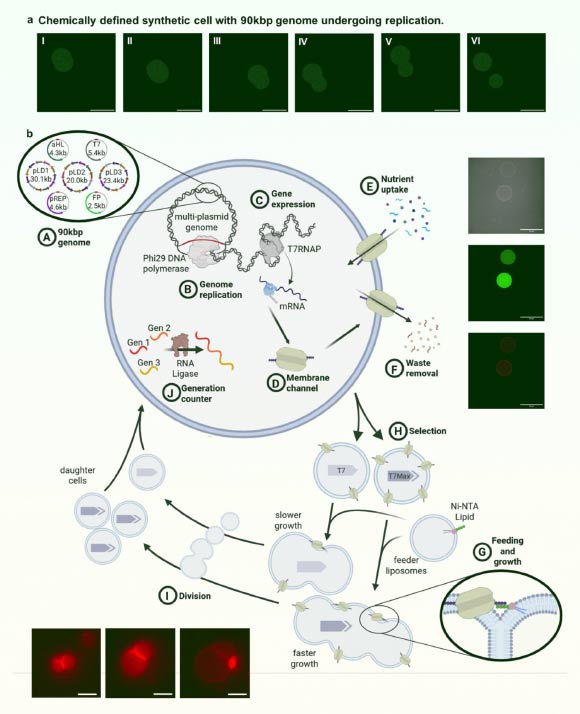
    Cell cycle of a synthetic cell with a 90 kbp genome undergoing selective replication. Image credit: Gaut et al., doi: 10.64898/2026.07.01.735724.

    “DNA serves as the program for all living organisms,” stated Dr. Katarzyna Adamara, the corresponding author, along with her research team.

    “While the human genome consists of approximately 3 billion base pairs, biologists estimate that a living cell’s genome can be as small as 113,000 base pairs. In contrast, Spud Cell’s genome is reduced to an impressive 90,000 base pairs.”

    Different from natural cells, which have inherited complex machinery through billions of years of evolution, these synthetic cells were assembled from the ground up using chemically defined components: lipid membranes in the form of liposomes, a minimal protein synthesis system, and a 90,000-base pair genome distributed across seven or eight plasmids.

    The genome is specifically engineered to encode all necessary functions for the cell to nourish itself, replicate its DNA, grow, and divide.

    To sustain themselves, synthetic cells merge with small “feeder” liposomes providing essential lipids, enzymes, and small molecules.

    This fusion relies on a modified bacterial pore protein produced by the cell itself, featuring a chemical tag on its outer surface. This tag binds to a corresponding tag on the feeder liposome, facilitating fusion and delivering vital raw materials. Researchers describe this mechanism as a predator attracting extra prey.

    Through recurrent feedings, the cells employ enzymes sourced from bacterial viruses to replicate their DNA and mechanically divide into daughter cells.

    By monitoring chemical markers from each round of feeder liposomes, researchers traced a single lineage of cells over five generations. Surprisingly, around 30% of the surviving daughter cells retained a complete copy of their seven-part genome, despite the absence of a cytoskeleton or specialized systems for DNA distribution—elements relied upon by all natural cells.

    The scientists investigated whether Darwinian selection could manifest in this simplified system.

    They engineered a variant of the feed protein with a more robust genetic promoter, enabling cells to more effectively fuse with feeder liposomes.

    When fast and slow-growing cell variants were mixed for five generations, the faster cells gradually dominated the population, increasing from a balanced mix to as much as 61% in one experiment.

    When feeder liposomes were scarce, mimicking limited resources, the advantage of rapid growth became even clearer, with fast-growing cells outnumbering slow-growing cells by more than two to one.

    “This is probably the most exhilarating project I’ve ever been a part of,” said Dr. Adamara.

    “We’ve replicated in chemistry what was once thought to be exclusive to biology: the complete behavior of cells.”

    “This demonstrates that fundamental life functions, such as growth and reproduction, do not require extraordinary complexities.”

    Ultimately, they designed a division mechanism that doesn’t depend on the cell’s cytoskeleton but relies on proteins that cluster on the cell surface to pull membranes apart.

    This genetically encoded division may also confer a feeding advantage, with faster-growing cells yielding more daughter cells.

    “This research is merely the beginning,” Dr. Adamara concluded.

    “We illustrate that it is feasible to manipulate the essential functions of cells.” An international collaboration is necessary to harness the complete potential of this technology and make it practical and robust.

    A paper outlining these findings was published as a preprint on July 2nd on BioRxiv.org.

    _____

    Nathaniel J. Gaut et al. 2026. A chemically defined synthetic cell capable of growth and reproduction. BioRxiv doi: 10.64898/2026.07.01.735724

    Source: www.sci.news

    Share. Facebook Twitter Pinterest LinkedIn WhatsApp
    Previous ArticleExperts Rank 400 Jobs by Dementia Risk: Surprising Results Revealed!
    Next Article Unlocking the Bermuda Triangle Mystery: How Science Provides Answers

    Related Posts

    Science

    Postcard from the Grave: Exploring Nature’s Haunting Beauty

    Science

    Why the Next U.S. Congress Should Ban Self-Improving AI Development

    Science

    Natural Floating Island Installed in Glasgow Park as a Lasting Games Legacy Project

    Science

    Extremophile Transgene Enhances Drought Resistance and Yield in Cereal Crops

    Science

    Black Friday 2026 Telescope Deals: Smart Telescopes and Binoculars

    Science

    NASA Science: Imbued with Sivrich

    Science

    Why Certainty Can Be a Failure in Science

    Science

    Chromosomal Glue May Improve Fertility by Stabilizing Aging Eggs

    Add A Comment
    Leave A Reply Cancel Reply

    Stay In Touch
    • Facebook
    • Twitter
    • Instagram
    • Pinterest
    Top Picks
    Science

    The Great Zoo Escape: What Happened After the Largest Animal Escape in History?

    Have you ever heard the incredible story of monkeys and Yorkshire puddings? In 2024, a…

    NASA Glenn’s Flight Research Legacy: Decades of Innovation and Discovery

    2027 BMW i7 xDrive60: Improved Battery and Driving Range

    Best Google Pixel 10 Cases and Accessories (2026): Top Mous, dbrand, and Bellroy Picks

    SDCC Unveils Final Trailer for Coyote vs. Acme: What to Expect

    Most Popular
    Science

    Animals May Have Evolved 200 Million Years Earlier Than Previously Thought

    Science

    Greenpeace Drops Boulders on North Sea Fishing Grounds off Norfolk to Block Trawling

    Categories
    • AI (9)
    • Gadgets (6)
    • Science (3,613)
    • Space (3)
    • Technology (3,044)
    • Wheels (3)
    Our Picks
    Science

    Stunning Images Reveal Sand’s Advance on Sahara Desert Oasis

    Technology

    Spanish Data Authority Receives First Report of AI-Related Data Breach

    © 2026 Hitechub.
    • Home
    • About Us
    • Privacy Policy
    • Terms & Conditions

    Type above and press Enter to search. Press Esc to cancel.

    GDPR Cookie Banner

    We are using cookies to give you the best experience on our website.

    You can find out more about which cookies we are using or switch them off in .

    Ad Blocker Enabled!
    Ad Blocker Enabled!
    Our website is made possible by displaying online advertisements to our visitors. Please support us by disabling your Ad Blocker.