


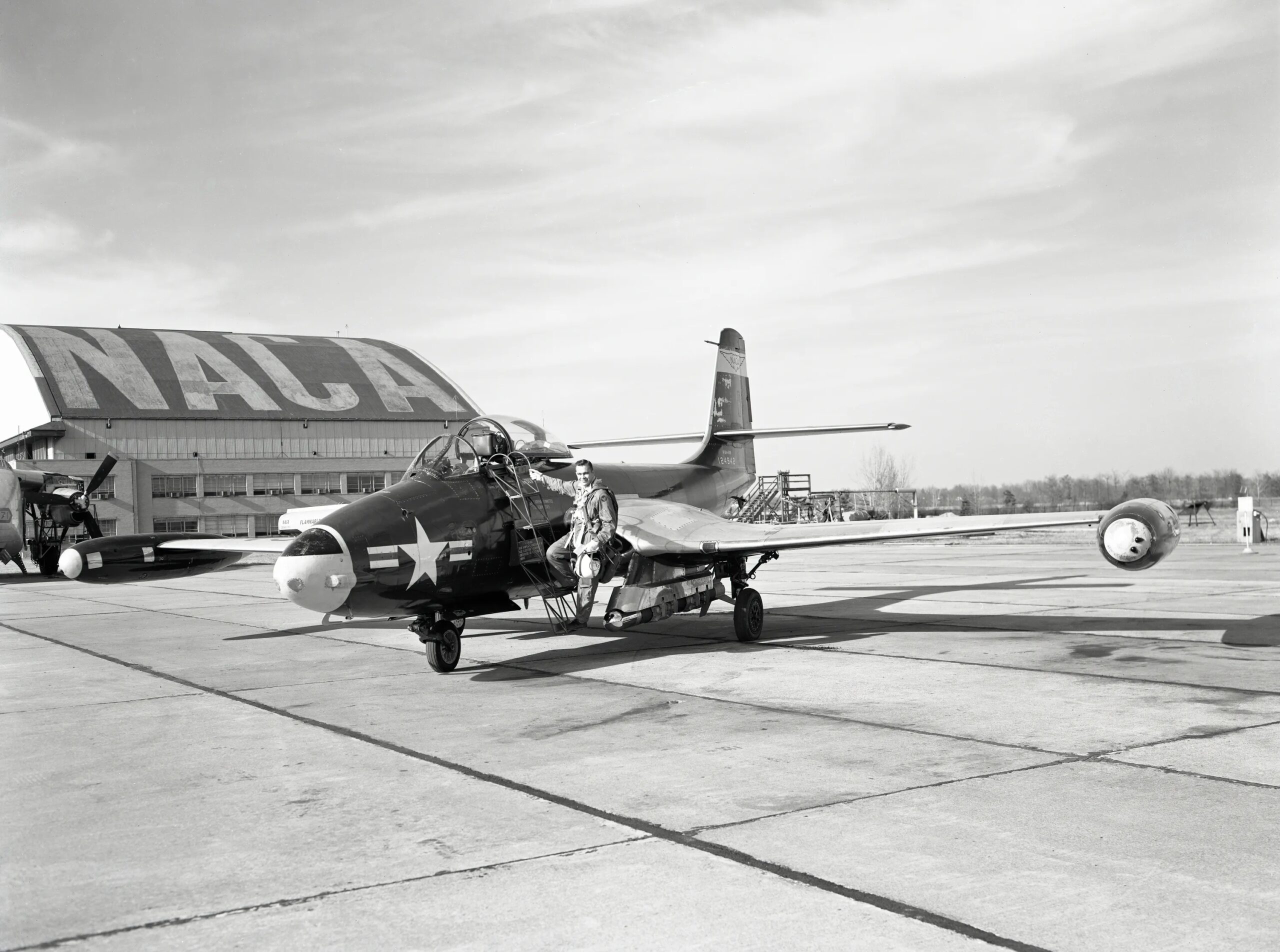
For more than 80 years, NASA Glenn Research Center in Cleveland has used flight testing to turn laboratory discoveries into proven aerospace technologies. By flying aircraft through icing clouds, high-altitude environments, and carefully controlled atmospheric conditions, NASA Glenn researchers collect real-world data that connects laboratory theory with in-flight performance.
NASA Glenn’s flight research began in the 1940s, when the center operated as the Aircraft Engine Research Laboratory under NASA’s predecessor, the National Advisory Committee for Aeronautics. During World War II, engineers and pilots worked to improve aircraft performance and engine reliability at high altitudes. By the mid-to-late 1940s, Glenn flight tests had helped advance early jet and ramjet engines. Over time, the center’s aircraft research expanded to improve the efficiency, reliability, and environmental performance of conventional aircraft engines.
A pioneering group of test pilots played a vital role in establishing NASA Glenn’s reputation for aerospace research. The center’s first generation of pilots included Howard Lilly, Joseph Walker, William Swan, and William “Ed” Goff. Their work helped create the foundation for more than 20 Glenn pilots who followed, including future astronauts Neil A. Armstrong and Fred Haise.
Working alongside Glenn researchers, engineers, and support teams, these pilots developed the airborne research capabilities that NASA continues to use today. Their missions demonstrated how flight testing can close the gap between laboratory experiments and real-world aircraft performance.
“These missions turned the aircraft into a flying laboratory,” said Mark Russell, a NASA safety officer and pilot who previously served as acting director of aircraft operations at Glenn. “They bridged the gap between ground testing and full-scale flight, proving the measurements needed to link theory and performance. The tests also helped validate techniques and procedures that would later be used on spacecraft and orbital missions.”
From the beginning, NASA Glenn aircraft have supported a broad range of aerospace research and technology demonstrations.
For decades, NASA Glenn flight tests have focused on understanding in-flight icing hazards and improving aviation safety. The center’s de Havilland DHC-6 Twin Otter served as the primary icing research aircraft for nearly 40 years. Data collected during these missions helped shape modern aircraft icing standards and improve the safety of civil aviation.
NASA Glenn flight research has also explored advanced propulsion systems with the potential to transform aviation. Today, researchers are studying hydrogen as a possible aviation fuel, building on work conducted decades ago with the Martin B-57B Canberra. After developing a hydrogen fuel system for the aircraft, NASA tested its safety between February and April 1957. The flights demonstrated reliable system operation and high efficiency, marking an important milestone in hydrogen-powered aviation research.
Flight testing has also helped NASA develop technologies designed for use beyond Earth. In 1963, Glenn began a program to evaluate the performance of solar cells under conditions similar to those encountered in space. Specially modified aircraft, including Learjet platforms, recreated aspects of the sunlight and atmospheric environment experienced outside Earth’s atmosphere. Over the decades, high-altitude flight tests have supported the calibration of space-based solar technology while adapting the program to new aircraft.
NASA Glenn researchers have applied these airborne capabilities to environmental science as well as aviation and space exploration. Using a Twin Otter and an S-3B Viking, researchers flew over the Great Lakes to track harmful algal blooms in Lake Erie. By measuring changes in water color and composition, the aircraft collected data that improved satellite-based monitoring of water quality and ecosystem health.
Glenn research aircraft have also supported spaceflight technology through microgravity testing. Specially modified aircraft, including a DC-9, performed parabolic flights that created brief periods of weightlessness. These missions allowed researchers to study the behavior of fluids, combustion, materials, and experimental hardware in near-zero gravity before conducting experiments in space.
Other major achievements from NASA Glenn flight research include supporting sustainable aviation technologies, developing more fuel-efficient engines, evaluating sustainable aviation fuels, and advancing the in-flight instruments and measurement techniques used across aerospace research.
In 2024, Glenn’s flight operations division supported optical communications research using the center’s Pilatus PC-12 NG aircraft. The mission successfully demonstrated the transmission of large amounts of data through laser communication systems connected to NASA’s legacy infrastructure. The work contributed to NASA’s broader effort to advance optical communications for future space missions. NASA also demonstrated optical communications during the Artemis II mission, transmitting substantial amounts of data from the Orion spacecraft to multiple ground stations during its 10-day journey.
As NASA’s flight research program has evolved, the agency has also changed how it manages its research aircraft. In October 2025, NASA streamlined aircraft flight operations and relocated the aircraft from Glenn to NASA’s Armstrong Flight Research Center in Edwards, California. NASA Glenn continues to collaborate with Armstrong on icing research, propulsion testing, communications technology, and other advanced aerospace projects.
From wartime engine development to modern research in aircraft safety, sustainable aviation, propulsion, environmental monitoring, and space communications, NASA Glenn flight testing has consistently transformed laboratory ideas into real-world innovations. For more than eight decades, NASA Glenn has proven new technologies in the skies—helping shape the future of aviation and space exploration.
Source: www.nasa.gov