


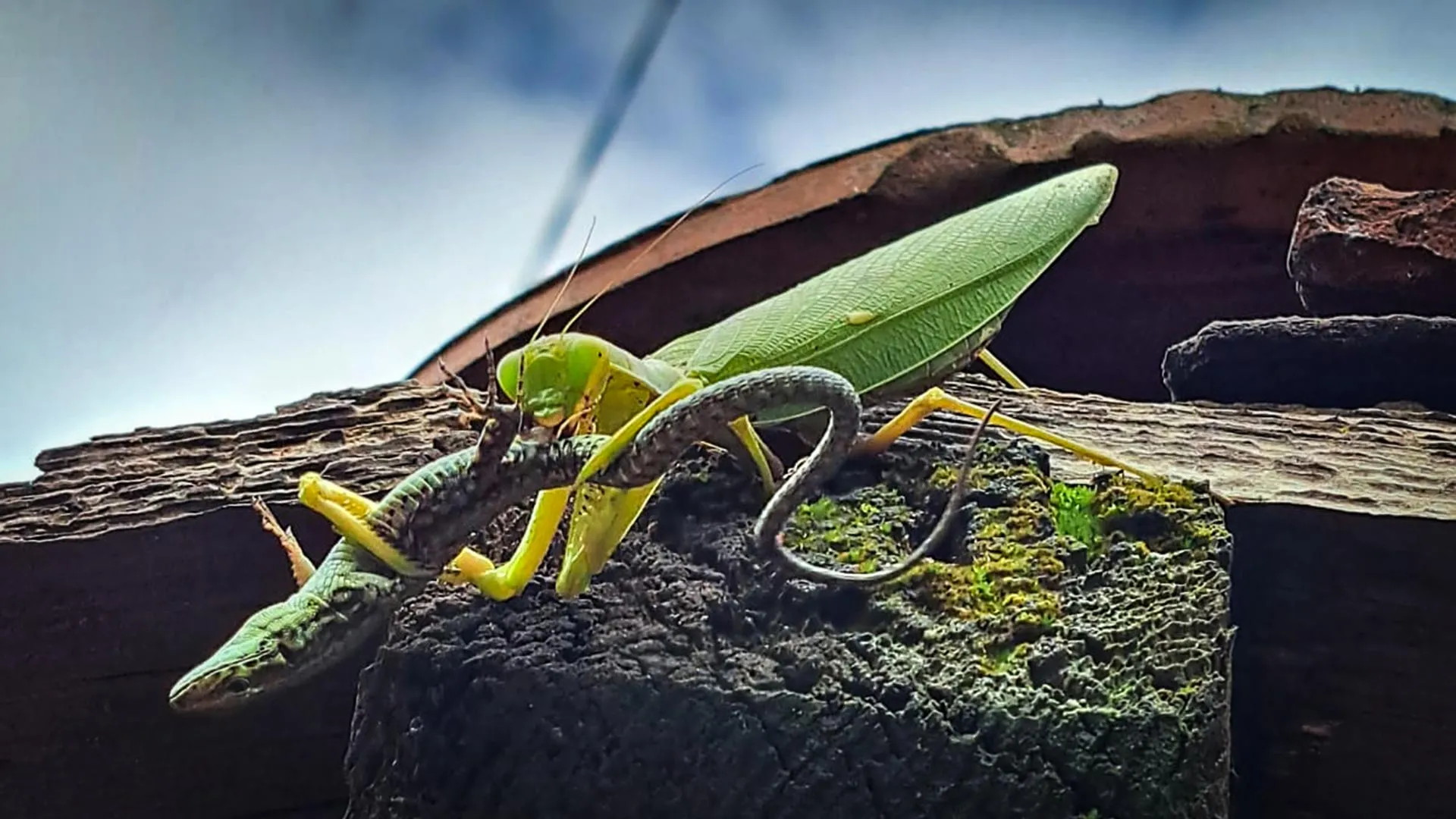
Praying mantises have captivated humans for centuries. Various cultures perceive them as mystical guides that assist lost travelers in finding their way home or as eerie creatures linked to misfortune. Beyond folklore, native praying mantises serve a crucial ecological purpose, acting as indicators of healthy and biodiverse ecosystems.
However, scientists are sounding the alarm about two Asian praying mantis species that pose an increasing threat to Europe’s native wildlife.
Asian Giant Praying Mantis Officially Classified as an Invasive Species
Recent research published in the open access Orthoptera Research Journal has designated two species of praying mantises—that is, Hierodura tenuidentata and Hierodura paterifera—as invasive alien species (IAS) in Europe. The study, led by Roberto Battiston from the Museum of Archeology and Natural Sciences G. Zanato, examined the ecological impacts of these Asian native species in Europe, a topic that has received limited scientific focus.
Battiston notes that these insects have been in Europe for about a decade but have dramatically increased their populations in recent years across Mediterranean and continental regions.
“Due to climate change, they are migrating northward,” Battiston said, highlighting that established populations in parks and gardens are frequently reported by the public. Their large and impressive appearance makes them seem like a welcome sight, diverting attention from their potential ecological impacts.
“This research aims to provide answers and develop strategies to manage their growth.”
Why Do Praying Mantises Spread So Quickly?
Hierodura tenuidentata and Hierodura paterifera are sizable, adaptable predators that thrive in trees and shrubs. They also reproduce rapidly, with each egg case yielding around 200 offspring—nearly double the number produced by native European praying mantises (Mantis religiosa). Young nymphs are less prone to cannibalism, allowing their populations to flourish.
This reproductive success creates significant challenges for native wildlife. Female non-native mantises attract native males, who attempt to mate but are often consumed, leading to a decline in local populations. These invaders also prey on a variety of native species, including crucial pollinators like honeybees and protected small vertebrates, such as tree frogs and lizards.
The researchers emphasize that assessing these impacts is vital, particularly on Mediterranean islands rich in unique invertebrate and vertebrate species.
Cats, Cities, and Climate Change
Interestingly, domestic cats emerge as the primary vertebrate predators of these invasive praying mantises, accounting for 45% of recorded predation events.
Battiston highlights that while cats may help control the number of invasive mantises, they can’t differentiate between invasive and native species. Free-roaming cats also prey on the European praying mantis, already pressurized by competition from invaders, leading to their decline in many peri-urban environments.
Human activity is also fueling the spread of these insects. Urban and suburban landscapes offer ideal conditions; Hierodura mantises often utilize structures like insect hotels for hunting. Urban heat islands sustain activity levels late into the cold season, extending both their survival and geographic spread.
Citizen Science Can Help Slow the Spread of Invasives
To better understand and manage these invasive praying mantises, researchers are turning to the public.
“My colleagues William Di Pietro and Antonio Fasano (GRIO) have initiated a large-scale citizen science project that has successfully gathered over 2,300 reports from enthusiasts and citizens. Citizen science is crucial not only for monitoring but also for raising awareness and actively involving the public in addressing these issues,” Battiston stated.
People can contribute more than just sightings. During the winter months when trees shed their leaves, the insect’s ootheca—a brown, spongy egg case roughly 2-3 cm long—can be easily spotted on branches. These egg cases can be removed without harm, but Battiston advises seeking expert guidance to avoid accidentally taking native mantis eggs.
Protecting Europe’s Unique Biodiversity
The spread of these Asian praying mantises underscores the ways human activity and climate change can disrupt natural barriers that previously constrained invasive species. As these adaptable predators continue to encroach upon Europe, public awareness, citizen science, and targeted conservation efforts are essential for protecting the continent’s unique biodiversity.
Source: www.sciencedaily.com