


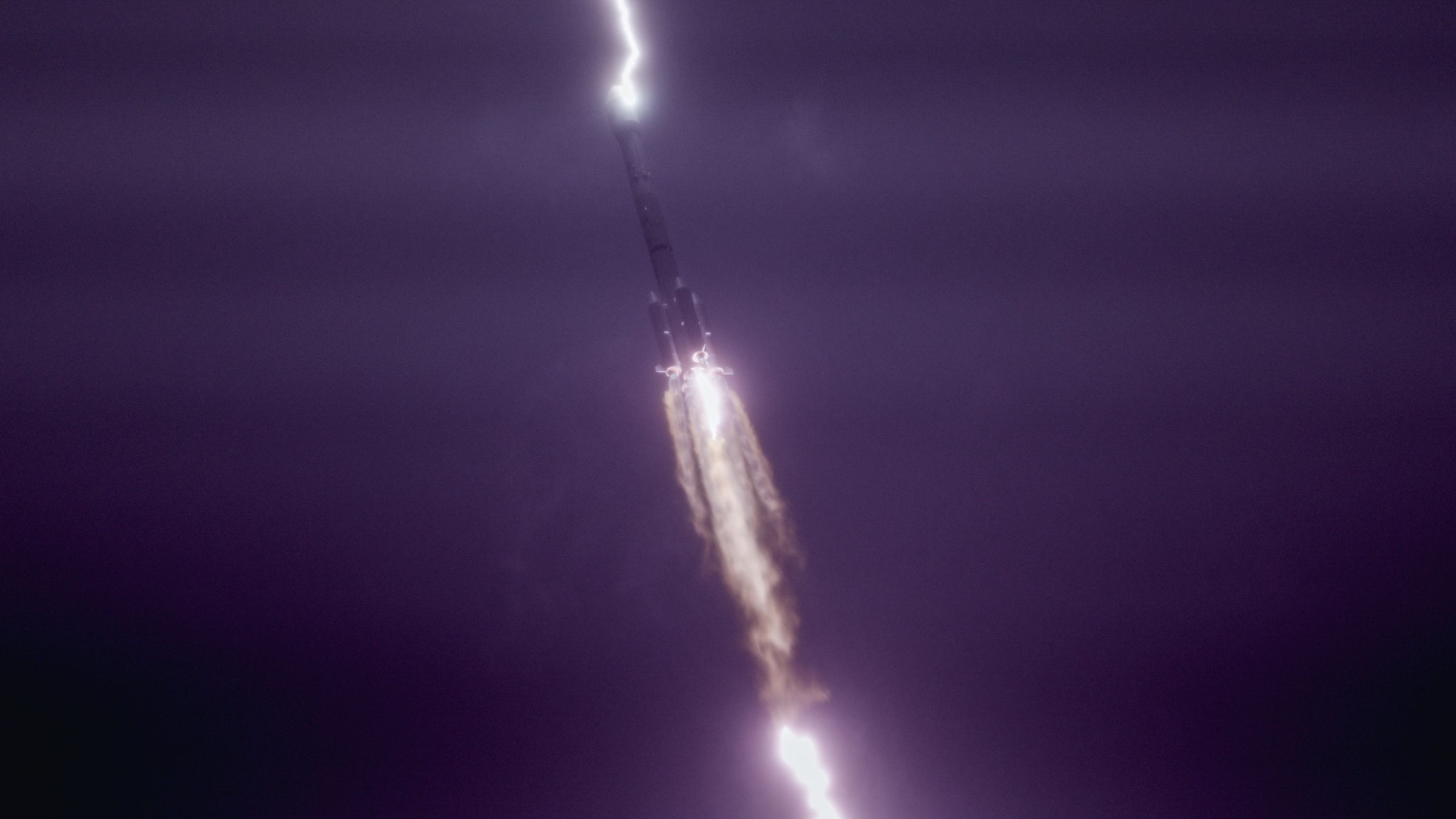
Lightning Strikes Chinese Long March 3B Rocket During Liftoff
Spectators at a recent rocket launch in China witnessed a rare and dramatic event when lightning struck a Long March 3B rocket shortly after liftoff.
Striking images captured the precise moment a powerful bolt of lightning wrapped around the rocket’s fuselage and passed through its exhaust plume before extending toward the ground.
Although lightning can carry at least 100 million volts of electricity, the uncrewed rocket continued its flight and successfully delivered its payload into orbit.
The Long March 3B launched from the Xichang Satellite Launch Center in southwest China at approximately 8 p.m. local time on July 23, according to Live Science’s sister site Space.com. Around 30 seconds after liftoff, lightning suddenly struck the ascending rocket, briefly lighting up the night sky.
Launch video shows spectators wearing raincoats and holding umbrellas gasping as the lightning bolt hits the rocket. The crowd then cheers when the spacecraft continues climbing without any visible interruption.
A translated statement released by the state-owned China Aerospace Science and Technology Corp. described the mission as a “complete success.” It said the Long March 3B deployed the Tianlian-2 (06) satellite, a geostationary communications relay satellite designed to support China’s Tiangong space station.
The official statement did not refer to the lightning strike.
Get the world’s most fascinating discoveries delivered straight to your inbox.
Modern rockets are built with highly conductive outer shells that can redirect electrical charges around the vehicle’s exterior. This design helps shield sensitive electronics and any crew inside, functioning in a way similar to a Faraday cage.
Commercial aircraft use comparable protection and are struck by lightning about once a year on average, according to the National Weather Service.

The Long March 3B is one of China’s largest rockets and has completed more than 100 missions since its first launch in 1996.
(Image credit: VCG/VCG via Getty Images)
Even with modern safety systems, rockets typically launch during favorable weather conditions to reduce the risk of lightning and other atmospheric hazards.
Other rockets struck by lightning
The exact number of rockets hit by lightning during the history of spaceflight is unknown, but several notable incidents have been documented.
One of the best-known examples occurred during NASA’s Apollo 12 mission in November 1969. Shortly after liftoff, the Saturn V rocket carrying astronauts Charles Conrad, Alan Bean and Richard Gordon was struck by lightning twice.
The strikes caused permanent effects in some nonessential instruments and sensors, according to a report. Nevertheless, Apollo 12 continued its journey and safely carried the astronauts to the Moon and back.
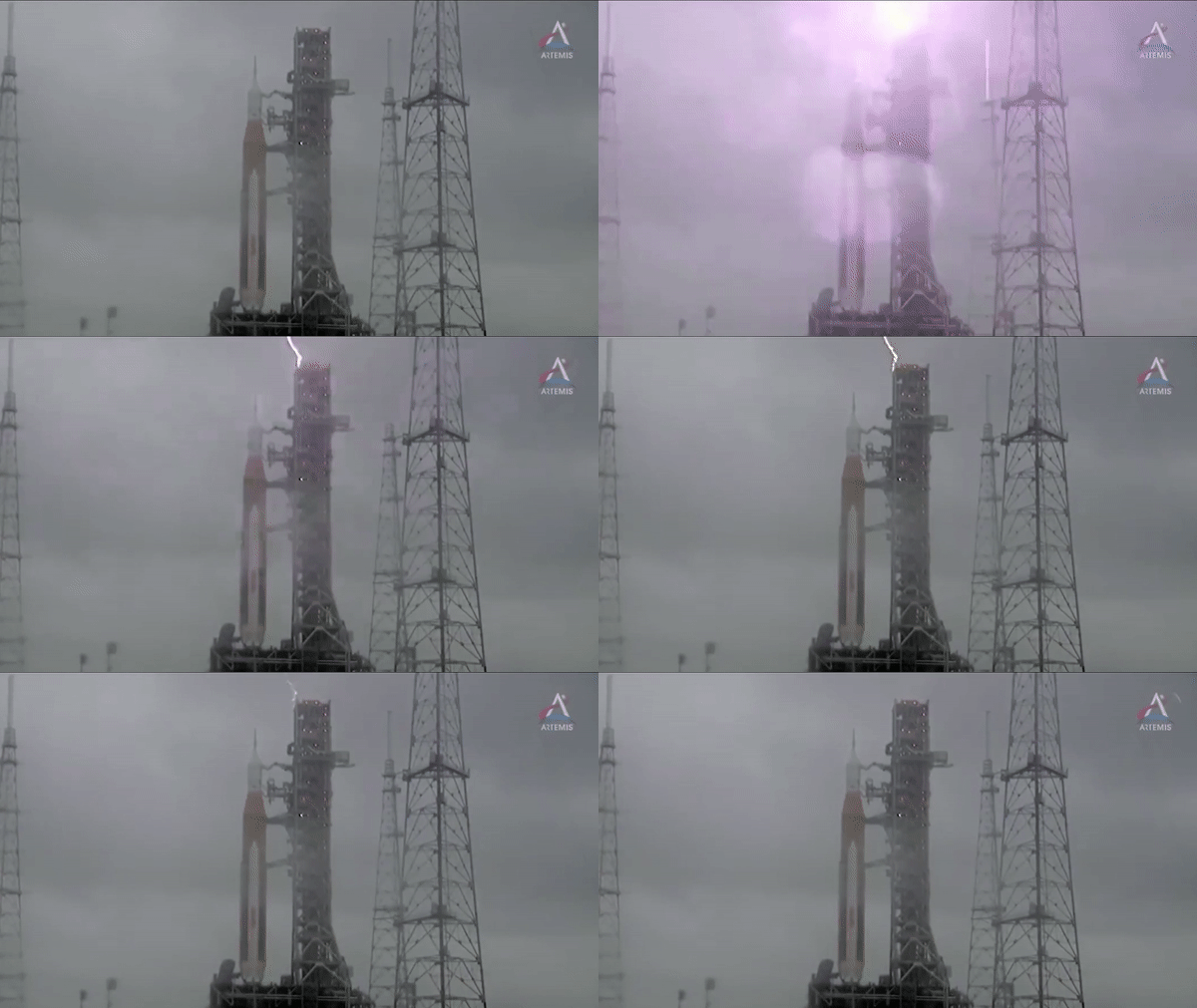
NASA’s Artemis I rocket was struck by lightning during a “wet dress rehearsal” several months before its launch.
(Image credit: NASA)
In another incident, a Russian Soyuz rocket was reportedly struck by lightning in 2019 while carrying a communications satellite into low Earth orbit, Ars Technica reported.
Lightning can also strike rockets while they are still on the launchpad. In 2022, NASA’s Space Launch System rocket was hit during a “wet dress rehearsal” for the Artemis I mission. Such incidents are now uncommon because launchpads are typically equipped with lightning protection towers that help divert electrical strikes away from rockets, according to The Institution of Engineering and Technology.
However, not every lightning strike has ended safely. In 1987, an Atlas-Centaur rocket known as AC-67 was destroyed 48 seconds after liftoff from Cape Canaveral, Florida. A NASA report concluded that the electrical discharge caused a “single-word memory alteration” in the rocket’s navigation computer. The resulting guidance failure sent the rocket sideways, causing it to break apart.
Source: www.livescience.com