


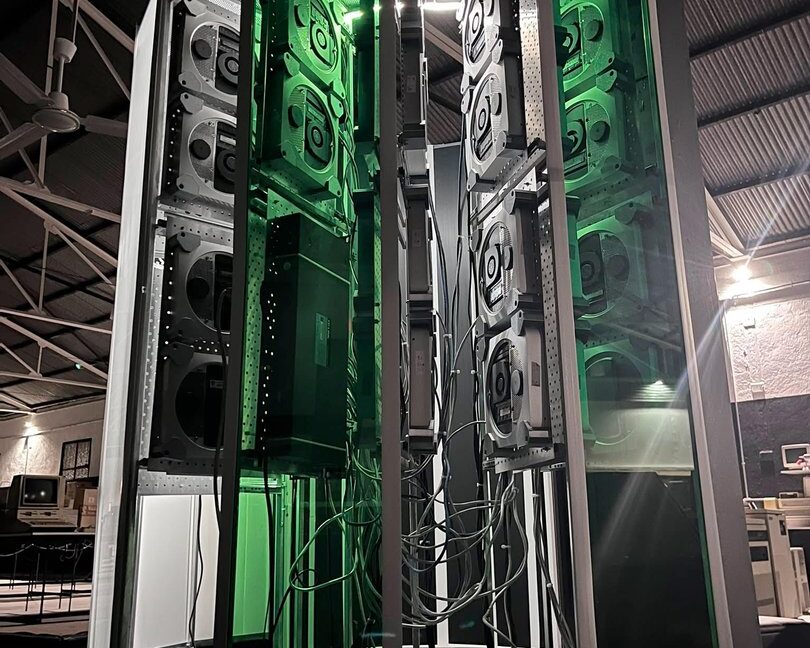
30 Vintage Mac Minis Recreate a Cray-1 Supercomputer in Spain
A 1:1-scale replica of the famous Cray-1 supercomputer has been unveiled at the Computing History Museum in Spain. Rather than using expensive modern hardware, the creative team built the working system with 30 Mac Minis dating primarily from 2012.
The 18-month project celebrates the Cray-1 and Apple’s 50th anniversary. It also gives museum visitors a hands-on way to explore how computer architecture and parallel processing have evolved since 1976.
A Mac Mini cluster delivers up to 1.5 teraflops
Although a decade-old Mac Mini might not seem like an obvious foundation for a cluster supercomputer, the computers can be connected over a network and configured to work together. In modern testing, the cluster delivered 1.3 teraflops using 64 active processing cores.
The museum reportedly measured 1.5 teraflops using all 70 available cores before one node went offline. The benchmarks were produced with a custom Python script for matrix multiplication. Five of the computers use quad-core Intel Core i7 processors, while the remaining 25 use dual-core Intel Core i5 chips. All but two of the machines are from 2012; the other two were released in 2014.
Visitors can watch the system execute matrix algorithms in real time and compare performance ranging from a single processor core to the complete cluster running in parallel.
How the replica compares with the original Cray-1
The original Cray-1 used vector processing, which applies a single instruction to multiple data elements simultaneously. The replica takes a different approach, distributing workloads across independent processors in a parallel cluster.
Despite using consumer hardware, the Mac Mini system is considerably more capable than the original machine. The Cray-1, which was originally developed for research, had a theoretical peak performance of approximately 160 megaflops.
Instead of relying on macOS, the team installed a standard Linux distribution. The cluster uses MPI, or Message Passing Interface, a software layer that enables the individual computers to exchange tasks and coordinate their workloads.
Cray-1 replica with its iconic padded bench seat. The only thing missing is Robert Redford and Ben Kingsley discussing SECTEC astronomy.
Credit: Museo de Historia de la Computación
Passive cooling keeps the Mac Mini supercomputer quiet
Building the 30-computer cluster was not the team’s only engineering challenge. Anyone familiar with server rooms—or with installing computer equipment in a basement—knows that cooling fans can make a system extremely noisy.
To reduce the noise, the museum team used passive convection cooling for each Mac Mini. The computers are mounted in a steel rack chassis with aluminum trays that help dissipate heat. Compared with the roar of a modern data center, the resulting cluster is almost inaudible.
Source: arstechnica.com