


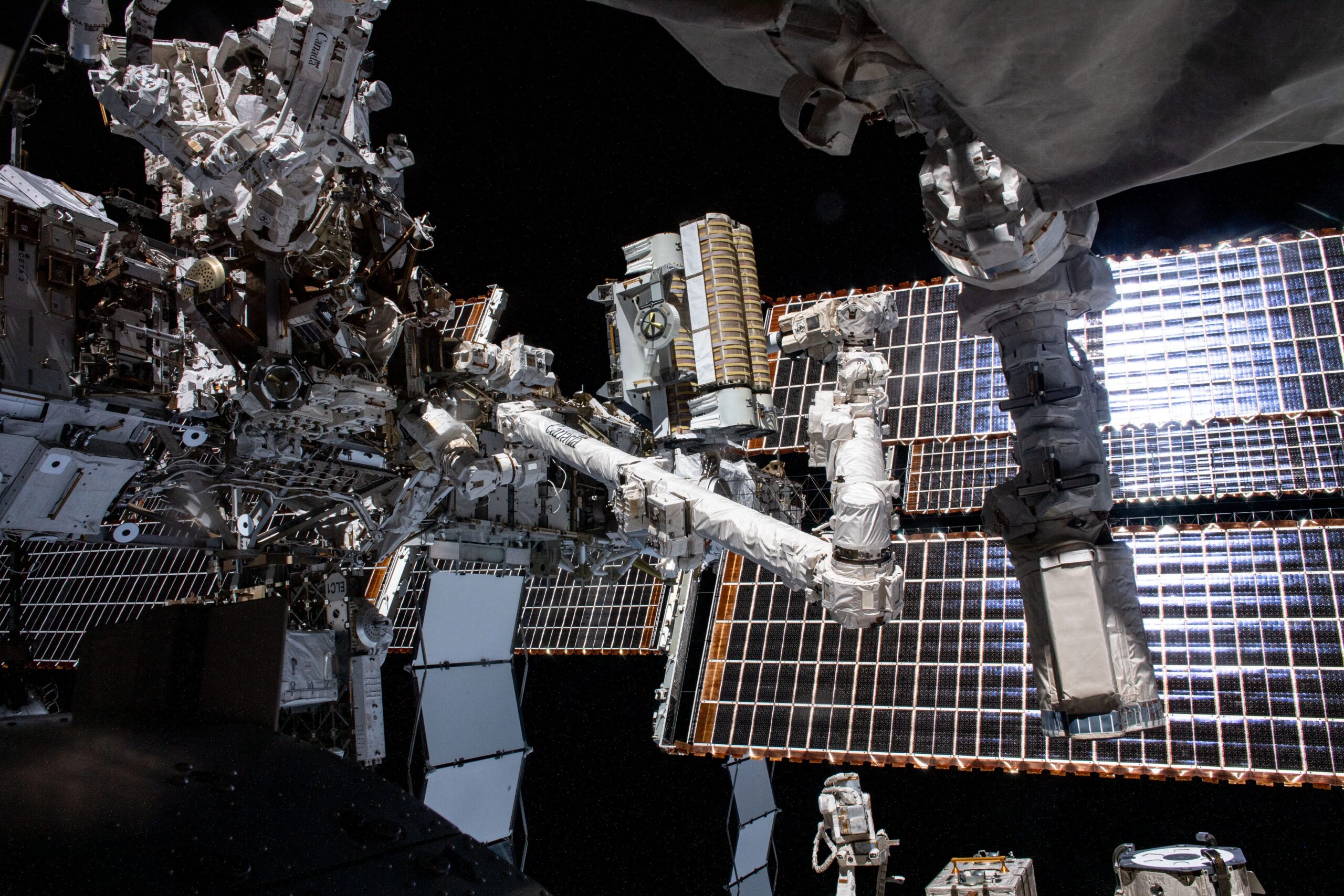
NASA’s New IROSA Solar Arrays Boost International Space Station Power
Orbiting about 400 miles above Earth, the International Space Station (ISS) depends on solar power for its life support systems, daily operations, and hundreds of research studies. Over the past five years, NASA has expanded the station’s power generation and distribution capabilities with the next-generation International Space Station Roll-Out Solar Arrays, known as IROSA.
How IROSA Solar Arrays Work
A technology demonstration conducted aboard the space station in 2017 tested the effectiveness of the IROSA design. Each lightweight, compact array begins as a cylinder and unfolds like a yoga mat after installation. This design reduces mass and volume during launch while using an autonomous self-deployment system to minimize deployment risks.
IROSA is also scalable to meet different mission requirements. Each array is about half the size of the station’s traditional solar arrays, yet it can generate approximately 28 kilowatts of additional power.
Eight IROSAs Expand ISS Power Capacity
Six IROSAs were installed outside the International Space Station between 2021 and 2023. In 2023, updated power forecasts prompted a request for another set of arrays. The new IROSAs were launched in the trunk of a Dragon spacecraft during SpaceX’s 35th Commercial Resupply Services mission to NASA’s space station.
Together, the eight IROSAs will add more than 160 kilowatts of power for space station research and operations. The upgraded solar power system will help the ISS continue supporting science and technology demonstrations in low-Earth orbit.
Preparing for Future Space Exploration
With the power system upgrade complete, the space station will continue supporting NASA’s legacy in low-Earth orbit while advancing technologies for missions throughout the solar system. The ISS is an important testing ground for future human exploration and planetary defense technologies, including demonstrations such as NASA’s Double Asteroid Redirection Test.
Source: www.nasa.gov