


Crystal growth of CrSb single crystals
Single-crystal CrSb samples were synthesized using the chemical vapour transport method. Stoichiometric quantities of chromium (Cr chunks, 99.995% purity) and antimony (Sb shots, 99.9999% purity) served as the starting materials. Iodine was added as the transport agent, with the quantity selected to produce a pressure of 1 bar under the crystal-growth conditions. The materials were sealed under vacuum in a quartz ampoule and positioned in a horizontal two-zone furnace. The furnace temperature was gradually increased to T1 = 925 °C and T2 = 900 °C. The ampoule remained at these temperatures for two weeks before being cooled to room temperature at the natural furnace-cooling rate.
The synthesis produced hexagonal CrSb platelets measuring up to 1.5 mm in diameter, as well as larger, several-millimetre regions containing intergrown crystals. Only isolated single-crystal CrSb specimens were selected for the measurements described in this study.
CrSb sample characterization
Several single crystals from the same growth batch were selected and crushed into a fine powder. The powder was spread on a microscope slide coated with a thin layer of vacuum grease. Powder X-ray diffraction measurements were performed in Bragg–Brentano geometry using a Bruker D8 diffractometer with a Cu source. The diffraction pattern is shown in Extended Data Fig. 1. Measurements covered a 2θ range of 10°–90°; no diffraction peaks were detected below 20°.
The sharp, well-resolved diffraction peaks demonstrate the high crystallinity of the CrSb powder. Rietveld refinement produced an excellent fit, with RBragg = 3.39. All observed reflections were accounted for, confirming that the samples were phase pure. The refined crystal structure is consistent with previously published results40.
Electrical transport, magnetization and Laue diffraction measurements were also carried out, as shown in Extended Data Fig. 1. The crystals were primarily screened using temperature-dependent resistivity measurements to determine their residual resistivity ratios (RRRs). The low-temperature resistivity was fitted to a quadratic temperature dependence and extrapolated to absolute zero to obtain the residual resistivity. The resistivity at 300 K was divided by this value to calculate the RRR. A larger RRR generally indicates a longer electronic mean free path and superior crystal quality. The CrSb crystals typically exhibited RRR values between approximately 10 and 28. The highest-quality samples were oriented using Laue diffraction before high-magnetic-field de Haas–van Alphen (dHvA) effect measurements.
dHvA torque magnetometry measurements
After characterization and quality screening, the best CrSb crystals were transported to the National High Magnetic Field Laboratory in Tallahassee, Florida. Torque magnetometry measurements followed the procedure described in ref. 48. Each sample was attached to a flexible BeCu cantilever using several layers of General Electric low-temperature varnish. This provided both reliable thermal contact and strong mechanical adhesion. The cantilever was soldered in position with its head suspended a short distance above a copper baseplate.
During magnetic-field sweeps, the magnetic torque acting on the CrSb sample caused the capacitance between the cantilever and copper baseplate to change. This variation was detected using a General Radio analogue capacitance bridge with phase-sensitive detection. The torque response was calibrated in farads using an Andeen-Hagerling digital capacitance bridge.
All dHvA measurements were performed in the 41.5 T all-resistive magnet in Tallahassee. The experiments used a 3He sample environment and a custom-designed probe mount. The sample angle relative to the magnetic field was adjusted in situ with a brushless linear motor. Angular positions were calibrated by monitoring the torque-background sign change, which identifies high-symmetry crystal directions, and were independently verified with a Hall sensor.
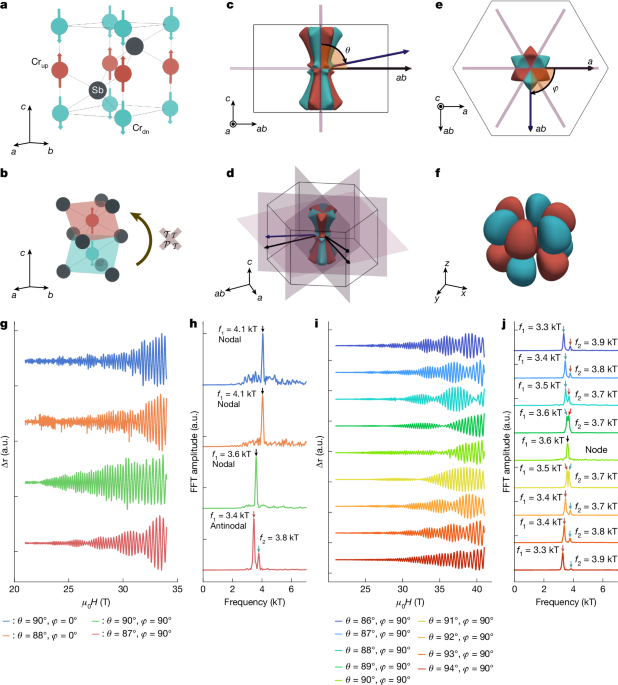
The oscillatory torque component, Δτ, was separated from the background torque, τ, using locally estimated scatterplot smoothing (LOESS)49. Because CrSb has a complex web-like Fermi surface, the dHvA signal at a particular angle can contain many frequency components and may therefore have a complicated waveform. To focus on the dogbone Fermi-surface sheet, we combined high-pass filtering with short LOESS windows.
The dogbone frequencies are most pronounced above 3 kT. We therefore applied a Butterworth high-pass filter to the inverse-field data in this frequency range. A short sliding LOESS window was also applied to τ to model slow oscillations within the background, which was assumed to vary quadratically with H. This procedure generated a Δτ waveform dominated by high-frequency oscillations. For the traces in Fig. 1, a 0.7 T LOESS window was used. A 1.2 T window was selected for Fig. 2 to reveal the stronger low-frequency spectral weight associated with the web sheet. In Fig. 4, a shorter 0.6 T window isolated the >3 kT components used in the temperature-dependence analysis.
Density functional theory calculations for CrSb
Electronic-structure calculations for CrSb were performed using the all-electron, full-potential linearized augmented plane-wave (FP-LAPW) method implemented in the WIEN2k software package50. The electronic bands were converged using a 43 × 43 × 28 Monkhorst–Pack k-point mesh across the Brillouin zone of the primitive hexagonal unit cell. Exchange–correlation effects were described using the generalized gradient approximation.
Two inequivalent chromium sites, Cr1 and Cr2, were specified in the primitive unit cell to represent Cr atoms with opposite spin polarizations. The calculations were initialized with one Cr site having a larger spin-up density and the other having a larger spin-down density. The onsite spin polarization was allowed to evolve during the self-consistency cycles until a compensated collinear ground state was obtained. Quantum-oscillation frequencies from the resulting Fermi-surface sheets were calculated using SKEAF (ref. 51), while the Fermi surface was visualized with py_FS (refs. 48,52).
For ambient-pressure CrSb with the NiAs-type structure (P63/mmc), we used lattice parameters of a = 4.12 Å, b = 4.12 Å and c = 5.47 Å. The unit cell contains two equivalent Cr sites and two equivalent Sb sites, as listed in Extended Data Table 1. To model opposite Cr spin orientations, the crystal symmetry was reduced from P63/mmc to P3m1.
The DFT results initially produced a Fermi surface in which the down- and up-spin dogbone sheets were open around the high-symmetry point, giving them a cylindrical topology. This topology is inconsistent with the quantum-oscillation measurements, which detect oscillations when the magnetic field is oriented close to the a and ab directions. Such frequencies would not be expected for perfectly cylindrical sheets at these field orientations. We therefore propose that the relevant bands form closed, dogbone-shaped Fermi-surface sheets.
To close the open Fermi-surface sheets in the DFT model, the band energies were shifted relative to the Fermi energy. The dogbone-like sheets were shifted downward by 0.11 eV, bringing the calculated frequencies along the a, ab and c directions into good agreement with the quantum-oscillation data. Because the dogbone sheets are hole-like, the electron-like ‘web’ sheets were shifted upward by 0.015 eV to preserve the total carrier number (see Supplementary Information).
Role of spin–orbit coupling in CrSb
Real materials exhibit spin–orbit coupling and many-body electronic correlations, so a completely non-relativistic description is an idealized approximation. However, the symmetry-based interpretation used here remains valid. CrSb has an inversion-symmetric crystal structure, ensuring that the spatial symmetries responsible for protecting the nodal planes are preserved.
In the intense magnetic fields used in these experiments, field-assisted tunnelling, or magnetic breakdown, enables quasiparticles to cross the small hybridization gaps generated by weak spin–orbit coupling. This effectively restores the pristine altermagnetic quasiparticle trajectories. As discussed in the Supplementary Information, where electronic correlations are also considered, these effects support the simplified symmetry framework used in this work. The framework directly connects the quantum-oscillation frequency spectrum with the underlying CrSb altermagnetic order parameter Δk.
Estimating energy splitting from quantum-oscillation frequencies
Using the Onsager relation45, the quantum-oscillation frequency can be related to the extremal Fermi-surface area in reciprocal space:
$$f(E)=\frac{\hbar }{2{\rm{\pi }}e}{\mathcal{A}}(E).$$
(1)
The cyclotron effective mass, m*, is determined by the energy dependence of the orbital area:
$${m}^{\ast }={\frac{{\hbar }^{2}}{2{\rm{\pi }}}\frac{\partial {\mathcal{A}}}{\partial E}|}_{{E}_{F}}.$$
(2)
Differentiating equation (1) with respect to E gives:
$$\frac{{\rm{d}}f}{{\rm{d}}E}=\frac{\hbar }{2{\rm{\pi }e}}\frac{\partial {\mathcal{A}}}{\partial E}=\frac{\hbar }{2{\rm{\pi }e}}\frac{2{\rm{\pi }}}{{\hbar }^{2}}{m}^{\ast }=\frac{{m}^{\ast }}{e\hbar }.$$
(3)
This relationship allows the energy separation between two bands to be estimated from their frequency splitting:
$$\Delta E \sim \Delta f\frac{{\rm{d}}E}{{\rm{d}}f}=\frac{e\hbar }{{m}^{\ast }}\Delta f.$$
(4)
Real spherical harmonic notation
The altermagnetic spin-splitting symmetry of CrSb is represented in the main text using the real spherical harmonic \({{\mathcal{Y}}}_{4}^{-3}\hspace{0.04pt}(\theta ,\varphi )\).
Complex spherical harmonics are defined using associated Legendre polynomials:
\({Y}_{{\ell }}^{m}(\theta ,\varphi )={N}_{{\ell }m}{{\rm{e}}}^{{\rm{i}}m\varphi }{P}_{{\ell }}^{m}\hspace{0.03pt}(\cos \theta )\), where Nℓm is a normalization constant, \({P}_{{\ell }}^{m}(x)\) denotes an associated Legendre polynomial, and \({Y}_{{\ell }}^{m}(\theta ,\varphi )\) is the complex spherical harmonic for ℓ ≥ 0 and m ∈ [−ℓ, ℓ]. These functions are eigenfunctions of the total angular-momentum operator \({\widehat{L}}^{2}\) and the azimuthal rotation operator \({\widehat{L}}_{z}\), and form a complete orthonormal basis.
Because complex spherical harmonics are defined up to a phase factor eimφ, their magnitude is independent of φ. Real spherical harmonics are therefore more useful for describing the angular symmetry of unconventional magnetic order parameters because they have explicit φ dependence. The real spherical harmonics \({{\mathcal{Y}}}_{{\ell }}^{m}(\theta ,\varphi )\) are defined as linear combinations of complex spherical harmonics:
$${{\mathcal{Y}}}_{{\ell }}^{m}=\left\{\begin{array}{cc}\frac{1}{\sqrt{2}}({Y}_{{\ell }}^{-m}+{(-1)}^{m}{Y}_{{\ell }}^{m}) & \,\mathrm{if}\,m > 0\\ {Y}_{{\ell }}^{0} & \,\mathrm{if}\,m=0\\ \frac{{\rm{i}}}{\sqrt{2}}({Y}_{{\ell }}^{-| m| }-{(-1)}^{| m| }{Y}_{{\ell }}^{| m| }) & \,\mathrm{if}\,m < 0,\end{array}\right.$$
(5)
Equivalently, the real spherical harmonics can be written using associated Legendre polynomials:
$${{\mathcal{Y}}}_{{\ell }}^{m}=\left\{\begin{array}{cc}\sqrt{2}{(-1)}^{m}{N}_{{\ell }m}{P}_{{\ell }}^{m}(\cos \theta )\cos (m\varphi )\, & \text{if}\,m > 0\\ {N}_{{\ell }0}{P}_{{\ell }}^{0}(\cos \theta )\, & \text{if}\,m=0\\ \sqrt{2}{(-1)}^{m}{N}_{{\ell }|m|}{P}_{{\ell }}^{|m|}(\cos \theta )\sin (|m|\varphi )\, & \text{if}\,m < 0.\end{array}\right.$$
(6)
This definition produces a complete real basis spanning the same space as the complex spherical harmonics. Crucially, the real functions have well-defined angular magnitudes that vary with φ. This property enables the \({{\mathcal{Y}}}_{4}^{-3}\) harmonic to describe the characteristic g-wave symmetry of the altermagnetic order parameter in CrSb.
Contactless resistivity measurements in pulsed magnetic fields
Contactless resistivity measurements were performed using the proximity detector oscillator53 technique in pulsed magnetic fields. A selected CrSb crystal was placed on a hand-wound, 15-turn planar coil that served as the inductive element of the oscillator. The coil diameter was tailored to the sample width to maximize the filling factor. A counter-wound outer coil surrounding the same area as the inner coil compensated for magnetic flux generated during the field pulse and reduced background pickup.
As the magnetic field changes, variations in the sample resistivity ρ and susceptibility χs modify the oscillator inductance and shift its resonant frequency. This response is described by:
$$\frac{\Delta f}{f}\approx -\eta \,\frac{\delta }{d}\left({\mu }_{{\rm{r}}}\frac{\Delta \rho }{\rho }+\Delta {\chi }_{{\rm{s}}}\right),$$
(7)
Here, η is the coil filling factor, d is the sample thickness, and μr = 1 + χs is the relative magnetic permeability53. In metallic CrSb, eddy currents limit radiofrequency-field penetration to the skin depth \(\delta =\sqrt{2\rho /({\mu }_{{\rm{r}}}{\mu }_{0}\omega )}\), where ω is the excitation frequency. Consequently, the oscillator response is primarily determined by changes in the resistivity ρ.
The proximity detector oscillator measurements were carried out in a 65-T pulsed magnet at the Dresden High Magnetic Field Laboratory in Germany, using the procedure described in ref. 54. A custom 3He cryostat was integrated with the magnet and provided a base temperature of approximately 600 mK during the field pulses. The oscillator operated at a raw resonant frequency of 25 MHz. This signal was sent to a heterodyne mixing circuit, down-converted to approximately 10.5 MHz and recorded with a high-definition oscilloscope.
Quantum-oscillation signals were analysed over a magnetic-field range of 38–63 T. The background was removed using LOESS smoothing with an 8-T window and a second-order polynomial subtraction. A clear quantum oscillation with a frequency of 0.8 kT was resolved, as shown in Extended Data Fig. 7.
At sufficiently high magnetic fields, altermagnets may exhibit distinctive quantum-oscillation signatures, including frequency splitting at a field-induced Lifshitz transition between the up- and down-spin sheets55. However, measurements performed up to a maximum field of 64 T showed no evidence of these features, as presented in Extended Data Fig. 7. This absence is likely related to the very high ordering temperature and corresponding large altermagnetic energy scale of CrSb, which remains stable even at these extreme magnetic fields.
Source: www.nature.com