


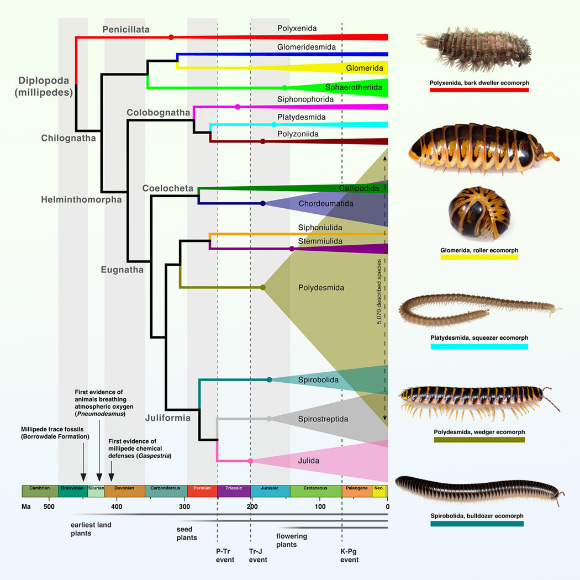
Two obscure groups of millipedes, Siphoniurida and Siphonocryptida, have now been identified as crucial gaps in the evolutionary history of Earth’s earliest land animals, according to a groundbreaking study led by entomologists from Virginia Tech.
Currently, there are 14,232 recognized millipede species, with at least that many more yet to be uncovered. Image credit: Vazquez Valverde et al., doi: 10.1016/j.cub.2026.05.035.
“Millipedes played a critical role in moving vertebrates onto land over 80 million years ago,” stated lead author Dr. Paul Marek from Virginia Tech.
“They laid the groundwork for later terrestrial life, including humans and vertebrates.”
In this study, Dr. Marek and his team utilized genomic data from existing millipede species alongside morphological evidence derived from fossil records.
The researchers scrutinized hundreds of genes across 82 millipede species and included data from 29 notable fossils.
A significant achievement was successfully sequencing the DNA from the previously elusive groups, Siphoniurida and Siphonocryptida, marking a first in scientific research.
The research team ventured to Mexico’s Los Tuxtlas Island and Spain’s Canary Islands to collect specimens such as Sifoniurus neotropicus and Hildicryptus canariensis.
“It took a team of 10 people over a week to locate this diminutive 10mm adult,” remarked lead author Luisa ‘Fernanda’ Vázquez Valverde, also from Virginia Tech.
“Finding them was challenging, as we initially mistook them for tiny white nematodes.”
“It wasn’t until I examined it under the microscope that I realized it was a millipede.”
Interestingly, it was discovered that Siphonocryptida is not a distinct order but part of a known lineage, while Siphoniurida was placed accurately on the evolutionary timeline.
The research indicates that millipedes originated approximately 460 million years ago during the Ordovician period, which predates the earliest known millipede fossils by around 35 million years, suggesting their emergence occurred much earlier than previously believed.
Millipedes were instrumental in shifting vertebrates onto land over 80 million years ago, feasting on decomposing organic matter before the existence of trees, foliage, and flowering plants, establishing themselves as some of the earliest pioneers of terrestrial life.
“The most astonishing finding was how ancient some of these millipede lineages are,” Dr. Marek added.
The study traces the evolution of millipede chemical defenses back approximately 260 million years, positioning them among the initial producers of biological and chemical defenses on the planet.
“They were the first to manufacture chemical defenses and operate as tiny chemical factories,” Dr. Marek concluded.
For complete results, refer to the study published in Current Biology.
_____
Luisa F. Vázquez Valverde et al. Reshape the millipede tree of life by incorporating the last two unsampled orders. Current Biology published online June 12, 2026. doi: 10.1016/j.cub.2026.05.035
Source: www.sci.news