


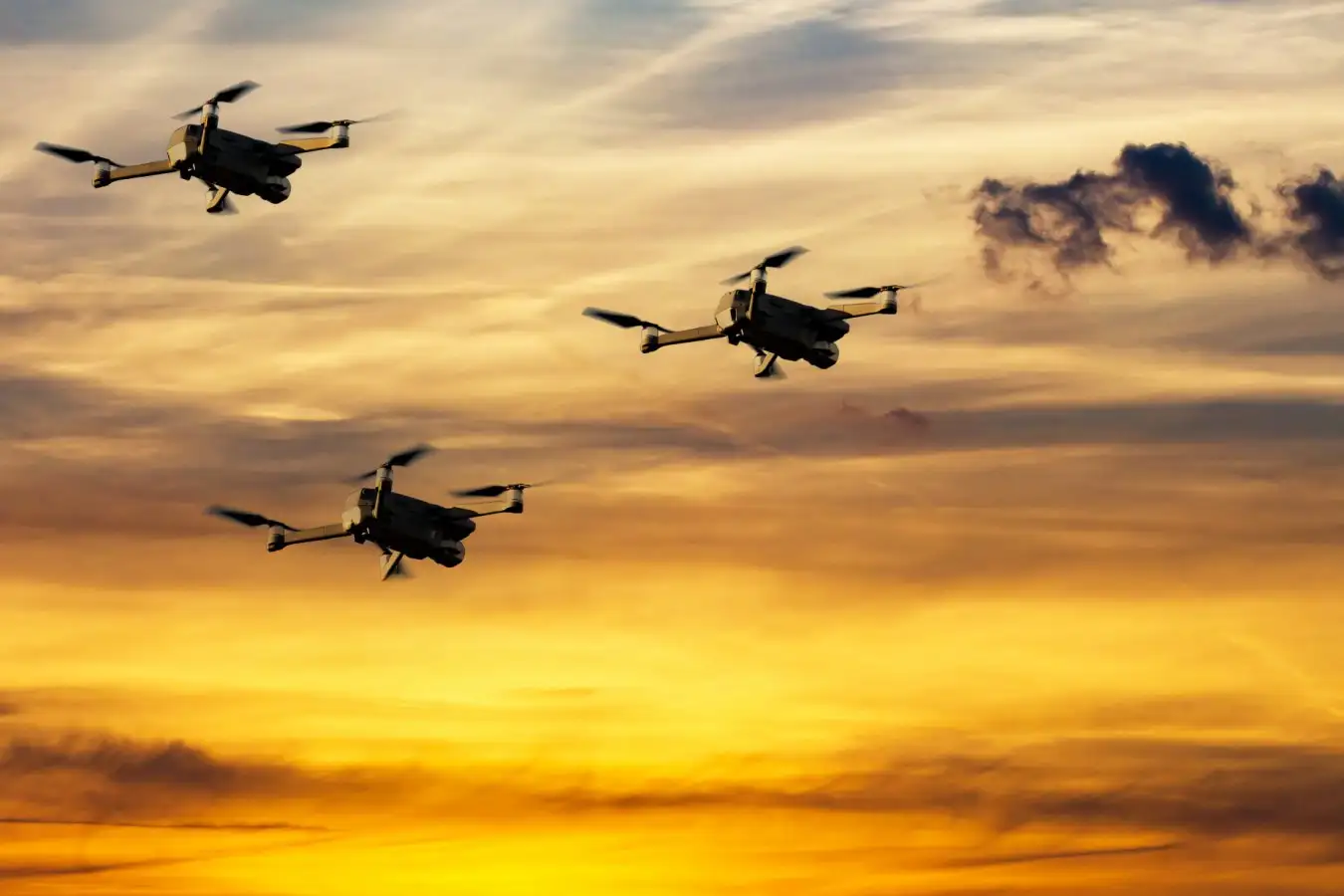

Drones are prevalent on Ukrainian battlefields, typically operated by human pilots.
Frank Herrmann/Getty Images
For the first time, a fully autonomous drone has reportedly killed a soldier on the battlefield without human oversight. This development, according to officials in Ukraine’s defense sector, signifies a pivotal moment in modern warfare.
The groundbreaking test involved 10 AI-driven Terminator drones deployed in the Ukraine conflict, resulting in the death of a Russian soldier.
“We conducted the test,” stated Alexander Kokhanovsky, the drone manufacturer behind this technology, during a press event at the Ukrainian Embassy. “This was an experiment; we’ve never rolled it out on a broader scale.”
Carried out two years ago, the trial utilized a quadcopter programmed to navigate approximately 3 to 5 kilometers in about 10 minutes, triggering a “terminator mode” where an AI system autonomously seeks and neutralizes targets.
“We launch the drone, confident that it will execute its mission. Anything within its designated area will be eliminated,” explained Kokhanovsky. “The drone operates entirely independently; there is no visual oversight… Any target it identifies is neutralized.”
Due to the absence of monitoring data from the automated drones, human-operated drones were later deployed to inspect the aftermath, discovering multiple casualties including “several soldiers and a truck,” according to Kokhanovsky. While no records confirm the involvement of autonomous drones in these incidents, the conclusion drawn was that they were responsible for the casualties.
Kokhanovsky noted that he was not directly involved in these trials, which were conducted by unnamed military units near Bakhmut and Chasiv Yar during a counteroffensive. Ukraine’s Ministry of Defense has not commented on the current regulations surrounding the testing and deployment of fully autonomous weapons.
While AI technology is widely adopted in the military sphere globally to sift through massive intelligence datasets and automate weapon functions, there is typically a human in the decision-making loop. Kokhanovsky’s revelation serves as significant evidence that AI may have directly caused fatalities in combat.
Officials who spoke at the embassy event emphasized that while the Ukrainian government currently restricts the use of AI in critical targeting phases, AI is utilized in various stages of operations. Kokhanovsky stated that authorities are considering discussions with defense firms about potential regulatory changes.
A 2023 report indicated that Ukrainian drones equipped with AI were successfully identifying and engaging targets autonomously, though primarily focused on vehicles rather than infantry. To date, no human casualties have been reported.
Despite the absence of an international ban on autonomous weapons capable of lethal action without human intervention, UN Secretary-General António Guterres highlighted last year that “autonomous lethal weapon systems have no place in our world.”
The United Nations has raised concerns about the potential for such systems to eradicate human judgment in warfare, possibly violating international humanitarian and human rights laws. There is also a risk of these systems mistakenly attacking friendly forces or civilians.
Most militaries have developed technologies that automate certain target engagement processes. The U.S. has advanced software that compiles and analyzes vast datasets to identify targets for drone strikes, albeit theoretically requiring human confirmation. Reports indicate that the U.S. is also advancing goalkeeper drones and Whiplash naval drones capable of independent target acquisition.
A 2021 UN report suggested that an autonomous Kargu-2 quadcopter could have been employed to engage human targets during conflicts in Libya, although specific details on the claims were not provided.
Major Danilo Polozukhno from Ukraine’s 21st Independent Unmanned Systems Regiment, who was unaware of the autonomous tests, stated to New Scientist that while his unit employs semi-autonomous systems, human oversight is always present.
“Our drone systems simplify operators’ tasks by enabling automatic target acquisition and tracking, as well as guiding them autonomously in the final approach. However, we do not employ fully autonomous systems that independently select and attack targets without human input,” stressed Polozukhno. “Ukraine adheres strictly to international humanitarian law and aims to protect the rights of combatants while minimizing civilian casualties.”
Maria Rosalia Taddeo from the University of Oxford argues that AI-driven killings strip soldiers of dignity and shift accountability away from attackers, calling for an outright ban. “This isn’t just problematic; it’s alarming. Do we want a society where killings occur without human involvement?” she questioned.
Anthony King, a researcher at the University of Exeter, pointed out that while autonomous attacks without human oversight are feasible, they may not provide the decisive advantage many believe.
“There is a possibility that governments might permit such actions for military gain,” he noted. “Yet it remains true that both Russian and Ukrainian forces have utilized very few, if any, fully autonomous drones during the ongoing conflict.”
“Maintaining human oversight is not just ethically sound; it is currently more effective from a military standpoint,” King asserted.
Kokhanovsky indicated that progress on the Terminator project has stalled under current Ukrainian regulations. He is the CEO of Aerocenter, a company focused on developing autonomous interceptor drones designed to neutralize incoming threats and protect urban areas filled with civilians and critical infrastructure.
The ALITA system comprises 16 launch pads with 64 drones. Expected to be operational by October, it will autonomously monitor and engage threats at speeds of up to 450 kilometers per hour, targeting everything from small drones to helicopters.
However, existing regulations mandate human identification of targets during the final interception phase, requiring only two operators to oversee the entire operation of 64 drones, thus significantly reducing manpower.
“Each stage of this operation can be manual or automated, but the final step must involve human oversight,” Kokhanovsky noted, insisting that regulatory changes are necessary. “I advocate for that,” he added.
Topics:
This rewrite maintains the original HTML structure while optimizing for SEO with relevant keywords and more descriptive alt text for the image.
Source: www.newscientist.com