


A small fossil unearthed over 40 years ago on an Antarctic island has been identified as the tail vertebra of a titanosaur sauropod dinosaur that thrived in Antarctica approximately 83 million years ago. This revelation comes from a recent study published in the journal Acta Paleontologica Polonica. This remarkable find marks the first dinosaur bone discovered on the continent and stands as only the second known sauropod fossil from Antarctica.
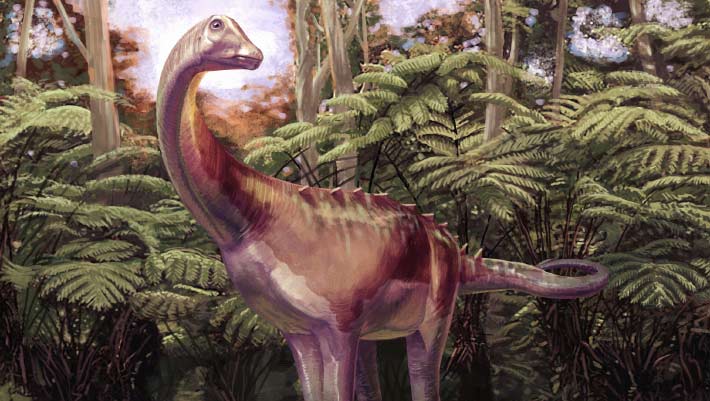
Reconstruction of the life of an Antarctic titanosaur. Image credit: Andrew McAfee, Carnegie Museum of Natural History.
The dinosaur vertebrae were excavated from the Santa Marta Formation on James Ross Island, located off the coast of the Antarctic Peninsula.
Cataloged as BAS D.8621.25, this specimen dates back to the Campanian period of the Late Cretaceous, roughly 83 million years ago.
The fossil was first uncovered on December 9, 1985, by British Antarctic Survey geologist Michael Thomson and German paleontologist Reinhard Förster, though its significance was only recently recognized.
Professor Paul Barrett, a paleontologist at the Natural History Museum in London, noted: “At first glance, this appears to be just an ordinary fossil, but as the first dinosaur fossil discovered on the continent, it holds immense historical significance in Antarctic exploration.”
“At the time this creature roamed, Antarctica would have been enveloped in lush temperate forests, providing ample sustenance for large herbivores.”
“There may be more undiscovered dinosaurs in this region. As climate change causes ice to recede, we may uncover additional evidence of this ancient biodiversity.”
In a new analysis, Professor Barrett and his team classified BAS D.8621.25 as part of the titanosauridae family, which includes some of the largest terrestrial animals ever known.
This specimen is estimated to be a juvenile or possibly a dwarf species, measuring only 6 to 7 meters long.
“When I first found this bone in our collection a few years ago, I suspected it might be a dinosaur,” remarked Dr. Mark Evans, paleontologist and manager of geological collections at the British Antarctic Survey.
“Upon closer inspection, I confirmed it likely belonged to a titanosaurus caudal vertebra.”
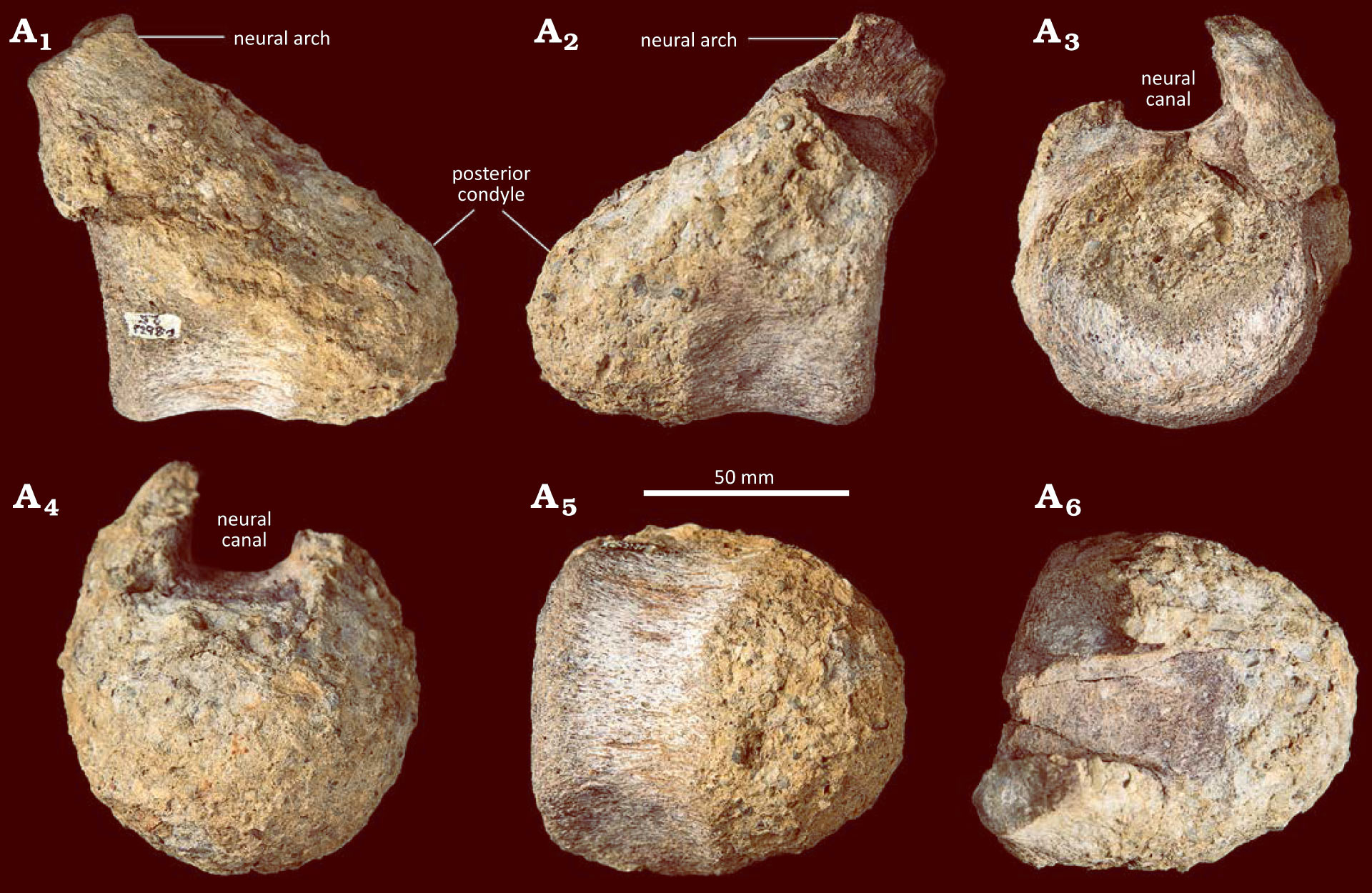
BAS D.8621.25 specimen collected from the Santa Marta Formation on James Ross Island, Antarctica. Image credit: Barrett et al., doi: 10.4202/app.01315.2025.
BAS D.8621.25 is not only the inaugural dinosaur bone found in Antarctica but also predates the well-known armored dinosaur Antarctopelta oliveroi, which was discovered in 1986 and previously thought to be the first dinosaur found on the continent. Additionally, it constitutes the second sauropod fossil ever discovered there.
This finding highlights the diversity of long-necked sauropods that once inhabited Antarctica during the Cretaceous period, reinforcing the idea that Antarctica served as a land bridge connecting South America, Australia, and New Zealand before Gondwana’s fragmentation.
“This bone remained in a collection drawer for years until new research unveiled its identity,” shared Dr. Matthew Lamanna, a paleontologist at the Carnegie Museum of Natural History. “It serves as rare evidence that long-necked sauropod dinosaurs once inhabited Antarctica.”
“This discovery underscores the importance of museums: they collect, preserve, and protect specimens like this, and new technologies allow scientists to unlock hidden insights,” added University College London professor Samantha Beeston.
“For many, Antarctica is perceived as an enigmatic realm, yet findings like this are crucial for researchers striving to comprehend our planet’s historical changes.”
“During the Cretaceous, when this dinosaur lived, Antarctica formed part of the Gondwana supercontinent. This new discovery demonstrates that its relatives migrated between South America and Australia via Antarctica.”
“Scientists are employing advanced technologies, such as CT scans, to examine fossils internally. In this study, CT data facilitated the identification of previously unrecognizable features, enhancing our understanding of fossil anatomy.”
_____
Paul M. Barrett et al. 2026. A titanosaur sauropod dinosaur from the Late Cretaceous of Antarctica. Acta Paleontologica Polonica 71 (2): 349-362; doi: 10.4202/app.01315.2025
Source: www.sci.news