


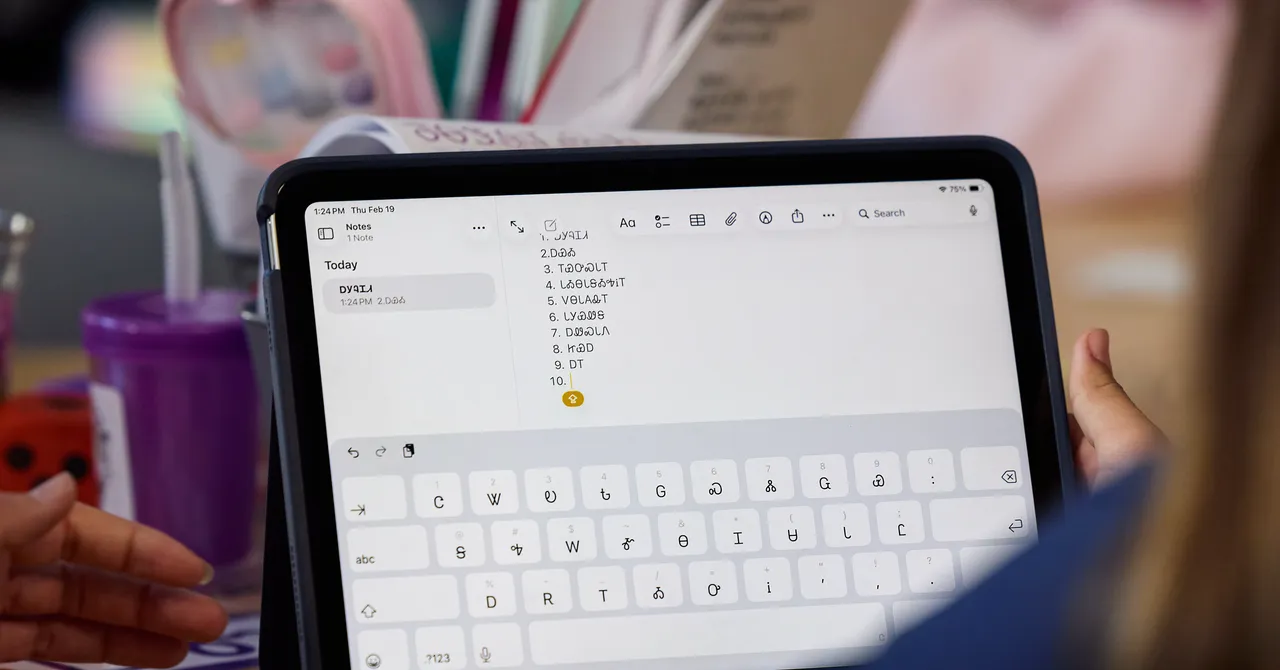
How Apple and Cherokee Immersion Programs Are Helping Revitalize the Cherokee Language
Cherokee Chief Chuck Hoskin Jr. fondly remembers a room full of Cherokee immersion students gathered around a screen to watch How to Train Your Dragon. With the exception of Hiccup and Astrid, who could not speak English, the main characters spoke Cherokee, dubbed with voices from the local community.
“They’re hearing it in our native language. That didn’t happen a generation ago,” Cherokee Chief Hoskin Jr. told WIRED. “Thankfully, we have come a long way from rote instruction and memorization in the classroom to a world where children can see creativity that sparks their imaginations and helps all children understand, read, and write more clearly.”
The Urgent Need to Preserve the Cherokee Language
There are currently about 1,500 active Cherokee speakers left, most of them over 70 years old. Hoskin Jr. says the community is rapidly losing that generation, which is why Cherokee leaders are devoting their time to developing second-language learners. The Cherokee Nation also has a baby immersion program, with the hope that a baby’s first word will be Cherokee.
“Historically, the enemies we have faced are the so-called Age of Discovery, colonization, the economic and geographical expulsion of our people, and boarding schools,” he says. “But that’s nothing compared to the math we’re facing right now. That’s why we’re filled every day with a sense of urgency to do everything in our power to find partners who can help accelerate what we want to do.”
How Apple Is Supporting Cherokee and Other Indigenous Languages
One such partner is Apple. The Cherokee people have long worked in collaboration with Apple. Apple has announced that the iOS keyboard supports more than 200 languages and language variants. Several languages were added in iOS 26, including Haitian Creole and Nez Perce. iOS 27 expands Native language support to include additional Native American languages, including Blackfoot, Comanche, and Northeast Cree.
The goal is to reach young people who already spend much of their waking hours on mobile screens. Hoskin Jr. says that revitalizing and preserving a language requires making it more accessible. Apple says the effort involves more than translating words. It is a multi-year process that requires thorough research, with the company relying on the expertise of community members.
Why Unicode Matters for Language Access
That process does not start in Cupertino. It starts with Unicode, an organization that approves and standardizes the characters used across digital devices. You may know Unicode for its role in supporting the new emojis that appear on smartphones each year. It also handles time zone localization, currency names, and imperial and metric systems.
To type or read characters on a smartphone screen, those characters must exist as characters recognized by the Unicode standard. “From a language perspective, everything starts with Unicode, but it really starts with letters and scripts,” says Unicode CEO Toral Cowieson. Unicode currently contains more than 157,000 characters.
Source: www.wired.com