


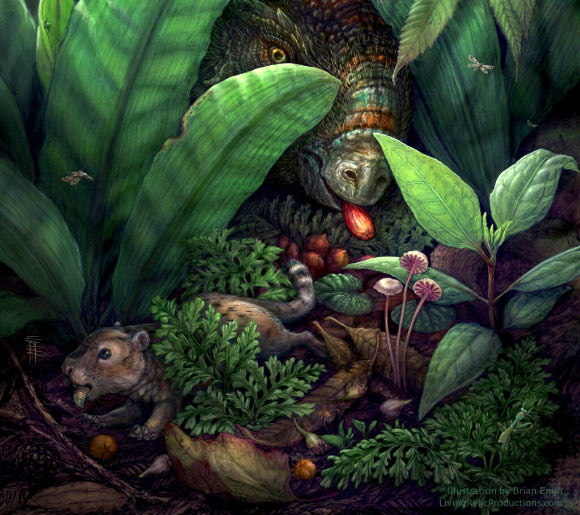
Fossils discovered in New Mexico’s Jose Creek Formation indicate that angiosperms (flowering plants) established dense, fruit-bearing forests approximately 75 million years ago—about 9 million years prior to the end-Cretaceous mass extinction that led to the demise of the dinosaurs. This finding challenges long-standing evolutionary theories regarding the rise of angiosperms as the dominant life form on Earth.
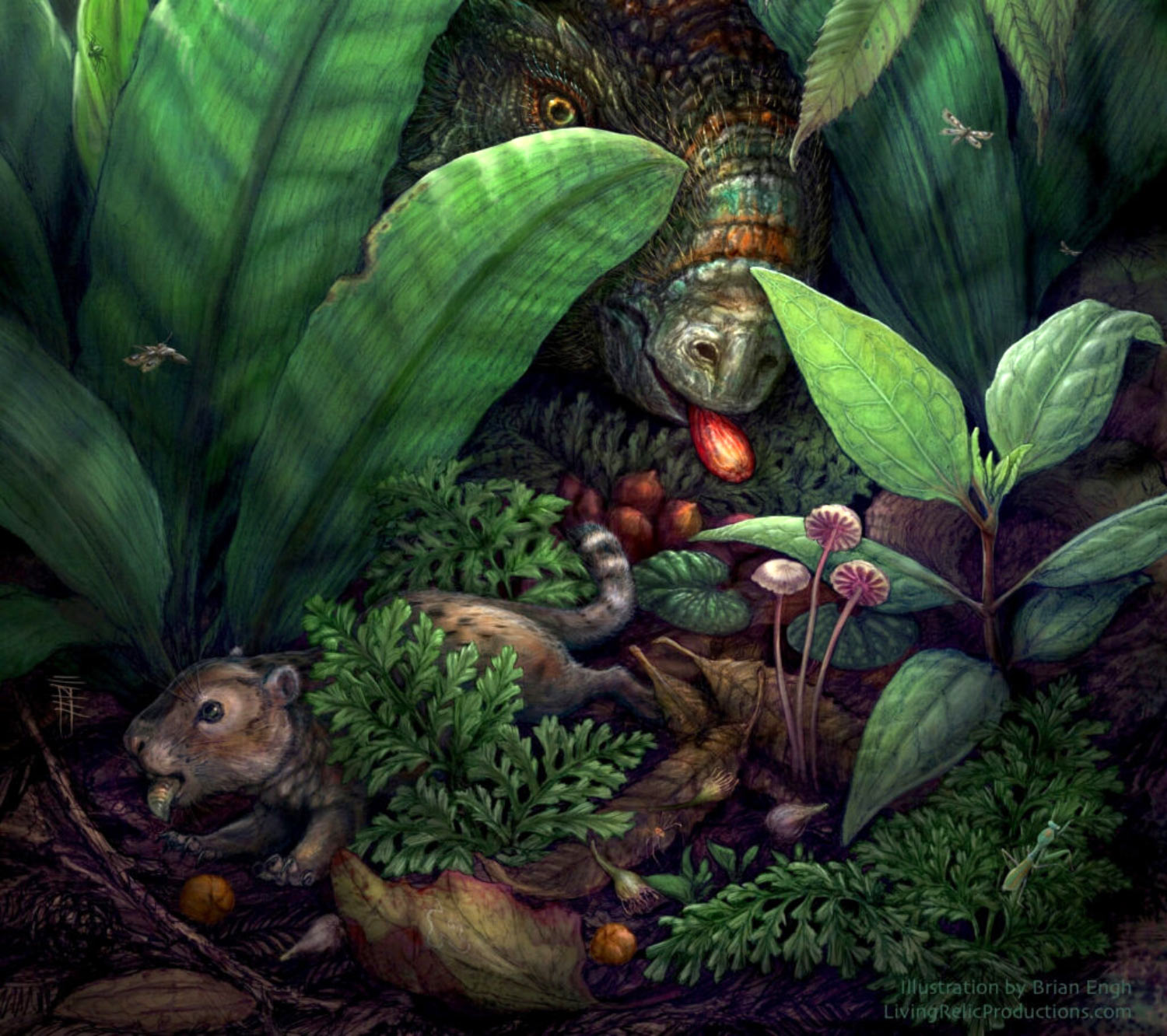
Reconstruction of a 74.6 million-year-old Dori tuff flora forest floor featuring hypothetical angiosperm-dispersal interactions. Plants such as leaves, fruits, seeds, and flowers are depicted in life-size based on fossil plants found at the site. The mammalian and dinosaur seed dispersers illustrated are based on the known fauna of the Late Cretaceous Campanian period. Image credit: Brian Eng livingrelicproductions.com.
“Our findings show that 10 million years before the extinction event, angiosperms were already allocating more resources towards individual diasporids and forming lush forests in certain hot, humid environments during the Late Cretaceous,” stated Jaemin Lee, a doctoral candidate at the University of California, Berkeley.
Flowering plants originated during the Early Cretaceous Period, around 135 million years ago. Initially, they were small, weedy, and unobtrusive, producing diminutive seeds that were either ineffective or easily dispersed by light winds.
By the late Cretaceous period, they had diversified dramatically in terms of size, leaves, and flowers, yet it was believed that in the shadow of dinosaurs, their seed-dispersal mechanisms remained unchanged.
However, the fossilized forests from the Late Cretaceous Doli tuff deposits of the Jose Creek Formation in New Mexico reveal a rich diversity of flowering plants, including large-trunked flowering trees from the laurel family and palms, alongside older lineages of ferns and sequoias.
Whereas in other Cretaceous floras, angiosperms had an average diasporid size comparable to that of a poppy seed, the average size in this fossil forest was similar to a large blueberry, representing more than a 100-fold increase in volume.
“While it may not seem significant, today’s larger fruits are the product of centuries of selective breeding,” Lee remarks.
“For instance, wild watermelons were only 5 cm (2 inches) in diameter.”
“The New Mexico site is unique because it captures an ancient setting where ash fell and subsequently buried an inland forest,” explained Cindy Louie, a professor at the University of California, Berkeley.
“Most fossil plant sites consist of materials that have been transported into lakes, rivers, or coastal sediments, conducive to fossilization but often representing a blend of materials from varying periods and habitats.”
“This ashfall occurred within a few days, as ash doesn’t remain airborne for long, offering a clear snapshot of that time period.”
“Ground cover plants can still be observed beneath the hardened ash layer.”
“And if you look slightly higher, you can see leaves that fell from the trees, positioned in all directions.”
“This site acts like a kind of Pompeii for plants, preserving everything in situ and enabling the reconstruction of forest structures,” added Lee.
“These remnants are carried from the tree canopy to the forest floor by ash fall and are preserved along with numerous leaves and flowers.”
“This forest represents the earliest known angiosperm-dominated ecosystem with notably larger discrete spores and boasts one of the most diverse Cretaceous leaf floras ever documented.”
“With minimal displacement from the forest canopy, everything is preserved instantly, allowing for detailed landscape reconstructions.”
“This research enhances our understanding of the complex ecological interactions among populations that are no longer present.”
For more on this study, refer to the findings published in the June 25th issue of Science.
_____
Lee Jae Min et al. 2026. The diversification of reproductive strategies in angiosperms preceded their extinction at the end of the Cretaceous. Science 392 (6805): 1380-1383; doi: 10.1126/science.adw9457
Source: www.sci.news