


How Pregnancy Changes the Brain: A Review of Mother’s Brain
Mother’s Brain: The New Science of the Neuromaternal Revolution
Susana Carmona
MIT Press, 2026
When I received a copy of neuroscientist Susana Carmona’s book Mother’s Brain, I thought a book about what happens to the brain during pregnancy had finally been published. In 1997, when I was a young assistant professor shortly after giving birth to my first child, I realized that books for pregnant people and new parents did not go into much detail about what was happening in the brain. As a neuroscientist, I wanted to understand: what was happening to my brain?
How menopause reshapes the brain
Another observation was how uncomfortable it felt to go from having so much attention paid to me during pregnancy—intrusive questions about what I was eating and unnecessary hands on my stomach—to having almost no attention paid to me after the baby was born. During pregnancy, the focus was directed almost entirely toward the baby. The baby may be cute, but what about the mother? What happened to me?
My brain was clearly changing, yet there was little scientific literature to explain what was happening. This was one of the main reasons I began working in the field of maternal neuroscience.
My first research on this topic concerned memory and changes in the volume of the hippocampus, a brain region involved in memory, during pregnancy (L. A. Galea et al., Hormones and Behavior 37, 86–95; 2000). Two years later, I was pregnant with my second child. By the end of the day, I could never remember where I had parked my car. When I was running late to pick up my first child from daycare, it was not unusual for me to be found crying in the stairwell of a 10-story parking lot.
Mothers are often told that their bodies will “bounce back” after pregnancy. But research by Carmona and her colleagues suggests that pregnancy can leave a lasting mark on the brain and body. This probably will not come as a surprise to parents, especially those who have given birth.
The remarkable brain and body changes of pregnancy
In many ways, Mother’s Brain is an ode to the extraordinary plasticity—the adaptability—of the brain and body during and after pregnancy. Pregnancy requires adaptations across nearly every physiological system. Carmona does an excellent job of explaining changes to the cardiovascular, immune and circulatory systems, as well as the remarkable role of the placenta in regulating many of these adaptations.
Given the scale of these physiological changes, it is no surprise that pregnancy leaves an imprint on the brain.
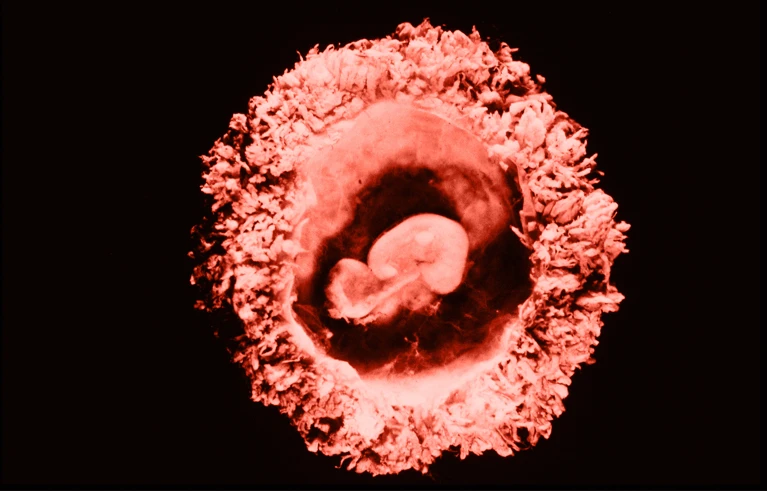
The embryo shares cells with the parent through the placenta.
Credit: OMIKRON/SPL
Carmona conveys an obvious love for motherhood while recognizing that motherhood is not universally enjoyable. I strongly agree with her assertion that prospective parents need honesty about the experience. Pregnancy and parenthood are not always positive, and some people experience mental-health problems for the first time during this period.
It is important that they seek and receive the support they need. Pregnancy and postnatal care should address mental health as well as physical health, and timely access to effective treatments such as talk therapy should be the norm. The consequences of inadequate support can be tragic.
What pregnancy reveals about the maternal brain
The best part of this book is Carmona’s explanation of how biologically extraordinary pregnancy is. She describes how cells from the baby can remain in the pregnant person’s body, sometimes for decades, although we still do not know how these cells contribute to long-term health.
Carmona also takes readers through the origins of her research questions and follows their journey from an initial idea to publication. She intersperses scientific explanations with anecdotes from her own life and pregnancies, making the research accessible without losing sight of its complexity.

What drugs are safe during pregnancy? There is a surprising lack of data
Why pregnancy and the brain remain understudied
I wish Carmona had elaborated further on another part of the story: how difficult it has been to convince the scientific community that the effects of pregnancy on the brain are worth studying.
Carmona’s first landmark paper on the subject (E. Hoekzema et al., Nature Neuroscience 20, 287–296; 2017) faced a difficult road to publication. I know this firsthand: I was one of the reviewers who discussed the importance and novelty of the work with the editor.
Because new discoveries are often treated as essential to research acceptance, there are hidden obstacles to publishing research on women’s health, even when the lack of existing research suggests that more studies are urgently needed. Many researchers in this field must justify why their findings are worth publishing. I wish the book had explored more fully the resistance to this work and why questions about pregnancy and the brain have so often been overlooked.
The implications of pregnancy-related brain changes also deserve careful discussion. These changes are natural adaptations. For example, brain volume often decreases during pregnancy, but that is not necessarily a bad thing—just as an increase is not necessarily a good thing. Different brain regions and measurements, including volume and connectivity, change in different ways during pregnancy and the puerperium, or postpartum period.
These distinctions can make it difficult to piece together the overall effects of pregnancy. They are also important for a general audience, because headlines about the brain “shrinking” during pregnancy can sound alarming without the proper scientific context.
What animal research reveals about pregnancy-related brain changes
Mother’s Brain discusses the hippocampus but pays relatively little attention to the striking similarities between discoveries in humans and decades of research in other mammals.
Studies of rodents show that pregnancy is associated with changes in cognition, hippocampal structure and the production of neurons in the brain. In rats, neuron production decreases during pregnancy and early postpartum. There are also subtle differences between a first and a second pregnancy.
Later differences between adoptive mothers and mothers that have given birth have also been observed in hippocampal cell production and memory, although these findings remain to be fully understood.
Over the long term, beyond the postpartum period, reproductive experience improves memory and hippocampal plasticity in some contexts. It produces changes in the quantity and connectivity of nerve cells that can persist throughout life.
This apparent discrepancy—some measures suggest reduced function while others suggest improvement—is why interpreting pregnancy-related brain changes requires more than asking whether a measurement goes up or down. The brain’s response to pregnancy is complex, adaptive and shaped by multiple biological systems.
By bringing this research to a wider audience, Mother’s Brain helps explain why pregnancy can have lasting effects on the brain and body—and why maternal mental health and neuroscience deserve far more attention.
Source: www.nature.com