


Scientists Find a New Way to Read the Charred Herculaneum Scrolls
Thousands of ancient scrolls charred by the eruption of Mount Vesuvius may soon be readable. Researchers have shown that they can decipher writing by recreating baked and rolled papyrus and detecting lead in the ink, according to a study published last Wednesday in PLoS ONE1.
How the Herculaneum scrolls were preserved
Nearly 2,000 years ago, the Roman town of Herculaneum in present-day Italy was destroyed by a massive eruption. Clouds of hot gas, ash and pumice incinerated people and property, while waves of volcanic mud later buried the town. The eruption also carbonized more than 1,000 fragile papyrus scrolls, preserving them in that state. Together, they form the only complete library known from the ancient world.
After the scrolls were discovered in 1752, some were physically unfolded and read. However, many crumbled into ashes, and the effort was quickly abandoned.
Using CT scans to read sealed scrolls
In recent years, researchers have combined X-ray computed tomography (CT) with machine learning to digitally unfold the Herculaneum scrolls. CT is an imaging technique that creates 3D models of an object’s interior by tracking how X-rays are blocked. Machine-learning tools can then help researchers identify and decipher writing hidden inside the carbonized papyrus.
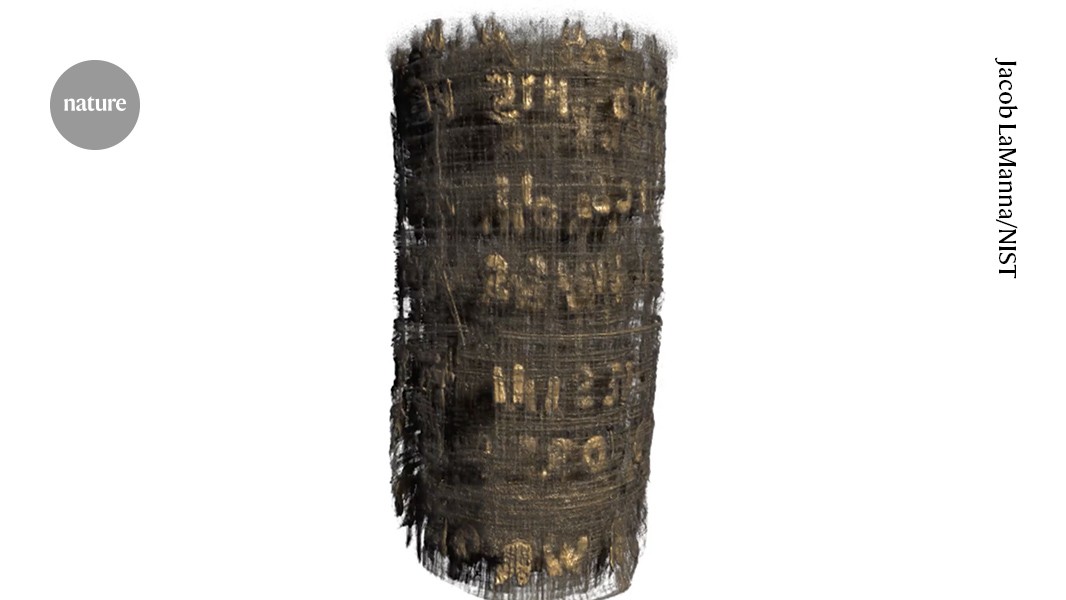
The papyrus was recreated, inscribed with text and burned to imitate the damaged scrolls of antiquity. Credit: Seiler et al., 2026, PLOS ONE, CC0
A breakthrough in virtually unfolding ancient texts
Last year, in a groundbreaking effort to virtually unfold and read the Herculaneum scrolls, the team won a $60,000 prize by using an algorithm to identify a Greek work. The achievement was part of the Vesuvius Challenge, a global machine-learning and computer-vision competition offering major prizes for reading the scrolls.
Earlier this year, the entire scroll was deciphered without being physically opened.2
However, researchers still often struggle to identify individual letters. Standard CT scans evaluate carbon-based materials, and both the ink and the papyrus contain carbon, making them difficult to distinguish.
“Overcoming the ink detection problem would go a long way in revealing the contents of the unfolded Herculaneum papyrus and help speed up the virtual opening process,” said Thomas Coward, a classicist at the University of Nottingham in the UK, in connection with the PLoS ONE study.
Why lead could make hidden ink easier to detect
Douglas Seiler, a former inventor at the University of California, Berkeley, and his colleagues wondered whether they could better distinguish ink from papyrus by detecting lead rather than carbon.
To test the idea, the researchers sourced papyrus and reed pens from Egypt and traditional lampblack ink from Japan to recreate carbonized scrolls. “We wanted the materials to be as identical as possible to the original scrolls,” Seiler says.
They used ink containing different concentrations of lead to write letters on the papyrus. The sheets were then rolled up and placed in a hot furnace to recreate the roasting that ancient texts underwent at Herculaneum.
To determine how well the burned scrolls could be read while still rolled, the researchers created 3D renderings by scanning each one in thousands of “slices” with the National Institute of Standards and Technology’s neutron and X-ray tomography system.
The team then virtually unfolded the scrolls using a customized version of software originally designed to analyze scans of thin-film coils inside lithium-ion batteries and understand performance losses.
Source: www.nature.com