


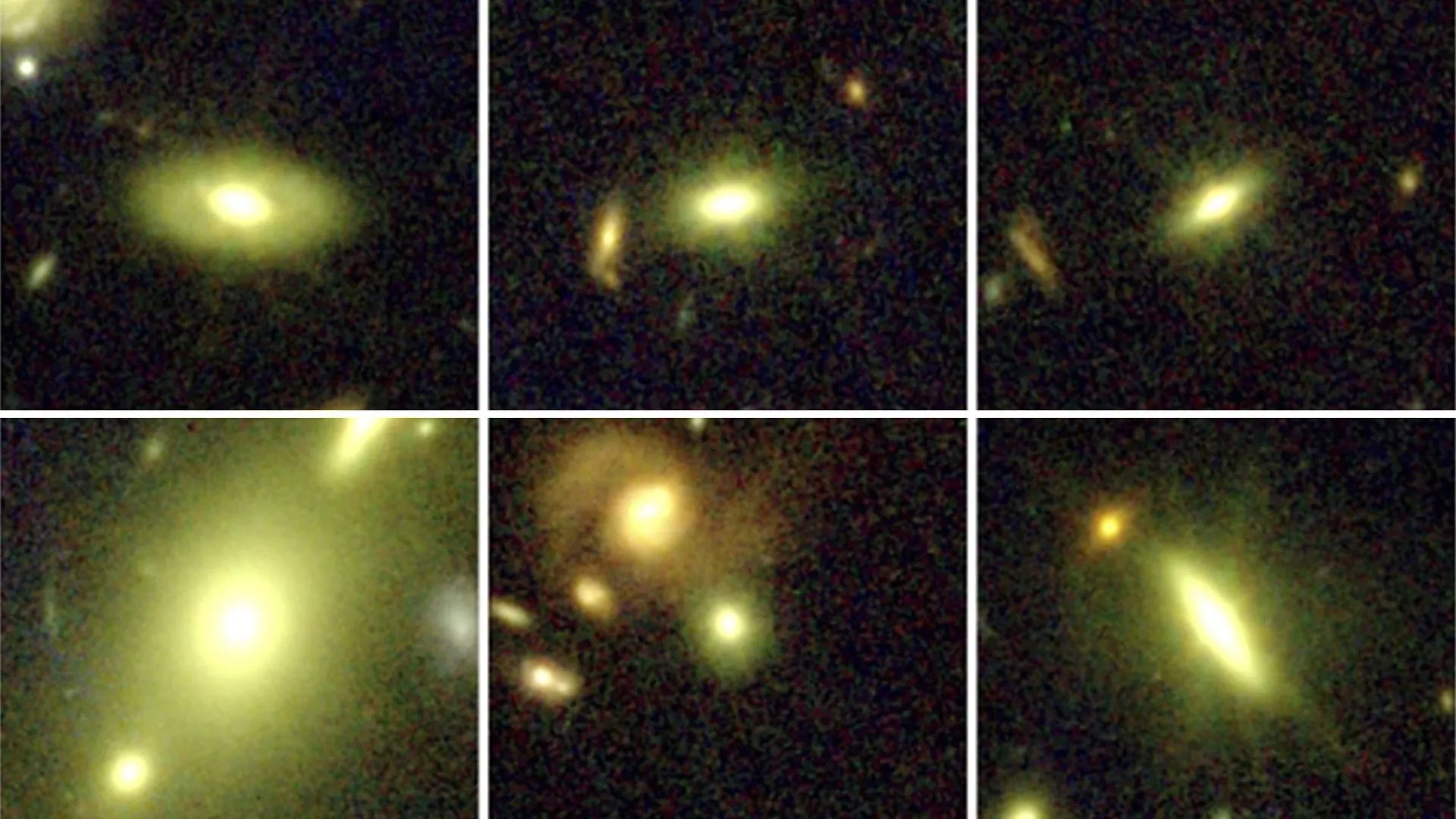
Astronomers using NASA’s James Webb Space Telescope (JWST) have discovered that some of the largest galaxies in the early universe contain far more small, low-mass stars than previously estimated. This hidden stellar population suggests that these ancient galaxies may be up to four times more massive than earlier measurements indicated.
The discovery, made by an international research team that includes scientists from Penn State University, presents a major challenge to current theories of early galaxy formation and evolution. The findings were published in Nature Astronomy.
JWST reveals hidden low-mass stars in ancient galaxies
Using NASA’s James Webb Space Telescope, researchers studied nine massive, mature galaxies that stopped forming new stars billions of years ago. The team combined JWST observations of the distant universe with earlier ground-based data collected by the Very Large Telescope.
For the first time, astronomers were able to reliably estimate the relative numbers of small, faint stars compared with much larger and brighter stars in galaxies located so far away.
“These galaxies are different,” said Joel Leja, associate professor of astronomy and astrophysics at Penn State University and a co-author of the study. “They are different in ways that are very difficult to understand because they are larger than we expected. They are therefore much more massive, containing three to four times more mass than previous estimates suggested.”
Astronomers made these measurements by separating each galaxy’s light into a spectrum. Subtle changes in color across the spectrum can reveal the types of stars present within the galaxy.
The challenge is that large, bright stars dominate a galaxy’s light, while smaller stars are much fainter and harder to detect. Penn State researchers contributed expertise and modeling techniques to interpret the light captured from these distant galaxies.
Bright stars can conceal vast populations of smaller stars
“If a galaxy were a city, the brightest stars would be skyscrapers visible from far away,” said lead author Chloe Chen, a recent PhD graduate at Leiden University. “Our model shows that a much larger population of low-mass stars is hidden by these rare, bright stars, much like houses concealed between skyscrapers. As a result, the galaxy is far more massive than previous estimates indicated.”
Traditionally, astronomers estimating the hidden mass of small, faint stars have assumed that stars form at approximately the same rate throughout the universe. The new findings challenge that long-standing assumption.
The research suggests that the most massive galaxies in the early universe may contain significantly more low-mass stars than smaller galaxies such as the Milky Way.
Co-author Marce Slob, a doctoral candidate at Leiden University, said one galaxy in particular stood out. It may have formed less than 1.5 billion years after the Big Bang, and its total mass could be four times greater than previously calculated.
“Until recently, measurements like this were simply not possible,” Slob said. “We needed a telescope capable of observing extremely distant galaxies, high-quality spectra and new analytical methods to identify the subtle signatures of faint, low-mass stars hidden inside these enormous cosmic systems.”
Hidden stellar mass creates a bigger early-universe puzzle
The discovery could significantly affect scientists’ understanding of how galaxies formed and evolved during the young universe.
Since JWST began observing the cosmos, astronomers have repeatedly discovered unexpectedly massive and mature galaxies that existed only a few hundred million years after the Big Bang. These observations have already placed pressure on established models of galaxy formation.
“This discovery has important implications for our understanding of the early universe,” said Leja, who is also affiliated with Penn State’s Institute for Computational and Data Sciences. “Since JWST’s launch, astronomers have found surprisingly massive, mature galaxies that were already present shortly after the Big Bang. These early galaxies are thought to evolve into the types of galaxies examined in this study. The tension with existing models becomes even greater if these giant, early-forming galaxies contain up to four times as many stars as previously believed.”
If early galaxies contained substantially more stars than researchers estimated, galaxy formation theories will need to explain how such enormous stellar populations formed so soon after the beginning of the universe.
More hidden stars could mean more early planets
The implications may extend beyond the evolution of galaxies.
“This result shows that much more mass is hidden in low-mass stars than previously thought,” said study leader Mariska Kriek, professor of extragalactic astronomy at Leiden Observatory. “This has implications for many areas of astronomy. Many planets orbit low-mass stars, so the discovery could also mean that more planets formed in the early universe than we previously assumed.”
Over the next several years, researchers plan to apply the same technique to even older galaxies. Their goal is to study galaxies closer to the period when the first stars and galaxies began to emerge across the universe.
Source: www.sciencedaily.com