


Researchers at Binghamton University apply 70-year-old information theory to the viral word game Wordle, showing how a strategically chosen first guess can significantly enhance a player’s odds of solving the puzzle.
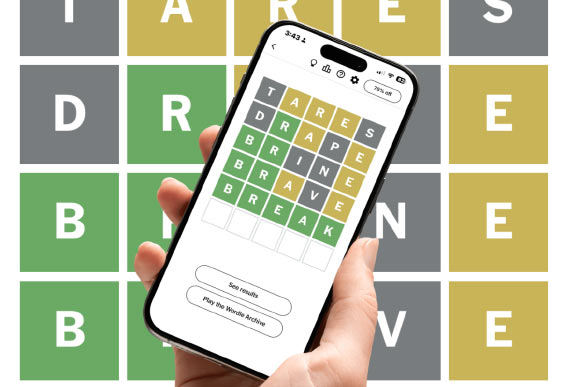
In Wordle, a widely-recognized word-guessing game, players strive to discover secret five-letter words within six attempts, utilizing feedback that color-codes the accuracy of their guesses. Optimizing guess selection boosts success in this limited-tries game. Image credit: Aladaleh et al., doi: 10.63562/2577-8439.1146.
Wordle is a popular online single-player game where players aim to identify a hidden five-letter word by guessing.
To win, players must guess the secret word within six tries; failure means losing the game.
After each guess, players receive feedback showing which letters are absent (gray), which are misplaced (yellow), and which are correct and properly positioned (green).
This feedback helps players refine their guesses by eliminating wrong choices and selecting new options for their next attempts.
“While Wordle is often seen as a simple word-guessing game, it functions as a dynamic feedback system, with each guess influencing future guesses,” said lead author Dr. Congyu ‘Peter’ Wu and colleagues.
“Through ongoing feedback, the game state evolves as players gain insights and narrow down possibilities, thereby reducing uncertainty with each round.”
“This uncertainty can be quantified using entropy. As feedback decreases possible solutions, the game’s entropy diminishes, transitioning from chaotic to organized states.”
“Information theory presents a robust framework for understanding decision-making processes within Wordle,”
The researchers applied Shannon entropy, a mathematical concept for uncertainty measurement, to identify which guesses yield the most useful information.
Their approach emphasizes making guesses that maximize information gain rather than solely targeting the most probable answer.
“When making a guess, previous attempts can exclude many options. By choosing words based on what’s left, players can gain information faster,” Dr. Wu explained.
“An important takeaway from this research is that a guess doesn’t have to be the most probable answer; it just needs to be informative,” added co-author Donald Stevens, a Binghamton University doctoral student.
“By utilizing Shannon entropy, the goal shifts from maximizing the likelihood of being right to maximizing expected uncertainty reduction.”
“This strategy enables us to solve puzzles with fewer attempts.”
Though their method may appear more random, it actually enhances the likelihood of making a successful guess by the game’s conclusion.
To implement this strategy in real-time, players can run a script or program alongside the game.
Players input the color-coded feedback provided by the game, and the program suggests optimal subsequent guesses to gather more information.
The researchers tested their method against conventional approaches focused on guessing frequent letters (A, E, R, etc.).
Across simulations, their strategy solved 99% of the puzzles, whereas traditional methods only managed to solve 90%.
“Experimental results demonstrate that entropy-based word selection enhances performance over heuristic approaches reliant on character distribution, providing a systematic decision-making framework in Wordle,” observed the researchers.
For further details, refer to their paper published in April 2026 in the Northeast Journal of Complex Systems.
_____
Talal Aladaire et al. 2026. Solving Wordle using information theory. Northeast Journal of Complex Systems 8(1):6; doi: 10.63562/2577-8439.1146.
Source: www.sci.news