


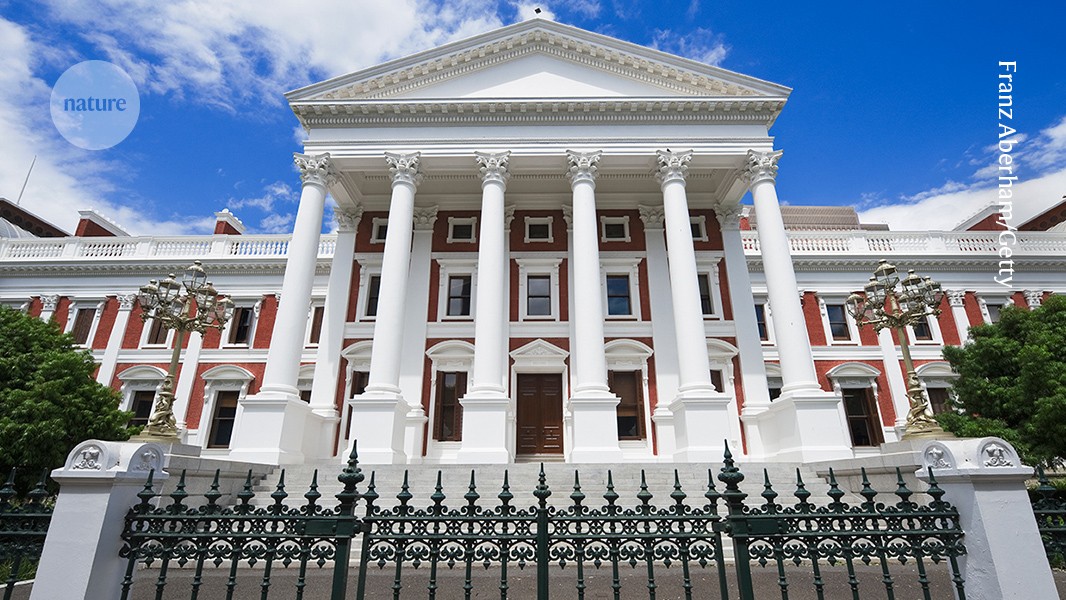
South Africa’s Parliament has not yet debated the proposed Natural Sciences Bill.Credit: Franz Aberham/Getty
Natural scientists in South Africa could face up to one year in prison if they fail to register with a government-backed professional regulatory body, under a proposed law expected to be introduced in Parliament.
The proposed Natural Sciences Bill would require some scientists to register with the South African Council of Natural Science Professions (SACNASP). Established in 2003, SACNASP was intended to register natural scientists across the country, although many have not joined.
“Our goal is not to be a gatekeeper, but to professionalize the natural sciences through registration and regulation,” SACNASP acting chief executive Matshidiso Matabane told Nature. “It is our duty to protect not only the profession itself, but also the public and the environment,” she said.
The bill says its objectives are to “protect and promote the public interest by regulating the conduct of working natural scientists” and to “ensure the protection of the environment.”
It would place natural scientists under a regulatory framework similar to those governing engineers and medical professionals, who must register with bodies such as the Engineering Council of South Africa and the Health Professions Council of South Africa.
However, leading researchers told Nature that many scientists are unaware of the proposed legislation and the potential prison sentence. Parliament has not yet announced a date for debating the bill.
“This is a money-making scheme,” said physicist Nithaya Chetty, chair of science at the University of the Witwatersrand in Johannesburg. Chetty is not registered with SACNASP and said he was unaware of the proposed law until Nature contacted him. He expressed concern that the bill would give “significant future powers to the SACNASP board” while relying on a vague definition of professional practice.
Lise Korsten, a plant scientist at the University of Pretoria and a former president of the African Academy of Sciences, also said she was unaware that the bill included possible prison terms. Korsten is not registered with SACNASP but supports accountability for scientists who provide consultancy services. Fraudulent “experts” are a “huge problem” in South Africa, she said. “It’s for the protection of the public.”
Proposed Natural Sciences Bill would replace existing law
The version of the bill published on 16 March would repeal the 2003 legislation governing SACNASP. It sets out the council’s purpose and governance structure and introduces the possibility of criminal penalties for “practicing natural scientists” who do not comply with the law, including a prison sentence of up to one year.
Public submissions on the bill are scheduled to close in May. It will then be referred to Parliament for debate, although the timetable remains unclear.
The bill defines “practice” in the natural sciences as “the rendering of services or the giving of advice in the profession of the natural sciences,” whether the work is paid or unpaid.
People who teach at accredited educational institutions or develop natural-science policies for the government would not be required to register. However, the bill does not clearly state whether academics who teach or conduct research must register if they provide advice or consultancy services to other organizations.
SACNASP referred questions about the bill to South Africa’s Department of Science, Technology and Innovation. The department had not responded to Nature at the time of publication.
The proposed legislation also provides few details about how scientists who fail to register would be prosecuted. It states that a professional code of conduct will be developed in consultation with representative organizations for scientists, which would themselves need to be registered.
Registration fees raise concerns
Full professional membership of SACNASP costs 1,920 South African rand (US$119) per year, in addition to a one-time registration fee. The fee is R2,560 for South African scientists and R5,410 for foreign scientists. South Africa’s minimum wage is R30.23 per hour, equivalent to approximately R5,200–R5,900 per month.
About 21,000 scientists are currently registered with SACNASP, Matabane said. They represent 26 disciplines, including mathematics, geological sciences and physical sciences. There are no available figures showing how many academics and other natural scientists in South Africa remain unregistered.
Source: www.nature.com