


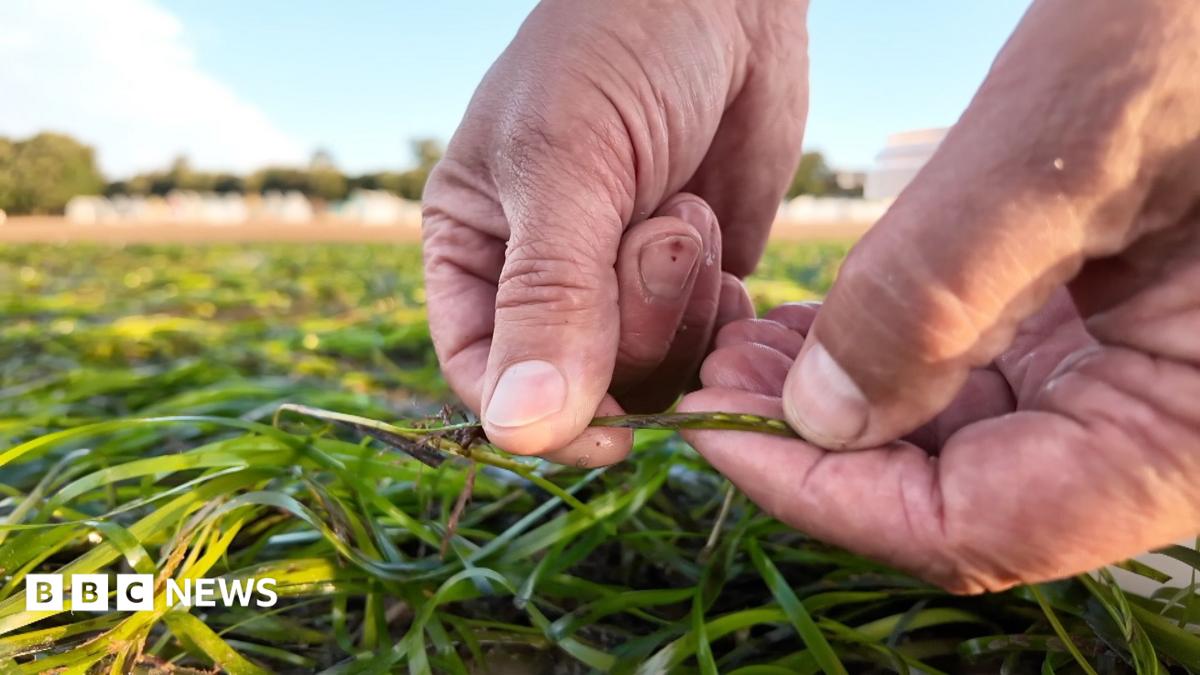
For seasoned seaweed seed collectors, the collection bucket rapidly fills with vibrant stem tips.
Newcomers to low tide trawling may notice there are few fishermen present initially, making the experience quite unique.
Identifying the optimal parts of the seaweed plant, including seeds that are at the prime picking stage, requires careful scanning.
The pod-like leaves, referred to as spathes, are rounder and paler compared to the typical black, flat seaweed leaves.
Seeds that are ready for harvesting are arranged in organized, slightly elevated rows along the surface.
Volunteer Sophie Whitemoore noted: “Sometimes, when you touch the seaweed, you can feel the short stems, almost as if they contain Tic Tacs.”
Joining her is fellow volunteer James Harper.
“I’m still refining my personal technique,” he shares. “Essentially, you look for the roundest stem.”
Despite the early morning hours, the group maintains an enthusiastic spirit.
“It’s truly a passion for me,” says Jackie Mellan. “Whenever I get the chance, I make it a point to assist with restoration projects.”
Over the course of the next hour, volunteers diligently sift through the seaweed along the shore.
However, it’s a race against time; the shifting tides will eventually outpace the gathering efforts.
Once filled, the buckets are brought back to the parking lot where the crops are carefully transferred into barrels of cold seawater for processing.
Source: www.bbc.co.uk