


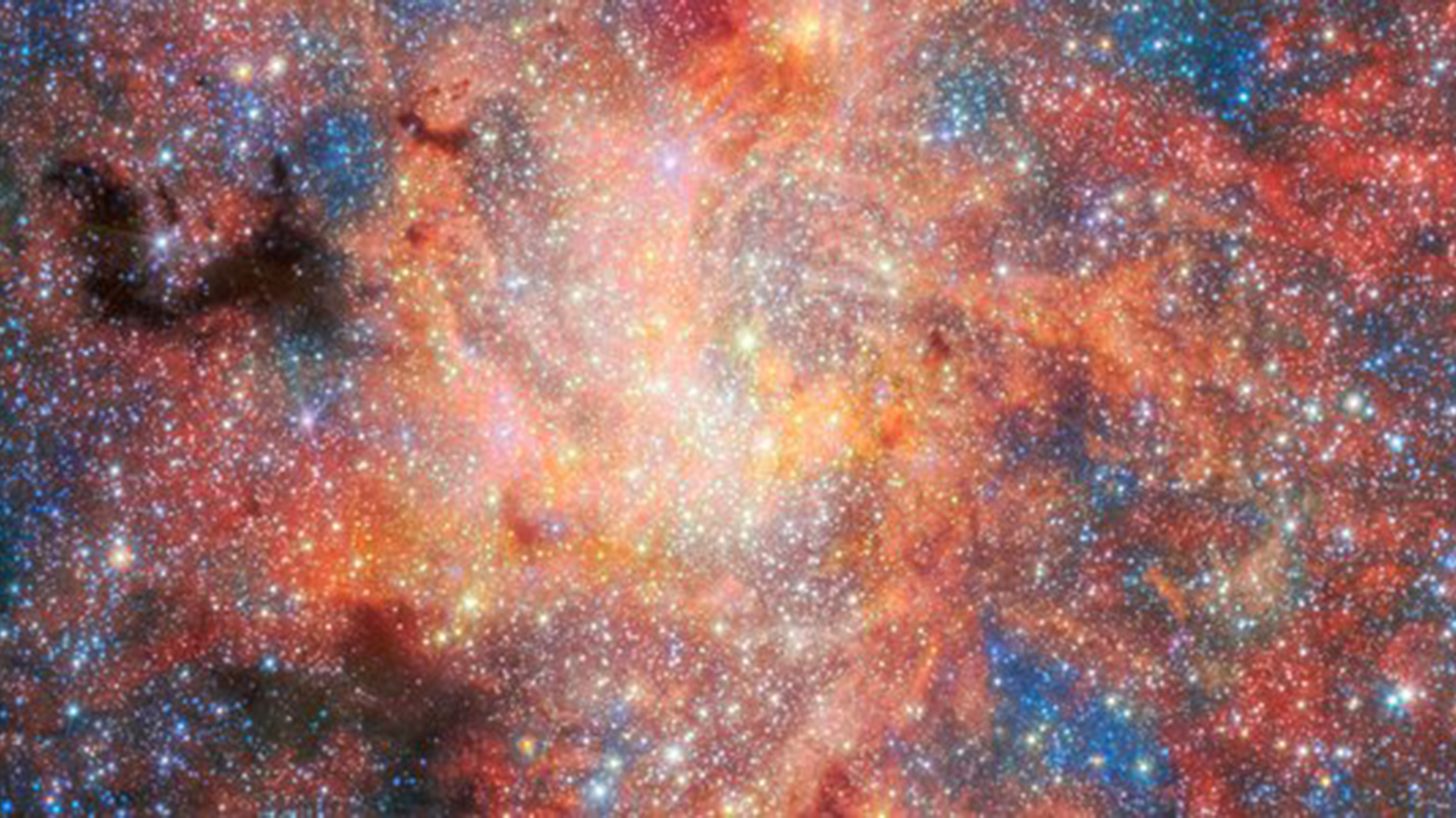
View of the Milky Way galaxy.
(Image credits: ESA/Webb, NASA & CSA, F. Peißker, J. Lu, F. Yusef-Zadeh, NB Sabha, C. Chan)
James Webb Space Telescope Detects Water Around a Star Near the Milky Way’s Central Black Hole
Simple facts
What is it: The region surrounding the aging star IRS 3
Where is it: Approximately 26,000 light-years from Earth
Distance from Sagittarius A*: About 0.55 light-years
When shared: August 11, 2026
A stunning new image from the James Webb Space Telescope (JWST) reveals a turbulent region surrounding IRS 3, an aging star located close to the supermassive black hole at the center of the Milky Way.
Although the scene appears colorful and serene, the environment is extremely hostile. Powerful radiation and gravitational forces from Sagittarius A*—the Milky Way’s central black hole—surround the star. Despite these conditions, astronomers have discovered that IRS 3 is still shedding material into space and that its envelope contains traces of water.
Astronomers have detected water around other stars before, but this is the first confirmed detection so close to Sagittarius A*. The finding provides new insight into how stars evolve and produce cosmic dust in the extreme environment of the galactic center.
Observations published August 11, 2026, in Astronomy & Astrophysics show that aging stars such as IRS 3 can continue releasing dust even near the Milky Way’s central black hole. The result challenges the idea that the galactic center is too extreme for this process to occur.
“The detection of water is particularly interesting because it shows that molecular substances can survive in environments dominated by intense radiation,” researchers said in a statement from the European Space Agency.
Latest videos from
Live Science
How the James Webb Space Telescope Captured the Image
The image was created by combining observations from two JWST instruments: the Near-Infrared Camera (NIRCam) and the Mid-Infrared Instrument (MIRI). Together, they reveal both the structure of IRS 3’s dusty envelope and its chemical composition.
“This is the first time that a continuous mid-infrared spectrum has been collected for this star,” said Macarena García Marín, a researcher at the European Space Agency and principal investigator of the study. “It allowed us to identify features in the silicate dust and determine the true chemical identity of the star.”
The observations were carried out as part of the Mid-infrared Properties of Nearby Iconic Galactic Centers program.
A separate image shows IRS 3’s position relative to Sagittarius A*. The star lies approximately 0.55 light-years from the black hole, an extremely close distance on a galactic scale.

This image shows the position of the star IRS 3.
(Image credits: ESA/Webb, NASA & CSA, F. Peißker, J. Lu, F. Yusef-Zadeh, NB Sabha, C. Chan)
IRS 3 Is a Dust-Producing Aging Star
IRS 3 is an unusual star in the late stages of stellar evolution. It belongs to a group of aging stars known as asymptotic giant branch stars. At this stage, stars become large, relatively cool and highly luminous while losing their outer layers through powerful stellar winds.
These stellar winds release gas and dust into space. Over time, that material can help seed future stars, planets and other cosmic structures throughout the universe.
Because IRS 3 is located so close to Sagittarius A*, astronomers were unsure whether it could continue producing dust in such an intense radiation environment. The new JWST observations offer strong evidence that it can.
A Layered Shell of Gas and Dust
To study IRS 3’s envelope, researchers combined JWST spectroscopy with models showing how starlight travels through different dust configurations. The best-fitting model revealed a layered, shell-like structure extending approximately 10,000 astronomical units from the star.
Temperatures in the envelope vary significantly. Material near IRS 3 reaches about 1,200 kelvin, or 927 degrees Celsius, while the outer edge is much colder at roughly 100 kelvin, equivalent to about minus 173 degrees Celsius.
Mid-infrared observations also revealed clear signs of oxygen-rich dust. Earlier research had classified IRS 3 as carbon-rich based on the shape of its surrounding envelope. However, the new analysis identified two strong infrared signatures associated with silicate dust, which is made primarily of silicon and oxygen.
The discovery of water inside the star’s envelope is especially significant. It suggests that molecules can survive even under the intense radiation surrounding the Milky Way’s central black hole.
Using the spectral observations and stellar models, the researchers estimate that IRS 3 has a mass approximately six times that of the Sun. The star is thought to be about 72 million years old and shines with a brightness roughly 60,000 times greater than the Sun.
How much do you know about black holes? Take our black hole quiz.
Topics
Source: www.livescience.com