


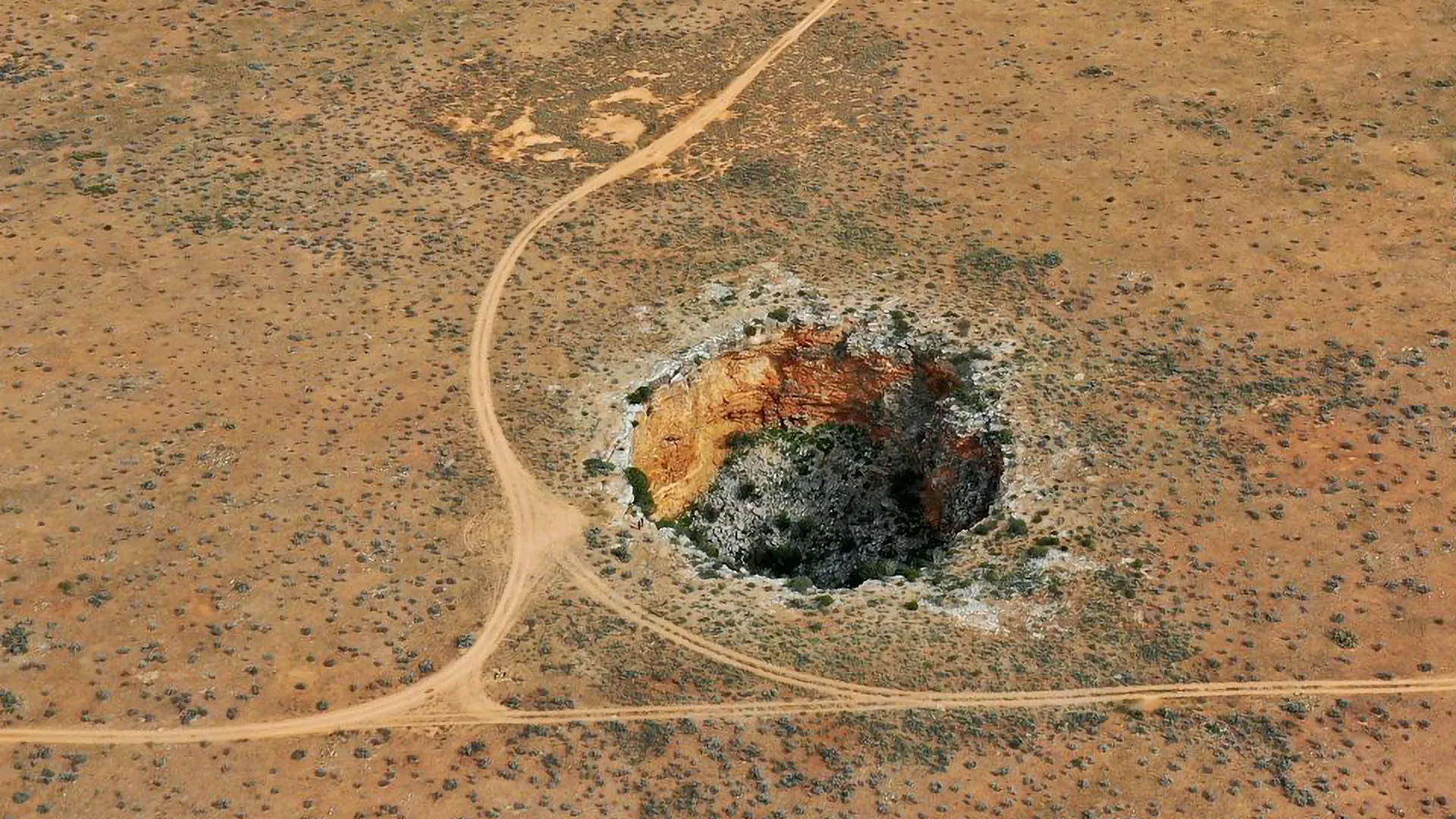
Covering more than 200,000 square kilometers in southern Australia, the Nullarbor Plain is one of the world’s largest limestone regions. A shallow sea receded from the area about 14 million years ago, helping create the arid landscape seen today. New research published in Communications Earth & Environment has found that seemingly shallow trenches on the plain can be surface traces of deeply buried cave systems, offering a new way to detect hidden caves on Earth and potentially on other planets.
The Nullarbor’s arid conditions created barriers for plants and animals, while poorly adapted colonial Victorian explorers described it as “the kind of place one falls into in a bad dream.” In contrast, the Mirning people have lived around Nullarbor Bay and the Great Australian Bight for tens of thousands of years. They have observed the landscape change as sea levels rose and fell, including during the last ice age about 20,000 years ago.
To an untrained eye, the Nullarbor Plain can appear simple and featureless. Beneath its surface, however, lies a largely hidden underground world.
Over millions of years, water has eroded the limestone and formed a complex network of caves extending for kilometers underground. Much about these caves remains poorly understood, partly because they are generally known and accessible only where they reach the surface.
The new study, published in Communications Earth & Environment, describes a method for tracking cave systems even when they are deeply buried. The research also helps explain the formation of a previously mysterious shallow trench feature in the Nullarbor and suggests a way to identify hidden caves beyond Earth.
A valley without a river
Evidence of the Nullarbor’s underground landscape is scattered across the plain, including small cave openings and shallow depressions. Some previously unexplained structures are long—up to 20 kilometers—and shallow, measuring several meters deep. They generally run from north to south and are barely visible from the ground, although they stand out in modern digital landscape models.
Although these shallow channels resemble flat-bottomed valleys, they were not carved by rivers. They begin and end abruptly and are not connected to the existing river and drainage networks that extend into the upland areas around the Nullarbor.
They also lack the branching patterns typical of rivers, and sediments within them show no evidence of being deposited by running water.
What the researchers discovered
To investigate how the structures formed, the researchers combined several techniques. They mapped the trenches using drone and aerial photography, along with detailed satellite-based digital landscape models. They then examined the soil and rock layers in boreholes and caves.
Finally, they used geophysical methods to “see” into Earth’s interior, in a way comparable to using X-rays to examine internal structures in the body from outside.
The analysis showed that the shallow trenches at the surface lie above deep zones of fractured rock. In some locations, they align with known cave systems and sinkholes.
This indicates that the trenches are subdued surface expressions of deeply buried cave systems. Over millions of years, these systems can slowly “collapse upward” through the overlying rock layers until they reach the surface.
Caves as scientific archives
The findings could change how scientists interpret cave landscapes around the world. They suggest that researchers may need to look deeper underground to explain surface structures that appear straightforward.
Knowing where underground voids may exist is important when planning civil-engineering projects above ground, such as buildings and roads, and below ground, including tunnels and sewers. It can also help reduce geological hazards and support the management and protection of groundwater resources.
Karst landscapes—areas where water dissolves rock and creates caves and sinkholes—cover about 15% of Earth’s ice-free land surface. Groundwater in karst environments supplies between 10% and 25% of the world’s population with water.
Caves are also important scientific archives. Because they are protected from many surface weathering and erosion processes, they can preserve snapshots of ancient environments and ecosystems that would otherwise disappear over time.
They can also support unusual and vulnerable life forms that have evolved and adapted independently. These include species that may rank among the least studied creatures on Earth, such as the eyeless wasp reported from a pitch-black Nullarbor cave and several newly identified Australian cave crickets.
Finding these organisms and understanding their environments first requires locating the cave structures themselves. The researchers’ method could help with that task.
Lessons for caves on other worlds
The implications of the work extend beyond Earth. Caves can provide stable environments and protection from harmful cosmic radiation, making them promising places to search for life on other planets.
Mapping planetary surfaces across the solar system has identified numerous potential caves, including features thought to be associated with karst on Mars.
The Nullarbor’s dry, stable surface provides a useful analogue for identifying the subtle surface signs of hidden cave systems on planets that lack the dynamic water circulation found on Earth. Even if such caves are not inhabited, they could potentially provide attractive bases for future human explorers.
It remains unclear how many seemingly simple landscapes on Earth and other planets conceal extensive cave systems. The trenches examined in the study are unlikely to be the only examples, and similar subtle topography may have been overlooked elsewhere.
Sometimes the most remarkable discoveries are hidden in plain sight, within landscapes that seem already familiar.
The authors thank Matthias Leopold from the University of Western Australia; Rok Ciglič, Mateja Ferk, Jure Tičar, Matija Zorn and Matej Jelovčan from the Slovenian Academy of Sciences and Arts Research Center (ZRC SAZU); John A. Webb of La Trobe University; Uroš Stepišnik, Matej Drenec, Primož Mikulav, Tomislav Popit and Andrej Šmutz from the University of Ljubljana; and Jian-xin Zhao from the University of Queensland.
Source: www.sciencedaily.com