


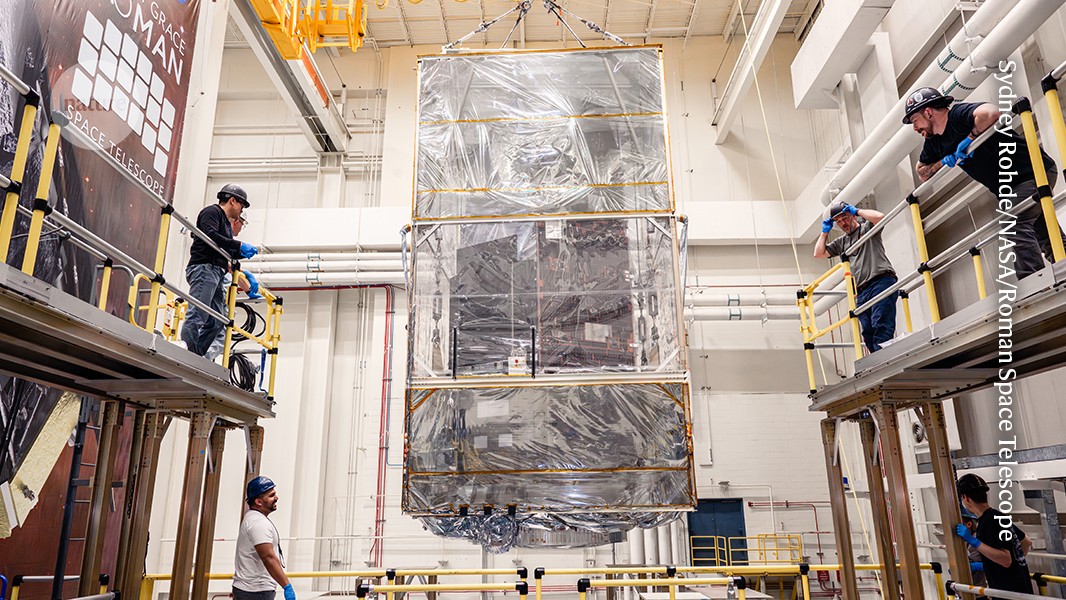
NASA’s Nancy Grace Roman Space Telescope will undergo vibration testing ahead of its scheduled launch on August 30.
Credit: Sydney Rohde/NASA/Roman Space Telescope (CC BY-NC-ND 4.0)
At NASA’s Goddard Space Flight Center in Greenbelt, Maryland, a countdown clock outside the main gate is marking the days until August 30 — the planned launch date for NASA’s Nancy Grace Roman Space Telescope. The observatory is scheduled to launch into Earth orbit from Kennedy Space Center in Florida. With a wide field of view and powerful infrared capabilities, Roman will survey the cosmos on a scale unlike any previous NASA space telescope. In just one month, it could observe as much of the Milky Way as the Hubble Space Telescope would cover in roughly a century.
JWST discovers ‘milestone’ confirming atmosphere of Earth-like exoplanet
The Roman Space Telescope is expected to provide new insight into the early universe and help scientists investigate dark energy, the mysterious force driving the accelerated expansion of the cosmos. Exoplanet researchers are also eagerly awaiting its launch. Roman could identify as many as 40 times more planets beyond our solar system than are currently known.
“Think of this as the largest census we’ve ever done of planets outside our solar system,” Julie McEnery, Roman’s senior project scientist, said at a NASA press conference last month. The survey could reveal everything from Earth-like worlds to unusual planets that are not gravitationally bound to any star.
Some of the telescope’s most important discoveries may be the ones scientists cannot yet predict. “What Roman tells us will probably be different and more interesting than what we came up with,” said Jesse Christiansen, chief scientist at NASA’s Exoplanet Science Laboratory in Pasadena, California. “We always find that nature is more imaginative than we are.”
A new world of planetary shadows
Roman will be especially powerful for exoplanet research because it will use three planet-detection techniques rather than relying on just one. Most discoveries are expected to come from the transit method. This technique detects the tiny dip in a star’s brightness when a planet passes across its surface, or “transits” the star.
By observing the crowded center of the Milky Way, Roman will monitor billions of stars approximately every 12 minutes. These repeated observations could reveal the characteristic flickers caused by transiting planets.
Using this method, Roman may detect approximately 100,000 exoplanets. That would represent a dramatic increase over the roughly 6,000 confirmed exoplanets known today.
This enormous catalog will help astronomers identify patterns in the distribution, size and orbits of planets throughout the galaxy. “We find individual planets and study them as best we can. But a single planet only gives us a snapshot,” Christiansen says. “Watching a movie requires extensive research on stars in different environments.”
Finding strange new worlds
The transit method is powerful, but it also introduces observational bias. Large planets orbiting close to their host stars are easier to detect because they block more starlight and transit more frequently. If astronomers searched for our own solar system using only this technique, “you probably wouldn’t find any planets because they’re not the right size and distance,” says Roman program scientist Dominic Benford.
To create a more complete exoplanet census, Roman will also use gravitational microlensing. This method detects planets when their gravity bends and magnifies the light from a more distant background star.
Roman is expected to find about 1,000 planets through microlensing, but these discoveries could be among the mission’s most significant. Because microlensing is sensitive to planets farther from their host stars, the technique may reveal worlds with sizes and orbital distances similar to those found in our solar system.
This super-Earth is the first planet confirmed to have a permanent dark side.
Source: www.nature.com