


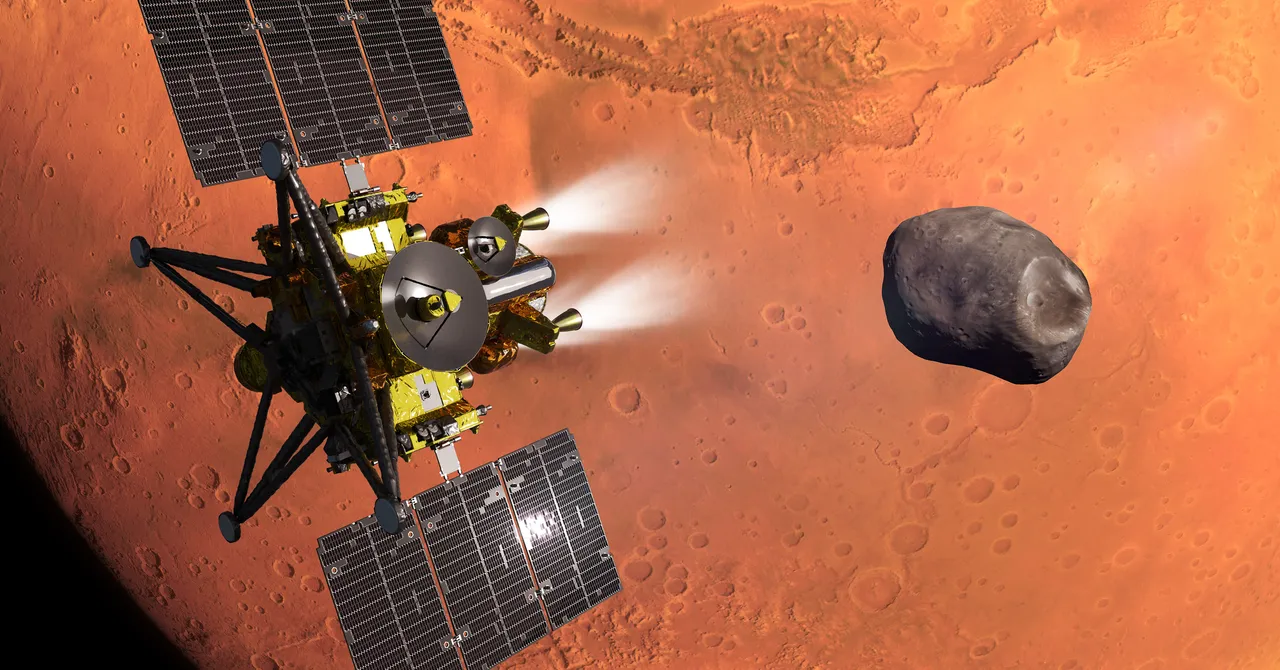
Japan’s MMX Mission Will Explore Phobos and Return Samples From Mars’ Mysterious Moon
It’s hard to imagine a more daunting journey than a trip to an alien moon named after the Greek god of fear—especially when three earlier attempts to reach it have failed.
Still, as Japan’s space agency JAXA and its international collaborators prepare to send a probe to Mars’ frighteningly named moon, “every member is filled with quiet excitement,” says Kiyoshi Kuramoto, who leads the mission’s international science team.
JAXA’s MMX Mission Will Visit Mars’ Two Moons
The mission, called Mars Moon Exploration (MMX), is scheduled to launch from Japan’s Tanegashima Space Center early Tuesday morning in Japan, or Monday afternoon in the United States. After nearly a year of travel, the spacecraft will arrive at Mars and its two moons: Phobos, whose name means fear, and Deimos, whose name means dread or terror.
MMX will observe both moons from afar and collect samples from Phobos to investigate how the moons formed. The samples could help scientists resolve one of the biggest mysteries surrounding Mars: whether its moons are captured asteroids or remnants of a massive collision.
Why Phobos’ Origin Remains a Mystery
Researchers have pursued similar missions for decades. Since the 1980s, Russia has sent three probes to Phobos, and all of them failed. Despite those setbacks, scientists remain eager to explore the moon because its origins are still unclear.
Some characteristics of Phobos and Deimos, including the pattern of visible light they reflect, suggest they may be asteroids pulled into Mars’ orbit by gravity. However, the moons’ nearly circular orbits around Mars’ equator indicate another possibility: They may have formed from debris left behind after a collision between newborn Mars and a giant asteroid, said Tom Statler, NASA’s MMX program director, at a press conference.
How MMX Will Study Phobos
The MMX spacecraft is equipped with an array of scientific instruments designed to examine Mars and its moons in detail. Using the MEGANE instrument, researchers will determine Phobos’ elemental composition by measuring the particles and gamma rays it emits.
If Phobos is enriched with volatile elements such as hydrogen and potassium, the findings could support the asteroid-capture hypothesis. A lower concentration of volatile elements may instead support the theory that Phobos formed from debris created by a giant impact.
“We don’t know anything about Phobos’ elemental composition,” says David Lawrence, who leads the MEGANE team at Johns Hopkins University. “For me, that’s what’s exciting: doing measurements that no one has done before.”
MMX Will Collect the First Samples From a Moon Beyond Earth’s
The spacecraft’s observations “give us some hints at answers to the really big questions we have about Phobos,” said Abigail Freman, an MMX team member at NASA’s Jet Propulsion Laboratory. “But in reality, the returned samples will answer those questions.”
After MMX studies Phobos with its onboard instruments, a rover will land on the moon’s surface to explore its terrain. It will collect at least 10 grams of material using two different sampling methods. The goal is to return those samples to Earth by 2031, making them the first samples brought back from a moon other than Earth’s.
Source: www.wired.com