


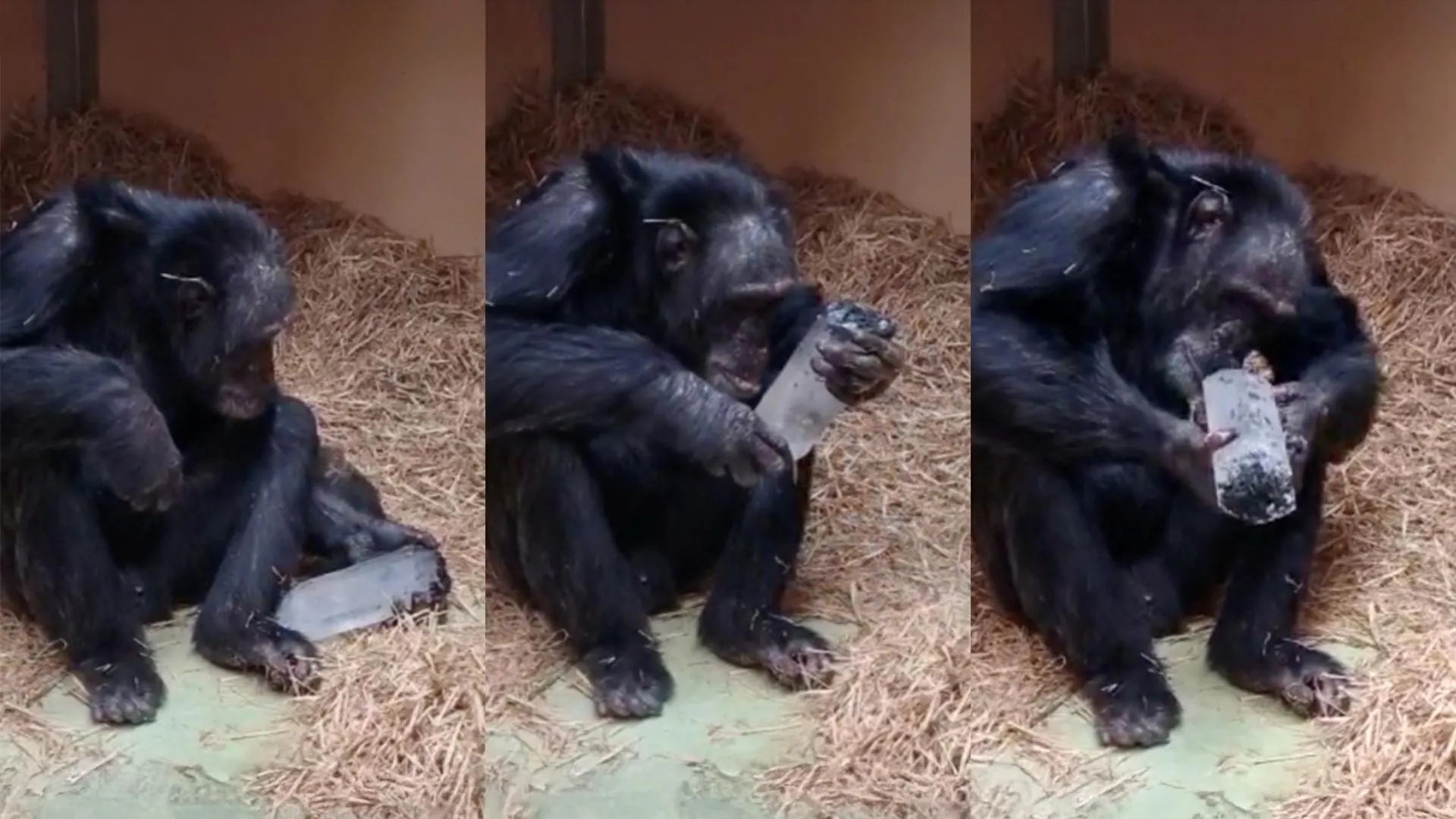
Recent archaeological discoveries have revealed that crystals were collected by early human relatives from the Homo tribe nearly 780,000 years ago. This behavior is intriguing as these crystals were not utilized as tools, weapons, or jewelry. What, then, made these rare stones worthy of preservation?
New insights from research published in Frontiers of Psychology offer potential explanations. Spanish researchers examined the allure of crystals by studying how chimpanzees, our closest living relatives, interacted with them. Their findings indicate that the fascination with crystals may stem from deep evolutionary origins that predate modern humans.
“We demonstrated that cultured chimpanzees can distinguish crystals from other stones,” stated lead author Juan Manuel García-Ruiz, Ikerbasque Research Professor of Crystallography at the Donostia International Physics Center in San Sebastian. “We were surprised by the intensity and naturalness of chimpanzees’ attraction to crystals, suggesting a deep evolutionary connection to these objects.”
Chimpanzees Display Fascination with Crystals
Despite diverging from a common ancestor six to seven million years ago, humans and chimpanzees share numerous behavioral and genetic traits. To explore whether a fascination with crystals is among them, researchers introduced two groups of enculturated chimpanzees at the Rainfur Foundation to crystals. The first group included Manuela, Guillermo, Ivan, Yaqui, and Toti; the second group comprised Gombe, Lulu, Pascual, and Sandy.
In the first experiment, researchers placed a large crystal, referred to as a monolith, alongside a similarly sized ordinary rock. Initially, both objects attracted the chimpanzees’ attention, but the crystal soon emerged as the clear favorite, while the regular rock was largely overlooked.
Once the crystal was removed from the display, the chimpanzees meticulously examined it, rotating and tilting it for different angles of view. Ivan, one of the chimps, eventually picked up the crystal and intentionally transported it back to his dormitory.
Researchers found that the chimpanzees’ curiosity peaked immediately after encountering the crystals, gradually diminishing over time. This pattern mirrors the way novelty wears off in humans. Eventually, the researchers had to exchange bananas for yogurt to entice the chimpanzees back to the study.
Chimpanzees Quickly Identify Crystals Among Pebbles
The second experiment tested whether chimpanzees could recognize smaller crystals analogous to those gathered by ancient humans. Researchers mixed a small crystal into a pile of 20 pebbles, and remarkably, a chimpanzee picked it out within seconds.
Even when pyrite and calcite crystals, which differ in shape from quartz, were included in the mix, the chimpanzees still discerned and selected the crystal type stones.
“The chimpanzees began to investigate the transparency of the crystals with keen interest, lifting them to eye level and peering through them,” said García-Ruiz. The animals continued examining the crystals for several hours.
Notably, a chimpanzee named Sandy exhibited particularly interesting behavior. She carried both pebbles and crystals in her mouth to a wooden stand where she organized them into separate groups.
“She isolated three different types of crystals based on clarity, symmetry, and luster from the pebbles. This capacity to recognize crystals despite their variations surprised us,” García-Ruiz noted. Since chimpanzees usually do not carry objects in their mouths, the researchers speculate that Sandy may have been hiding the crystals, suggesting she considered them valuable.
What Crystals Represented for Early Humans
The research team emphasized that future studies should explore personality differences among chimpanzees, although they did not examine whether certain individuals show a greater interest in crystals.
“There’s a Don Quixote and a Sancho; some are attracted to the clarity of crystals, while others might focus on their scent or edibility,” García-Ruiz highlighted.
The researchers also pointed out that the chimpanzees in the study were accustomed to human environments, regularly encountering objects not found in the wild. They argue that similar experiments should eventually involve less culturally influenced apes, ideally in wild populations.
By synthesizing findings from both experiments, the research team concluded that transparency and geometric shape are key features that make crystals appealing. These same traits may explain why our early ancestors chose to gather them.
Unlike the typically curved and branched shapes of trees, mountains, rivers, clouds, and animals, crystals possess flat surfaces and straight edges, representing unique polyhedra in nature. Researchers propose that these unusual forms could have captured the attention of early humans as they sought to comprehend their surroundings.
“Our research sheds light on the fascination with crystals and contributes to the understanding of the evolutionary roots of aesthetics and worldviews,” concluded García-Ruiz. “We have evidence that crystals have held a special place in our hearts for at least six million years.”
Source: www.sciencedaily.com