


Close Menu
HitechubHitechub
    What's Hot
    Science

    Scientists Reverse Aging in Liver Cells and Cut Alzheimer’s-Related Proteins in Half

    Science

    NASA’s The Million Panel Project: A Breakthrough in Scientific Research

    Technology

    Critical Citrix NetScaler Authentication Bypass Exploit Now Available to Attackers

    Important Pages:
    • About Us
    • Privacy Policy
    • Terms & Conditions
    Facebook X (Twitter) Instagram Pinterest
    Facebook X (Twitter) Instagram
    HitechubHitechub
    Monday, November 30
    • Shop
      • Fashion
        • Mens
        • Womens
        • Accessories
          • Handbags
          • Keychain
          • Masks
          • Money clicps
          • Neck Pillow
          • Rings
          • Towels
          • Wallets
        • Jewelry
        • Watches
        • T-shirts
        • Hawaiian shirts
        • Vests
        • Swim trunks
        • Swimsuits
      • Fun
        • Magic cubes
        • Magnifiers
        • Misc
        • Photo books
        • Puzzles
        • Toys
      • Home
        • Cleaning/Care
        • Mailbox covers
        • Mugs
        • Pot Holders
        • Spoon
      • Office and Electronics
        • Chairs
        • Office Supplies
        • IPad cases
        • Laptop stickers
        • Mouse pads
        • Notebooks
        • Pencil bags
        • Pens
        • Phone cases
      • Personalized
      • Pets
      • Sports
        • Cycling
          • Balaclava Mask
          • Bike Bell
          • Bike Computer
          • Bike Fender
          • Bike Grips
          • Bike Kickstand
          • Bike Light
          • Bike Locks
          • Bike Mitts
          • Bike Pumps
          • Bike Repair Stand
          • Bike Seat
          • Bike Trainer
          • Bike Wheels
          • BIKES
            • Folding Bikes
            • Road Bikes
          • Carbon Fiber Bike Products
          • Cycling Mask
          • Kid’ Bike Helmets
          • Inner Tube
          • Motorcycle Bag
          • Nylon Pedals
          • Adult Helmets
          • Photochromic Sunglasses
          • Soft Coolers
          • Suction Cup Bike Rack
          • Tool accessories
          • Winter Cloth
          • Heart Rate Monitor
        • Outdoors/Camping
          • Outdoor Bags
        • Sweatband
    • Technology
      1. AI
      2. Gadgets
      3. View All

      This is the most popular CEO in the world

      Sectors in which “Chat-GPT” is most often used

      Artificial intelligence has begun to “swallow” professions

      The unusual robot conductor of a concert in Seoul

      Here’s how you can tell if your phone is being tapped

      PlayStation 5 becomes a completely silent console and gets more space

      This is the first phone that can be used to park a car

      Best Gaming Laptops 2023: Powerful Portables for PC Games

      VisionQuest Review: A Satisfying Conclusion to the WandaVision Trilogy

      New Balance Japan Data Breach Exposes 3.7 Million Customer Records

      Webz.io Launches Self-Service Dark Web API with Free Monthly Credits

      University Board Confirms Data Breach After Unauthorized Password Change

    • Science
      1. Space
      2. Wheels
      3. View All

      Space Perspective: A Journey to the Edge of Space

      5 Fascinating Facts About Space

      Space Exploration: Unveiling the Wonders of the Universe

      Toyota wants to make a new generation battery with a range of up to 1,200 km

      Meet Toyota’s lunar “baby” that could make exploring the Moon easier

      What does a night drive look like with one of the most beautiful cars in the world: the Rolls-Royce Ghost

      Licensing Mechanisms of RNA-Guided DNA Integration in Type I-F3 CAST Systems

      What Archaeological Treasure Would You Discover?

      5 Key Lessons from the Failed COP31 Climate Change Negotiations

      Top Major Cities Worldwide for High-Quality Research in 2025

    HitechubHitechub
    Home » Why Early Humans Collected Strange Stones 500,000 Years Ago: Scientists May Have the Answer
    Science

    Why Early Humans Collected Strange Stones 500,000 Years Ago: Scientists May Have the Answer

    Share Facebook Twitter Pinterest WhatsApp
    Share
    Facebook Twitter LinkedIn Pinterest WhatsApp

    Rare stones, fossils and ancient flint tools found at prehistoric sites in Israel may offer clues about the evolution of the human mind. Researchers from Tel Aviv University and their collaborators suggest that early humans may have collected some of these objects as personal souvenirs, using them to recall meaningful places and experiences. If so, this behavior could have contributed to the development of autobiographical memory and a sense of personal identity.

    People still commonly collect colorful seashells from beaches or bring unusual stones home from hikes. Such objects usually have little practical or monetary value, but they can evoke vivid memories of people, places and experiences. A new study from Tel Aviv University suggests that humans may have been collecting souvenirs as early as 500,000 years ago, and that the practice may have influenced the evolution of memory.

    The research was led by Dr. Yoav Lam and Professor Ran Barkai of the Department of Zoology at Tel Aviv University’s Wise School of Life Sciences, along with Dr. Ella Assaf of the Department of Archeology, Faculty of Humanities, Entin. They collaborated with Professor Riad Mudrik of the School of Psychological Sciences at the Gordon School of Social Sciences and Dr. Bar Efrati of the University of Oxford. Their findings were published in evolutionary anthropology.

    An ancient stone with no apparent practical purpose

    The researchers combined evidence from archaeology, evolutionary theory, psychology and neuroscience to examine aspects of prehistoric human behavior. Early humans sometimes collected, transported and stored objects that appeared to have no practical function. The researchers propose that these items may have carried personal meaning, serving as tangible reminders of experiences and places their owners had visited.

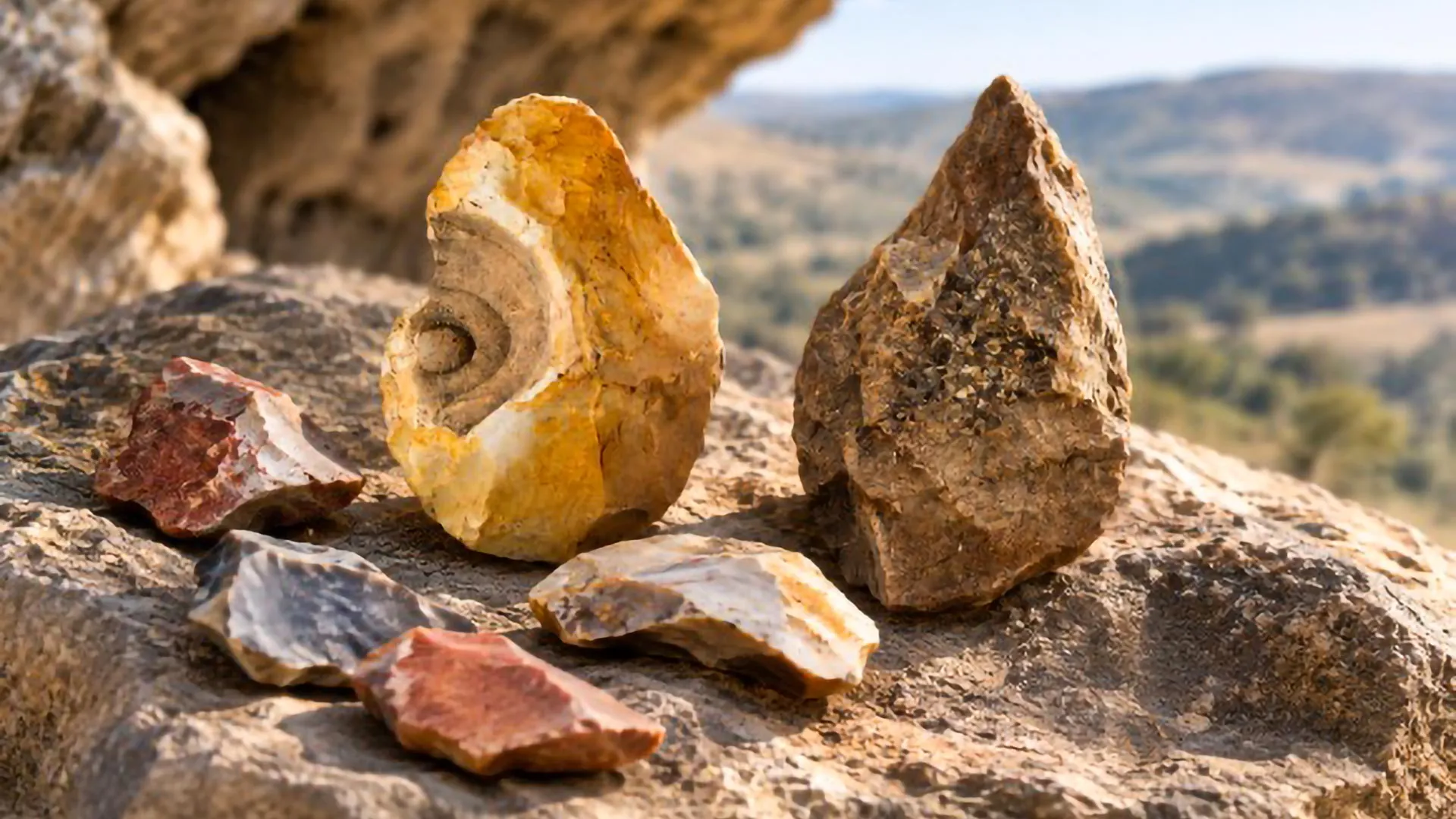
    Evidence of this behavior comes from several sites across Israel dating back hundreds of thousands of years. At Qesem Cave, archaeologists found small, colorful pebbles that had been brought from different locations, although no practical use for them could be identified.

    Another example comes from the Saknin Valley, where early humans made flint hand axes containing fossils and distinctive geological features. In some cases, the tools were shaped so that these unusual characteristics remained prominent, visible and tangible.

    Archaeologists also found much older flint tools at the Lebadim, Jaljuria and Kesem caves. Prehistoric humans had recovered the tools after their surfaces had already aged. Although some had been resharpened, most of their original surfaces and traces of early craftsmanship remained intact. The researchers suggest that the changes accumulated over time may have contributed to the objects’ value to their collectors, because their appearance preserved a record of their past.

    How memorabilia may have shaped human memory

    The researchers suggest that bringing objects back from specific locations may have provided early humans with physical cues for remembering personal experiences. Sensory details such as an object’s color, shape and texture may also have helped people determine whether a memory came from something they had experienced themselves, heard from someone else or imagined.

    Unlike many everyday objects, souvenirs can carry meanings unique to their owners. They are portable and can be shown to other people. Displaying an object associated with a past experience may have lent additional credibility to the owner’s account of what happened.

    The ability to recall personal experiences accurately has considerable social value. Memories of previous encounters, alliances, gift exchanges, shared responsibilities and rights to particular places can help people navigate complex social relationships. Reliable personal memories may also support cooperation, maintain relationships and build trust within communities.

    The researchers propose that, over generations, collecting and using mementos may have created evolutionary pressures favoring brain mechanisms that help people identify the origins of their memories and assess how reliable they are.

    The interaction between physical objects collected by humans and biological processes in the brain may have contributed to the development of autobiographical memory. This form of memory allows people to recall events from their lives and connect them to an ongoing personal story. It is a fundamental part of understanding who we are and how identity develops over time.

    A changing prehistoric environment

    Why did humans begin collecting meaningful objects at this particular point in history? Professor Barkai suggests that the behavior may have emerged in response to major environmental changes that forced early humans to adapt their hunting strategies and explore different landscapes.

    “With the disappearance of large animals, especially elephants, early humans had to develop new hunting methods and become accustomed to hunting grounds populated by animals such as fallow deer and wild cattle,” he said. “Objects taken from these places may have helped them maintain a personal connection to the places where they would make their living.”

    Under this hypothesis, objects collected from important hunting sites may have helped early humans preserve memories of locations that were becoming increasingly essential to survival.

    The oldest human memory aid?

    The authors caution that their explanation remains hypothetical. Archaeological discoveries do not prove that all rare pebbles, fossils and ancient tools were intentionally kept as souvenirs. However, the archaeological record shows a surprisingly long history of humans collecting and storing objects that may have been associated with personal memories, extending from about 500,000 years ago to the present day.

    Given the persistence of this behavior, the researchers argue that collecting meaningful objects may have been more than a form of entertainment. It may have played a role in shaping human cognition during evolution.

    Dr. Lamb concluded: “When early humans brought back to caves the colorful stones and old tools they found in the landscape, the objects may have helped them remember important events and encounters throughout their lives. In this way, souvenirs became a kind of ‘external memory device’ and may have supported the evolution of the brain mechanisms responsible for the autobiographical memories that are so characteristic of us as humans and so important in forming our identities.”

    Source: www.sciencedaily.com

    Share. Facebook Twitter Pinterest LinkedIn WhatsApp
    Previous ArticleIntegrated Photonics for Augmented Reality Applications
    Next Article Webz.io Launches Self-Service Dark Web API with Free Monthly Credits

    Related Posts

    Science

    Licensing Mechanisms of RNA-Guided DNA Integration in Type I-F3 CAST Systems

    Science

    What Archaeological Treasure Would You Discover?

    Science

    5 Key Lessons from the Failed COP31 Climate Change Negotiations

    Science

    Top Major Cities Worldwide for High-Quality Research in 2025

    Science

    Scotland Heavy Rain: Flood Risks and Travel Warnings Issued

    Science

    Hera Probe Reveals Stadium-Sized Crater on Asteroid Dimorphos Created by NASA’s DART Mission | Space Photo of the Week

    Science

    LSD vs. Psilocybin: How They Leave Different Imprints on the Brain

    Science

    Black Hole Collisions Follow Surprisingly Simple Laws of Nature

    Add A Comment
    Leave A Reply Cancel Reply

    Stay In Touch
    • Facebook
    • Twitter
    • Instagram
    • Pinterest
    Top Picks
    Technology

    Porsche Previews New Mid-Engine Supercar That Could Outperform the 911

    Porsche Mission S Concept Previews a New Mid-Engine Supercar The Porsche Mission S offers a…

    How to Turn Off Music Videos on Spotify: A Step-by-Step Guide

    Jason Arday’s Death Should Prompt Deep Remorse and Reflection

    Study Finds No Link Between Illegal Immigration and Higher Crime Rates

    Download: Selling Battlefield Drone Data and AI Reconstruction Guide

    Most Popular
    Technology

    EDR Blind Spots: 3 Browser Attack Techniques That Evade Endpoint Telemetry

    Science

    150-Year-Old Mystery Solved: Who Was Buried in a Roman Coffin at Westminster Abbey?

    Categories
    • AI (9)
    • Gadgets (6)
    • Science (3,671)
    • Space (3)
    • Technology (3,067)
    • Wheels (3)
    Our Picks
    Science

    Mathematicians Amazed by AI and Human-Written Proof of the Riemann Hypothesis

    Technology

    Rocket Report: SpaceX Pushes Back on Military Launches as Spain’s Rocket Nears Completion

    © 2026 Hitechub.
    • Home
    • About Us
    • Privacy Policy
    • Terms & Conditions

    Type above and press Enter to search. Press Esc to cancel.

    GDPR Cookie Banner

    We are using cookies to give you the best experience on our website.

    You can find out more about which cookies we are using or switch them off in .

    Ad Blocker Enabled!
    Ad Blocker Enabled!
    Our website is made possible by displaying online advertisements to our visitors. Please support us by disabling your Ad Blocker.