


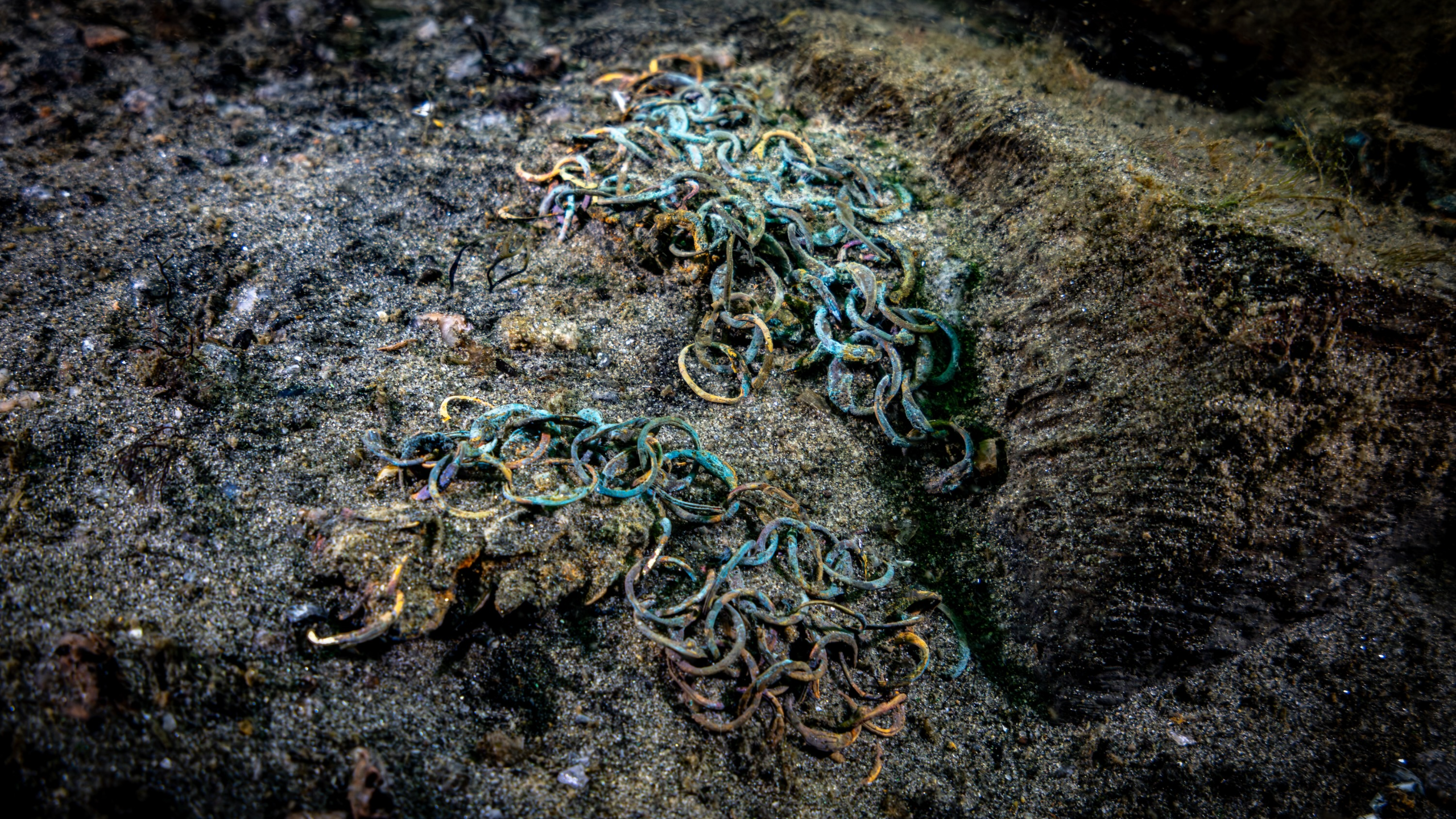
Archaeologists have recovered high-quality chainmail and unusual ammunition boxes from the 15th-century wreck of the royal warship Gribshunden, also known as Griffin. The vessel served as a “floating castle” for King Hans of Denmark before it caught fire and sank in 1495. Researchers recently began investigating the area beneath the forecastle, an elevated battle platform at the ship’s bow, where they found the well-preserved military equipment.
The chainmail was “rather surprisingly, completely exposed,” Rolf Warming, an archaeologist at Stockholm University and principal investigator of the Griffin project in collaboration with Södertörn University, told Live Science via email. “It was just a coincidence that we found it, but it shows how much remains at the wreck site.”
Armor linked to German mercenaries
According to a November 24 statement, the mail armor is made from a copper alloy and was found in parts of the ship that may have been used to store military equipment.
“According to historical sources, German mercenaries, or Landsknechts, were on board the Griffin when it sank in 1495,” Rodrigo Pacheco Ruiz, an archaeologist at the University of Southampton in the U.K. and a co-researcher on the project, said in the statement. The mercenaries may have stored the armor in this area, but “the exact function of this space has not yet been established,” Pacheco Ruiz said.
Griffin was the naval flagship of King Hans of Denmark and Norway. In 1495, Hans was sailing to Kalmar, Sweden, to negotiate a political alliance and bring Sweden back into union with Denmark and Norway. About 150 German mercenaries were traveling with him.
“Proving military strength was important, and German and Swiss mercenaries were the best mercenaries available at the time,” Warming told Live Science.
While the ship was in the port of Ronneby in present-day Sweden, it was struck by lightning, caught fire and sank. Witnesses reported that many people died, although King Hans was on land when the warship went down.
A well-preserved wreck
The wreck was rediscovered in the Baltic Sea off Sweden’s southern coast in the 1970s, but archaeologists did not officially identify it as Griffin until 2013.
The ship has remained unusually well preserved over the centuries because of the Baltic Sea’s low salinity and the absence of shipworms. These marine mollusks, also known as “sea termites” because of the damage they cause to wood, are known as funamushi.
Warming said the chainmail recovered in October is of very high quality, but it does not necessarily belong to an elite knight. “This type of armor is often repaired and reused and can remain in service for long periods of time, so these fragments may represent older military equipment that was still in service,” he said in a statement.
An ammunition box beneath the forecastle

The researchers also discovered a distinctive ammunition box known in German as a “Zeuglade.” They collected samples to determine what the box once contained and to look for possible traces of gunpowder. The box is believed to have belonged to one of the German mercenaries aboard the ship.
“This year’s campaign was a uniquely exciting study!” Warming told Live Science. “In the process of documenting the chest, we unexpectedly discovered fragments of exposed mail armor near the chest, along with other items that could indicate more of the chest.”
The find suggests that the area may have been a storage space directly below the forecastle. However, the researchers have not yet established whether the armor and ammunition box belonged to the same person.
Investigating medieval military logistics
The team is using chemical analysis to investigate the origins of the armor and the chest and to learn more about medieval military equipment.
“The mail armor likely belonged to a mercenary, but it could also belong to someone else,” Warming said. “This box could also be theirs, but we don’t know yet. In fact, this is a very interesting research question for us that could shed light on supply chains and military logistics. Did the mercenary forces bring their own ammunition and tooling on board the ship, or was this supplied by the Royal Fleet?”
Source: www.livescience.com