


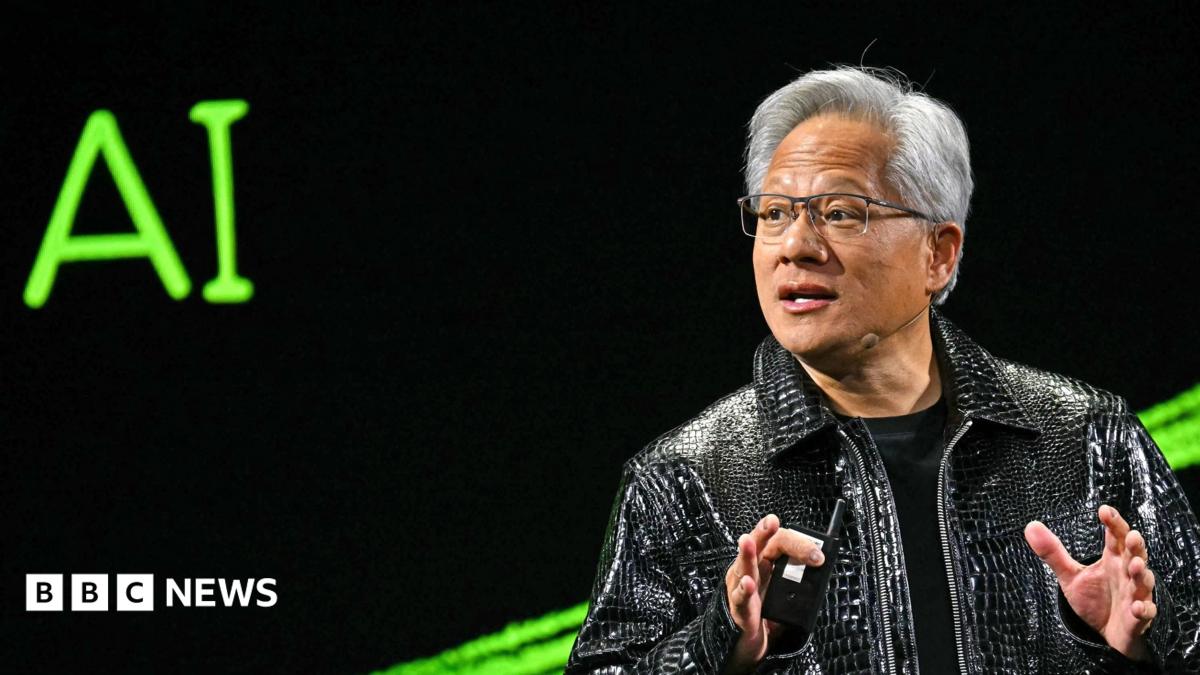
Nvidia’s long-running AI rally has come under renewed pressure as its share price declines, political intervention intensifies and investors question whether the technology boom can support current valuations. Concerns extend beyond Nvidia to Anthropic, OpenAI’s potential stock-market listing and the financing structure behind the data-center build-out.
Nvidia’s AI rally loses momentum
When trading opened on the Nasdaq, Nvidia’s super rally had disappeared. The company’s share price had already fallen nearly 30% over the previous six months, well before the Jensen Huang scandal broke earlier this month.
Concerns about the sustainability of the technology boom also predated Mr Hwang’s departure and did not disappear after his return. Investors remain uneasy about whether the AI market can maintain its current pace of growth.
Anthropic was already trading well below the gains recorded by the stock market last week. As the first pure-play AI company to go public, Anthropic is viewed as a major test of continued investor demand for artificial intelligence.
Trump intervention raises political questions
President Trump made an unusual phone call to CNBC and took credit for directing Nvidia’s board to reinstate Hwang. The intervention highlighted the scale of efforts by Silicon Valley and some members of the US administration to bring Hwang back to power.
Among the president’s most surprising comments was his suggestion that a two-day investigation into the allegations had cleared Hwang of national security concerns.
President Trump said he intervened because Hwang is a “national treasure” who has a next-generation AI chip “in his head”. He said that was why Hwang needed to return.
In financial markets, skeptics of the AI boom say they have never seen a strategy like this to support a stock-market surge. Bond vigilantes and short sellers are now confronting both Silicon Valley and the White House.
Investors are trading on the strength of political support rather than revenue figures, following a recent backlash by US voters against AI data centers.
Data-center financing adds to Nvidia’s risks
Against this backdrop, a recovery in Nvidia’s $400bn (£304bn) annual sales of advanced chips—the central cash-generating cornerstone of the technology boom—looks politically fragile.
That uncertainty adds to existing risks surrounding Nvidia’s central role in the network of financing, borrowing and cross-ownership supporting data-center construction.
Colette Kress, Nvidia’s short-term interim chief executive, had already indicated last week that she was withdrawing from this part of the strategy. The current status of that element remains unclear.
Anthropic and OpenAI face investor scrutiny
Anthropic’s falling stock price also raises questions about OpenAI’s plans to list on the stock exchange. Ultimately, the two companies could become the most important part of the broader AI investment story.
They remain valuable companies with powerful technology trusted by some of the world’s largest businesses. The central question is whether that dependence will weaken as companies avoid expensive frontier models and choose cheaper, generic models offered by China.
All of these developments could fuel further political backlash, with Nvidia’s current drama adding to the pressure.
Volatility signals a fragile market mood
It is highly unusual for the value of individual companies to fluctuate by trillions of dollars. Such extreme volatility points to a fragile mood among investors and highlights the uncertainty surrounding the AI boom.
Source: www.bbc.co.uk