


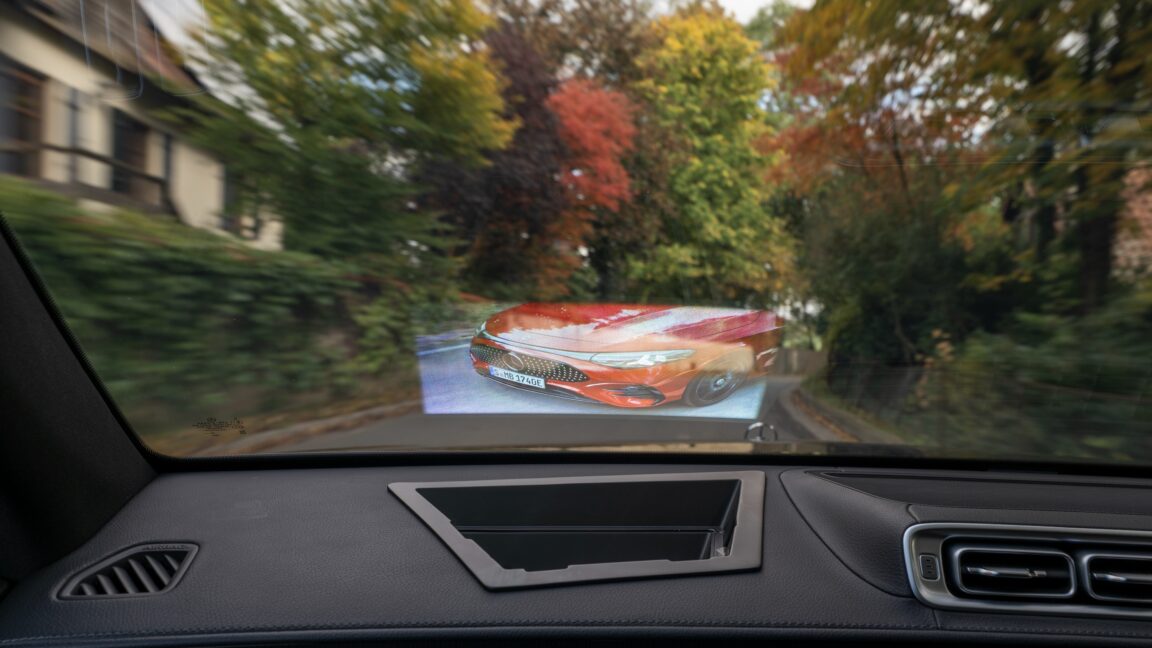
Mercedes-Benz is developing a holographic windshield display designed to give passengers a large virtual screen without adding a conventional dashboard display. The current prototype still has serious limitations, including low image quality, excessive contrast, and distortion caused by the windshield angle, but the company says production versions could offer a much larger viewing area, higher resolution, and quieter operation.
Mercedes plans a smaller, quieter projector
The production version will use a much smaller projector aperture than the prototype and existing head-up displays. Manual Holstein, a Mercedes manager involved in research into future display systems, said the projector could be compact enough to hide behind decorative wood or metal trim.
Holstein also said production models should eliminate audible fan noise and deliver improved resolution. The prototype already offered substantially higher resolution than current head-up displays, including Mercedes’ own system with augmented-reality elements.
During the demonstration, the system played a full-color, commercial-style video of the C-Class Electric. Holstein said the prototype was operating at only 20% of its maximum brightness, yet the image was still bright enough to view.
The prototype still has major limitations
Although the resolution is a significant improvement over the arrows, text, and basic graphics shown by today’s head-up displays, it remains poor compared with the touchscreens installed for passengers. The video also had excessive contrast, while the windshield angle compressed the image into a narrow vertical shape.
In its current form, the system is not a practical replacement for a phone, tablet, or conventional passenger display. Mercedes says, however, that this is only a prototype. Holstein said the holographic film, or “eyebox,” could be made considerably larger and taller in a production system, and described the distortion as a limitation specific to the prototype.
A virtual screen across much of the windshield
Mercedes envisions almost half of the windshield becoming a virtual screen visible only to passengers. In addition to video and other entertainment, the holographic display could highlight points of interest visible through the windshield.
A similar system could be installed on the driver’s side to provide situational information, support video calls, or show entertainment while the vehicle is parked. In the future, Mercedes’ Level 3 autonomous-driving system could allow drivers to view content beyond the road when they are permitted to take their eyes off it.
At a minimum, the technology could eventually replace current head-up displays and their relatively large projector housings, provided Mercedes can resolve the prototype’s image-quality and distortion problems.
Source: arstechnica.com