


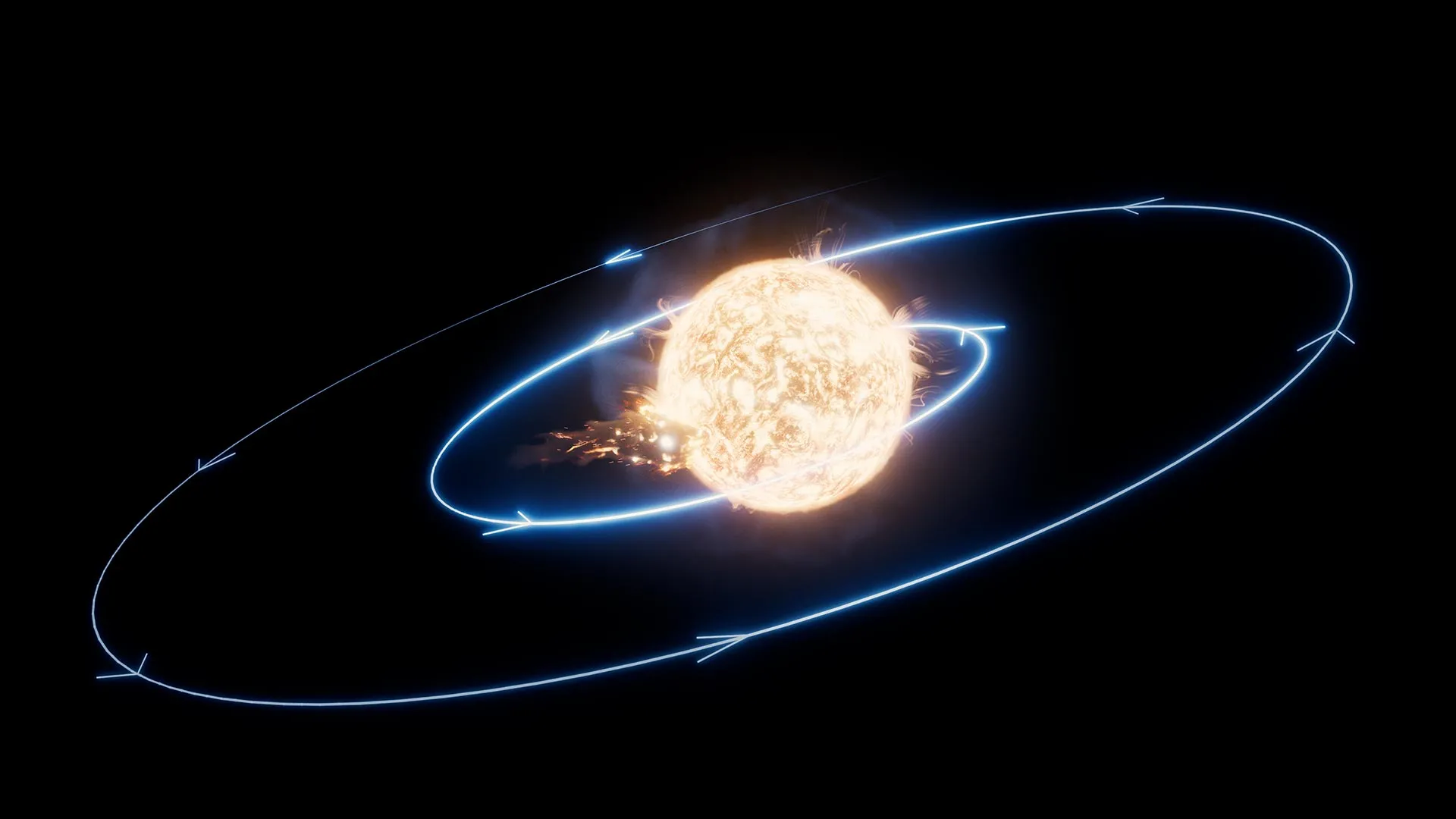
Astronomers have discovered compelling evidence that TOI-5882, a sun-like star located approximately 1,300 light-years away, may have consumed one of its own planets.
A research team led by Brooke Cotten, an astronomer at the University of Michigan, has uncovered vital clues regarding the star’s chemical composition. Notably, TOI-5882 contains significantly more lithium than typically found in stars of this nature.
“You’re what you eat, right?” Cotten remarked, a graduate student researcher in UM’s astronomy department and the lead author of the recent report in the Astrophysical Journal. “We know that planetary material has much higher lithium content than stars. Thus, when a star consumes a planet, it ingests a substantial amount of lithium.”
This research was partially funded by NASA and the National Science Foundation.
Understanding Planetary Engulfment
Astronomers refer to the phenomenon of a star consuming a planet as engulfment. Such events transpire rapidly on a cosmic scale, often lasting just days or weeks.
Due to the brief nature of these occurrences, scientists often miss witnessing them in real-time. Instead, astronomers look for chemical traces and evidence that persist after a planet has vanished.
“That’s the thrill of this field: solving mysteries,” Cotten said, who began her research as an undergraduate in the Ramat program at the University of California, Santa Cruz. “You can’t just watch a crime unfold, so you must utilize all available clues to reveal the culprit.”
Gaining insights into how to identify these phenomena could assist astronomers in determining the frequency and conditions under which stars consume planets.
Our solar system is also expected to meet a similar fate billions of years in the future. In approximately 5 billion years, the Sun will advance to its later life stages, transforming into a red giant and potentially engulfing Mercury, Venus, and possibly Earth.
Potential Role of Brown Dwarfs
TOI-5882 has not expanded sufficiently to explain how it devoured a planet based solely on its size. Therefore, researchers are considering an alternative explanation.
A large gaseous object, classified as a brown dwarf, also orbits TOI-5882. Although it possesses more than 20 times the mass of Jupiter, it is not massive enough to ignite and become a true star. This brown dwarf may have disturbed the orbit of the missing planet, leading it to collide with TOI-5882. Cotten indicated that this hypothesis will be explored in a subsequent study.
Lithium as a Chemical Fingerprint
Lithium serves as a crucial tool for astronomers studying planetary engulfment. Seth Jacobson, the lead author of the study and an assistant professor at Michigan State University, explained that while stars typically contain some lithium, planets usually possess far greater concentrations of the element.
“Lithium atoms delivered to a star through planetary engulfment resemble sports fans entering a stadium,” he described. “There may be a few early-arriving fans in the star’s atmosphere, but they will soon be outnumbered.”
Based on the lithium detected in TOI-5882, researchers estimate that the engulfed planet may have been between the mass of Earth and that of Neptune.
“The ability to observe a star 1,300 light-years away and confidently assert that it has higher-than-expected lithium levels highlights the precision of modern instruments and the complex interpretive work essential for understanding that signal,” remarked Melinda Soares Furtado, the study’s senior author and an assistant professor at the University of Wisconsin.
Comparative Analysis of TOI-5882
The project involved a collaboration of 14 researchers from the United States and Chile. The team employed spectroscopy to search for lithium signs in TOI-5882, a technique that reveals a star’s chemical composition by analyzing its light.
Observations showed that this star possesses a substantial amount of elements. The next challenge was to confirm that its lithium levels were indeed unusual compared to other similar stars.
To validate this finding, the researchers created a comparison group of 62 stars with similar ages, masses, and temperatures. They evaluated TOI-5882 against these stars using various methods.
“It’s not just about cherry-picking data to make it shine; the data is robust,” Soares Furtado emphasized. “Regardless of the approach, TOI-5882 appears to be extremely rich in lithium, placing it in at least the 97th percentile.”
A Unique Star with Lasting Evidence
This study builds on prior research by Soares Furtado, which identified the types of stars more likely to preserve evidence of planetary engulfment.
Many stars are less suitable candidates since chemical signatures from engulfed planets may dissipate or become challenging to distinguish. However, TOI-5882 emerged as one of the rare stars where evidence remains detectable.
Several other stars in the comparison group also exhibited unexpectedly high lithium levels. This discovery suggests that planetary engulfment may not be the exclusive mechanism by which stars can accumulate lithium, opening up new avenues for astronomical investigation.
Cotten finds the uncertainty inherent in this research particularly appealing.
“As a child, I aspired to be a private investigator,” she shared. “It’s likely the reason I find myself here. I feel like a detective.”
Source: www.sciencedaily.com