


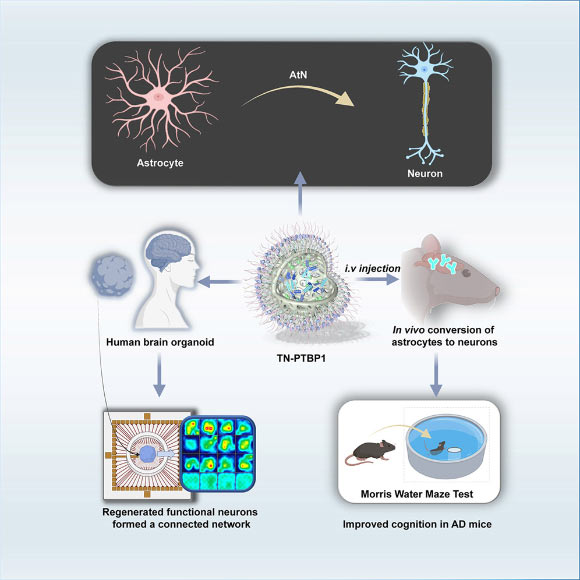
Researchers at the University of South Carolina have developed a nanoparticle-based Alzheimer’s disease treatment that reduced brain inflammation and amyloid-beta levels while improving learning and memory in mice. The experimental therapy, called Nano-ERASER, works by converting star-shaped brain cells known as astrocytes into functioning neurons.
Alzheimer’s disease remains irreversible in part because the adult brain has limited capacity to replace lost neurons. Wang et al. developed a Nano-ERASER-based system designed to promote adult neural regeneration in Alzheimer’s disease brains. Image credit: Wang et al., doi: 10.1016/j.celbio.2026.100575.
“Alzheimer’s disease is the most common cause of dementia, and no treatments currently reverse cognitive decline,” said Peishen Xu and colleagues at the University of South Carolina.
Alzheimer’s disease is associated with the accumulation of extracellular amyloid-beta plaques, neurofibrillary tangles formed from hyperphosphorylated tau, synaptic loss, inflammation, and the death of neurons.
Existing FDA-approved treatments, including cholinesterase inhibitors, memantine, and anti-amyloid monoclonal antibodies, may provide modest symptom relief or slow disease progression. However, they do not fully stop neurodegeneration or restore neural circuits that have already been lost.
Although amyloid-lowering therapies can reduce plaque burden, their benefits remain limited for many patients. Potential complications, including amyloid-related imaging abnormalities, restricted eligibility, and the need for intensive treatment, have encouraged researchers to explore regenerative approaches for Alzheimer’s disease.
In the new study, the researchers investigated a polymeric nanogel called Nano-ERASER. The system uses antibodies to target and promote the degradation of specific proteins inside cells.
The researchers designed Nano-ERASER to cross the blood-brain barrier and enter astrocytes. These star-shaped support cells are abundant throughout the central nervous system and help maintain the brain’s environment.
Once inside astrocytes, Nano-ERASER delivered antibodies targeting PTBP1, a protein involved in maintaining the cells’ identity. Reducing PTBP1 levels triggered the conversion of astrocytes into neurons.
Unlike gene-editing technologies such as CRISPR, Nano-ERASER does not directly modify DNA. The researchers also describe the cellular reprogramming process as reversible, potentially reducing concerns about permanent genetic changes.
“We hope this approach will be more effective and safer,” Professor Xu said. “You do not have to worry about potential side effects caused at the genetic level.”
First, the team tested Nano-ERASER in cultures of human astrocytes and in human brain organoids engineered to model features of Alzheimer’s disease.
In both experimental models, the treatment reduced PTBP1 levels and promoted the conversion of astrocytes into neurons. Additional testing indicated that the newly generated neurons were functional.
The researchers then treated mice with Alzheimer’s disease using the Nano-ERASER therapy. After several weeks, the animals showed improved nesting behavior and performed better in water-maze tests, suggesting improvements in learning and memory.
Brain analyses also revealed greater neuron density, lower levels of neuroinflammation, and reduced amyloid-beta accumulation—three important findings in the study of Alzheimer’s disease.
“After just two injections, these mice became smarter,” Professor Xu said. “We observed differences in the behavior of treated and untreated mice even after a single injection.”
The researchers said the findings represent an important advance in regenerative neuroscience, particularly because previous studies have debated whether blocking PTBP1 alone can produce nerve regeneration in living animals.
However, the study was conducted in laboratory models and does not demonstrate that Nano-ERASER can treat Alzheimer’s disease in humans. Further research will be required to evaluate the treatment’s safety, effectiveness, durability, and ability to cross the human blood-brain barrier.
“We plan to evaluate the long-term efficacy of this platform, test it in non-human primates, and someday begin clinical trials in humans,” Xu said.
“If we can advance this approach into the clinic, we could give hope to people living with Alzheimer’s disease.”
The team’s paper was published online in Cell Biomaterials.
_____
Wang Minmin et al. Reversing Alzheimer’s disease progression through Nano-ERASER-based adult neural regeneration. Cell Biomaterials, published online August 26, 2026. doi: 10.1016/j.celbio.2026.100575
Source: www.sci.news