


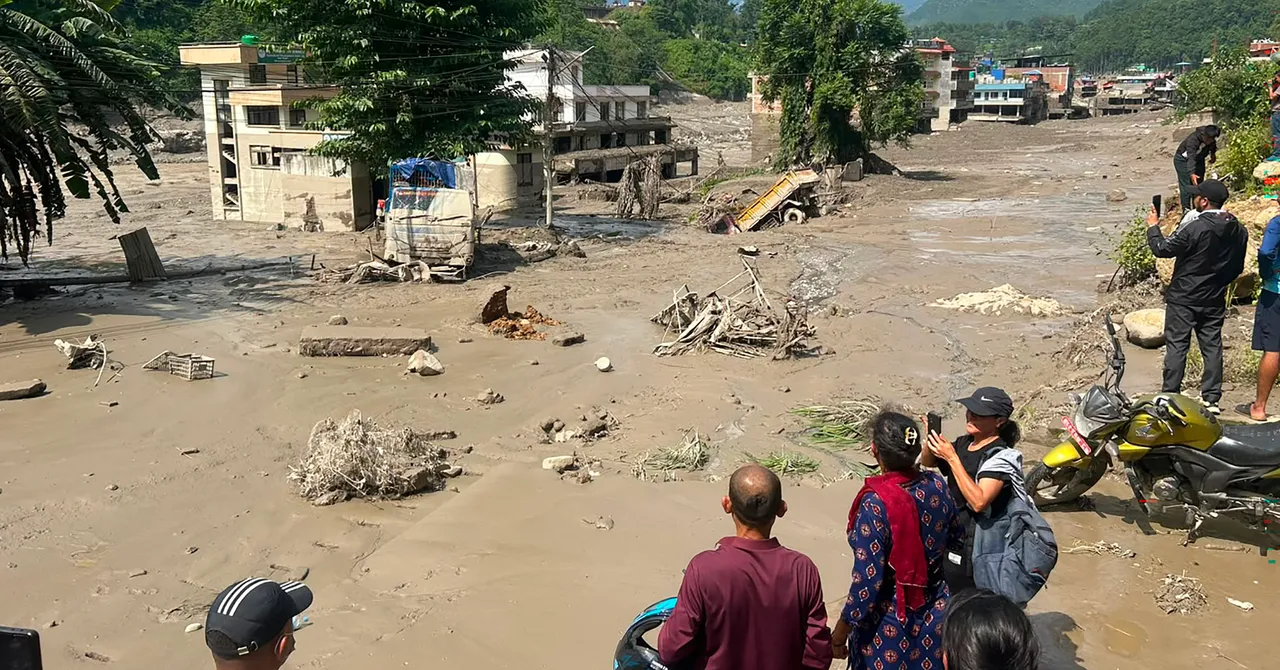
About 160 people were killed and hundreds more—including dozens of foreign tourists—remain missing after flash floods struck a mountainous region along the Nepal–Tibet border on Wednesday. Dramatic footage shared on social media showed residents fleeing a powerful wall of water that swept away buildings, vehicles and other debris.
Initial analysis of satellite imagery and reports from the Nepali government suggest the disaster may have been triggered by a landslide after a section of glacier ice collapsed from several hundred feet above the valley.
As temperatures rise across the Himalayas, glaciers are becoming increasingly unstable, raising the risk of catastrophic floods, landslides and other climate-related disasters.
“The glaciers there are definitely retreating,” said Joseph Shea, an associate professor of geography at the University of Northern British Columbia. “There’s a lot of glacier mass out there, but we’re seeing it thinning and retreating.”
The world has lost about 5 percent of its glacier ice since 2000, and the effects are expected to be even more severe in some regions. In Nepal, one glacier has lost nearly one-quarter of its area. According to research, more than 160 small glaciers in the country have disappeared entirely.
A recent study found that as much as 40 percent of the world’s glacier ice could disappear if global temperatures continue rising beyond the 1.5-degree-Celsius threshold.
Before-and-after images show debris left behind by the devastating flood.
The warming climate is creating cascading risks for communities near Nepal’s glaciers. Shea said that as glaciers retreat and become smaller, they may lose their ability to hold back sediment, increasing the risk of landslides. Retreating glaciers can also leave behind large, unstable lakes held in place by natural ice or sediment dams.
“If a sudden landslide occurs in the lake, the dam could overflow and the whole thing could collapse catastrophically,” Shea said. Two glacial lake outburst floods struck Nepal last year, affecting millions of people, according to research.
Wednesday’s flash flood may have been caused by the collapse of a glacier into the valley below. Daniel Sugar, a geologist at the University of Calgary in Canada, said satellite images reviewed by The New York Times indicated that a piece of ice roughly 2,000 feet wide may have fallen from an elevation of about 4,000 feet. The impact could have pulverized the ice and sent a powerful debris flow through the valley.
Sugar stressed that it is still too early to determine the precise cause of the flooding. However, he told Reuters that rising temperatures may have melted snow covering the glacier earlier in the week, potentially contributing to its collapse.
The glacier collapse and resulting debris flow were so large and powerful that they registered as a magnitude 5.2 seismic event, according to the U.S. Geological Survey.
Source: www.wired.com