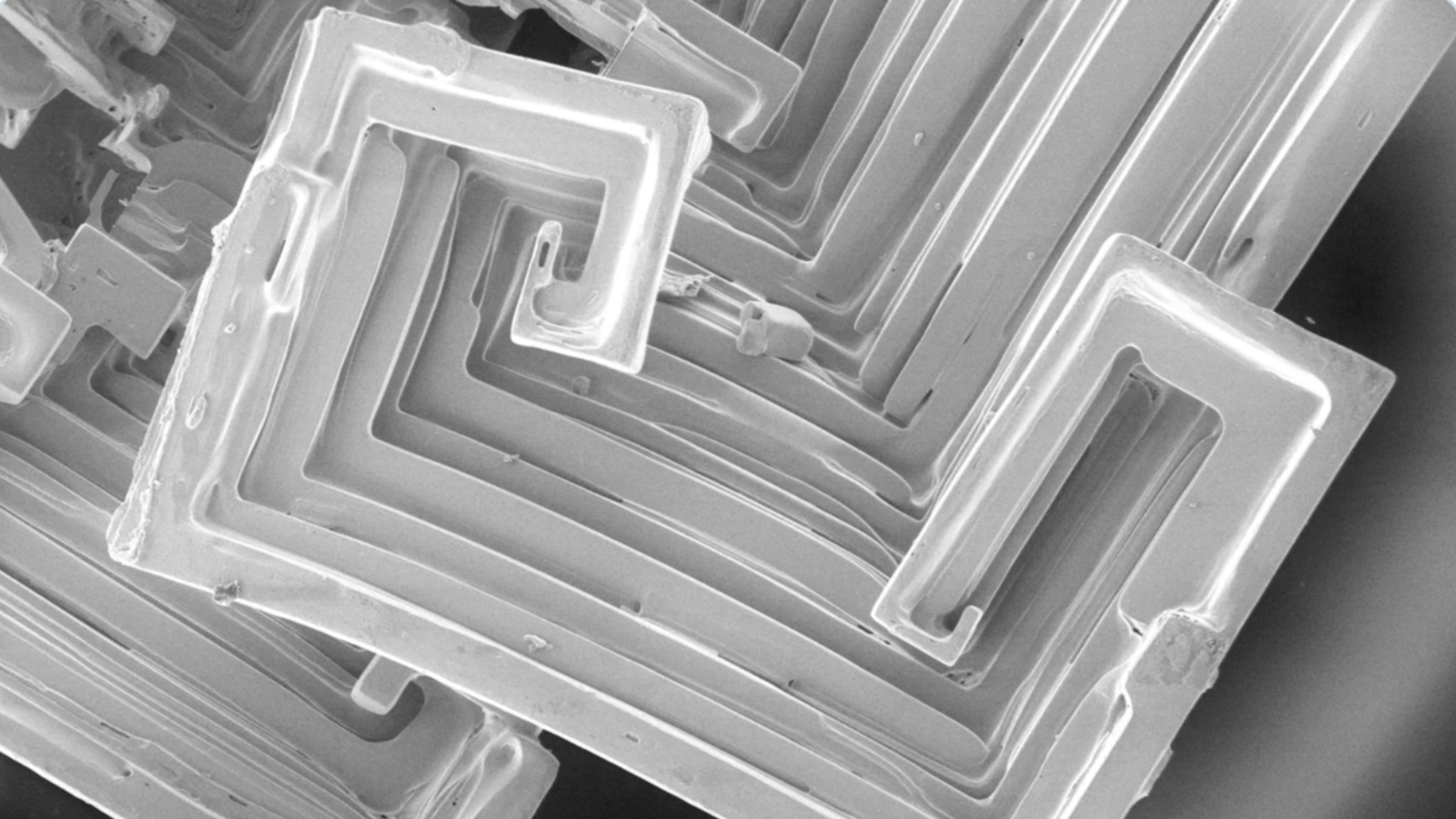
Astronauts have successfully cultivated crystals in space, but this celestial version exhibits extraordinary behavior. Under a microscope, the crystal formations resemble futuristic sculptures rather than natural structures. The pyramid-like configurations are layered in a stepped manner, creating an ethereal look. Scientists explain that such stunning shapes emerge when gravity is diminished.
In an image shared by NASA astronaut Don Pettit on July 18th, an attached video captured on the International Space Station (ISS) depicts the growth of potassium chloride crystals in a microgravity environment, characterized by near-weightlessness experienced in orbit.
Microgravity does not equate to complete weightlessness. Astronauts experience a gravitational force approximately one million times weaker than that at Earth’s surface. Ann Wilson, a chemistry and biochemistry professor at Butler University, explained to Live Science. This reduction in gravitational pull significantly impacts the human body and alters the behavior of both liquids and crystals.
“As gravity weakens, the force of molecular attraction becomes more pronounced,” Wilson noted, highlighting how factors like polarity dominate when gravity recedes.
Due to microgravity conditions, potassium chloride crystals, commonly used as a sodium alternative in foods and sports drinks, grow in a manner unattainable in terrestrial laboratories.
you may like
On Earth, crystals eventually become so heavy that they sag or sink in a container. However, in microgravity, they continue to expand outwards from their initial formation.
Wilson stated that potassium chloride typically crystallizes into cubic shapes. In microgravity, crystal growth primarily occurs at edges and corners, rather than on flat surfaces, resulting in the unique hollow pyramid-like formations visible in the image.
Get the world’s most fascinating discoveries delivered straight to your inbox.
In microgravity, crystals undergo “hopper growth,” where their outer edges grow faster than flat surfaces, resulting in a stepped appearance. This time-lapse captures growth within a thin film of water. Observe closely to see the emerging pattern! June 6, 2026
Scientists refer to this growth pattern as hopper growth, which is not exclusive to potassium chloride (ordinary table salt exhibits the same growth pattern). The emergence of a new corner during growth alters the orientation of the crystal, leading to the exquisite spiral patterns evident in the new images.
While these crystals are visually striking, the underlying scientific principles hold immense potential. Materials formed in a gravity-free environment often have fewer defects, enabling researchers to analyze what an “ideal” structure could be. This could enhance production processes for semiconductors and other advanced materials on Earth.
For Wilson, these images serve an additional goal: to spark curiosity.
“Watching videos of how things function in space is fascinating,” she remarked. “Who would have imagined that something as simple as potassium chloride could yield such amazing results?”
Astronauts aboard the ISS dedicate much of their time to scientific research that would be nearly impossible on Earth. Recently, they utilized the space station’s advanced Cold Atom Laboratory to create and analyze the elusive fifth state of matter, known as a Bose-Einstein condensate. Additionally, last year researchers exposed moss spores to the vacuum of space for nine months outside the ISS, and discovered they continued to grow upon their return to Earth.