


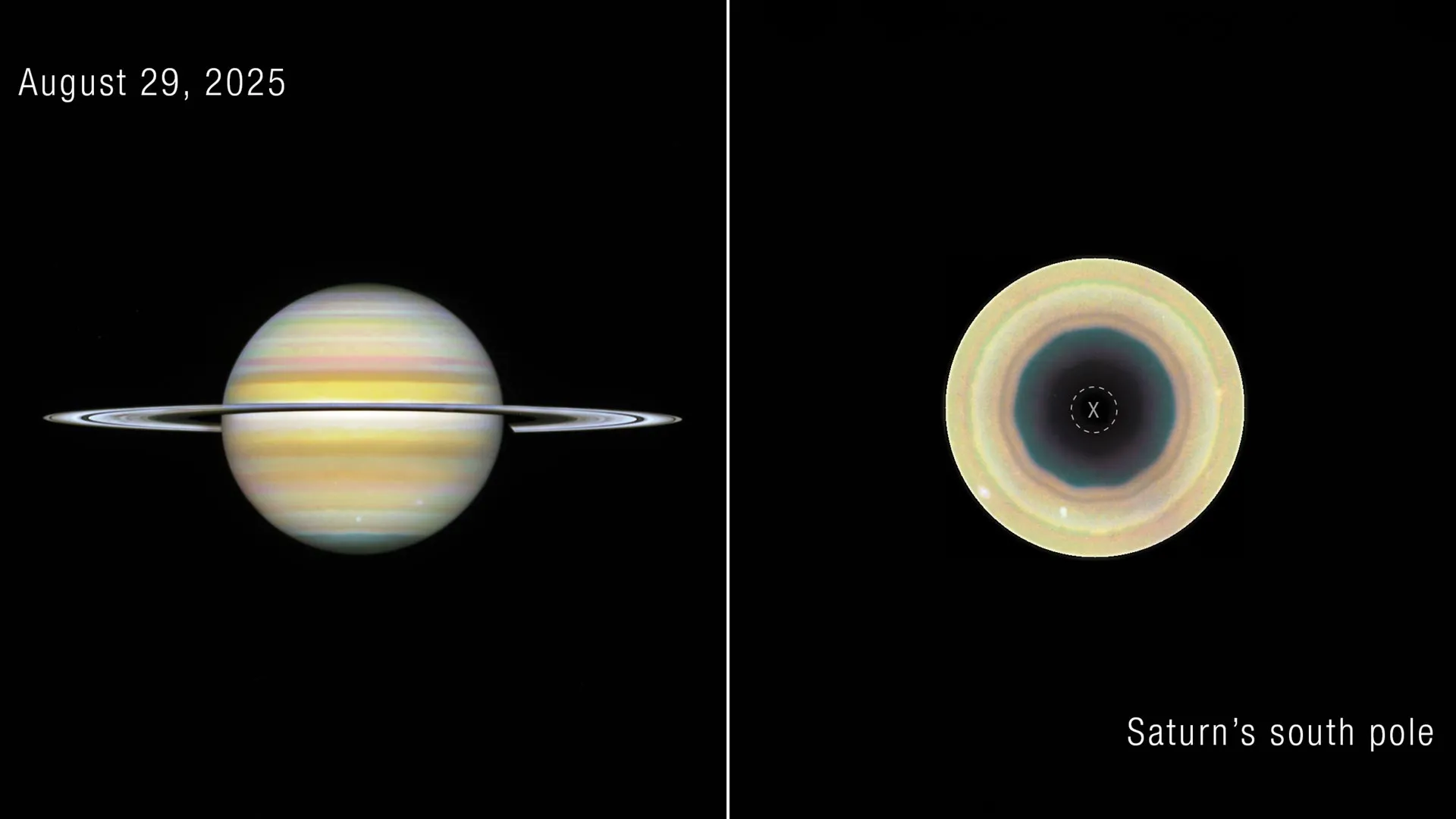
NASA’s Hubble Space Telescope has revealed a mysterious new atmospheric feature on Saturn: a giant, evolving, ten-sided wave circling the planet’s south pole. The newly observed structure, known as a decagon, could offer important clues about Saturn’s powerful jet streams and changing atmosphere.
Scientists have observed a large, regularly shaped jet pattern in Saturn’s southern hemisphere for the first time. Although the feature shares some similarities with Saturn’s famous north polar hexagon, key differences suggest that the southern decagon is a separate atmospheric phenomenon that may have formed recently.
The findings were published in the journal Science Advances.
A new atmospheric pattern emerges on Saturn
Researchers analyzed several years of Hubble observations, including data collected since 2023, to reconstruct how the feature developed. Early images showed only faint signs of a pattern before it evolved into the more clearly defined shape observed in recent images.
The observations come from Hubble’s Outer Planet Atmospheres Legacy (OPAL) program, which has monitored the atmospheres of the solar system’s giant planets for more than a decade. By collecting images each year, OPAL helps scientists track seasonal changes, storms, and evolving atmospheric structures.
“We’ve never seen anything like this in Saturn’s southern hemisphere,” said study co-author Amy Simon, OPAL principal investigator at NASA’s Goddard Space Flight Center in Greenbelt, Maryland. “The northern hexagon has been there every time we’ve looked for more than 40 years. This feature is different. It appears to be intensifying, giving us a rare opportunity to observe the development of large atmospheric patterns.”
Saturn’s changing seasons played an important role in the discovery. As the planet progressed through its seasonal cycle, its south pole gradually became visible from Earth again. Astronomers examining images from ground-based observatories were among the first to identify the unusual atmospheric structure.
Amateur astronomers help identify Saturn’s southern decagon
The study’s lead author, Agustín Sánchez-Lavega, is a researcher at the University of the Basque Country in Spain. The university operates the Planetary Virtual Observatory Laboratory, an online platform that collects images of planets in the solar system submitted by observers around the world.
In a 2024 image, Sánchez-Lavega and amateur astronomers Trevor Barry and Jean-Paul Auger noticed a faint, wavy band near Saturn’s south pole. Additional ground-based observations collected in 2025 provided stronger evidence that the feature was developing into a decagonal pattern.
To study the structure in greater detail, the researchers turned to Hubble. Because the space telescope observes Saturn above Earth’s atmosphere, it can capture sharper images throughout the planet’s complete rotation without the blurring caused by atmospheric turbulence.
“Given the symmetry of Saturn’s north-south jet stream system, we have been looking since 1990 for an equivalent of Saturn’s north hexagon at the south pole in Hubble images,” Sánchez-Lavega said. “Images from NASA’s Cassini spacecraft, which orbited Saturn from 2004 to 2017, did not show the slightest hint of the presence of long-lived atmospheric formations. Hubble data confirms the existence of this feature as far back as 2023.”
A structure reaching deep into Saturn’s atmosphere
The newly identified waves are embedded within one of Saturn’s powerful jet streams. Observations indicate that the pattern extends through multiple atmospheric layers, suggesting that it is more than a feature visible only at the tops of the clouds. Instead, the decagon appears to be a vertically connected atmospheric structure.
The feature’s apparent position changes slightly depending on the wavelength used by Hubble. Different wavelengths reveal different altitudes in Saturn’s atmosphere, allowing astronomers to study the decagon at various depths and observe small shifts in its location.
“The most interesting thing to me is that this seems to have only recently formed,” Simon said. “The question is, we’ve never seen it before, so why is it suddenly forming now?”
Scientists do not yet know what created Saturn’s southern decagon or whether the structure will remain stable. Additional observations from the Hubble Space Telescope and NASA’s James Webb Space Telescope, combined with advanced computer modeling, will be needed to determine how the feature formed, how long it may last, and how closely it resembles Saturn’s long-lived northern hexagon.
Decades of Hubble observations reveal Saturn’s atmospheric changes
Hubble’s long operational history has given astronomers an exceptional opportunity to monitor changes on Saturn and other planets over many years.
The OPAL program is especially valuable because it provides more than isolated snapshots. Regular observations allow scientists to follow seasonal cycles, track powerful storms, and identify atmospheric patterns that develop gradually over time.
“When we started the OPAL program, we were expecting some fascinating surprises, but we didn’t know exactly what to expect,” said study co-author Mike Wong from the University of California, Berkeley. “Many of the discoveries from OPAL are based on years of data, rather than just a single observation. Regular observations over long periods of time enable many new discoveries.”
Researchers will continue monitoring Saturn to determine whether the southern decagon becomes a stable, long-lasting feature like the planet’s northern hexagon or continues to change and eventually disappear.
Future observations could reveal what powers the waves and what the structure can teach scientists about the atmospheres of gas giants across the solar system. Studying Saturn’s atmospheric dynamics may also improve scientists’ understanding of large-scale weather patterns on Earth and other worlds.
Source: www.sciencedaily.com