


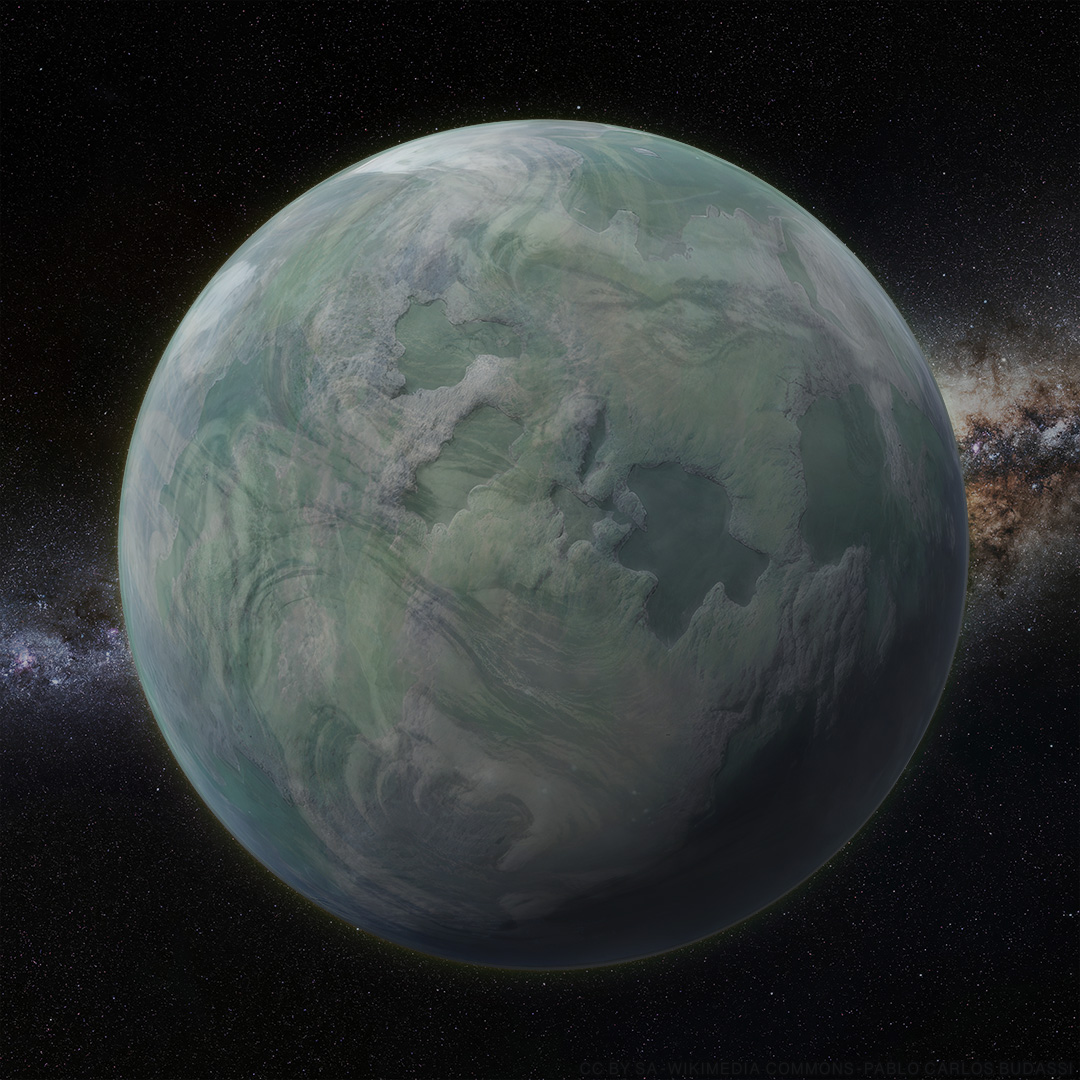
Could Complexity Reveal Extraterrestrial Life on Distant Exoplanets?
Astronomers and astrobiologists use spacecraft, satellites, rovers, radio telescopes, and observatories such as the James Webb Space Telescope (JWST) to search for extraterrestrial life. These tools photograph planets and moons, collect geological and chemical data, scan the sky for signals from intelligent civilizations, and analyze the atmospheres of distant exoplanets that may resemble Earth.
However, many current methods rely on assumptions about what alien life should look like. Researchers may search for atmospheric molecules similar to those on Earth, chemicals produced by familiar metabolic processes, or technology comparable to human technology. These assumptions provide useful starting points, but they could also cause scientists to overlook life that operates in fundamentally different ways—or mistake a nonbiological geological, chemical, or astronomical process for a sign of life.
What Is an Agnostic Biosignature?
To complement techniques based on Earth-like life, scientists are exploring methods that make as few assumptions as possible about extraterrestrial biology. These potential indicators are known as agnostic biosignatures.
One possible agnostic biosignature is complexity. Although complexity can be difficult to measure precisely, living systems generally create more complex patterns and structures than nonliving systems. A team of researchers recently tested whether they could distinguish between living and inanimate worlds by analyzing the complexity of patterns in reflected light from planetary surfaces.
Earth and Mars as Test Worlds
The researchers used Earth and Mars as stand-ins for exoplanets around other stars: two broadly similar planets, with life on one and no known life on the other. They collected reflected-light data from Earth using the Deep Space Climate Observatory (DSCOVR), an Earth-monitoring space station, and from Mars using the Hope probe, which observes the Martian atmosphere.
The research team identified three nearly identical wavelengths observed by the instruments studying each planet. They then used database measurements of the amount of light reflected by Earth and Mars—known as reflectance—over 486 local days.
Rather than using complete images or searching for specific chemicals, the researchers focused on individual wavelengths of light. If this approach proves successful, it could eventually be applied to distant exoplanets that cannot be photographed in detail.
Earth’s Reflected Light Was More Complex
The team compared the measured reflectances using statistical tests designed to identify fluctuations and randomness in the reflected light. The researchers interpreted these variations as indicators of the complexity and dynamism of each planet’s surface.
Of the 27 complexity metrics tested, Earth scored higher than Mars on 25. Mars scored higher than Earth on one metric, while the planets scored the same on another. Both worlds have atmospheres, weather, rocky surfaces, and periodic changes, but the planet with life produced a clearly more complex and dynamic signal.
The results suggest that differences associated with planetary complexity may be detectable even in small streams of reflected light traveling across great distances. That could give scientists another way to study potentially habitable worlds that are too far away for detailed imaging.
Why Complexity Is Not Proof of Life
The researchers concluded that complexity could be a useful agnostic biosignature, but they also identified important limitations. Earth differs substantially from Mars because it has oceans and a relatively thick atmosphere. Cloud formation, cloud dispersal, and sharp contrasts between land and water can make Earth’s reflected-light signal more complex, even when those patterns are not directly caused by living organisms.
The team proposed two possible explanations for the relationship between life and complexity on Earth. Life may help produce features such as the planet’s water cycle, or Earth may be inherently complex regardless of life. The current test cannot determine which explanation is correct because researchers would need to repeat it using a lifeless copy of Earth.
Nevertheless, the team argued that it is unlikely that Earth’s biosphere is completely unrelated to the water cycle, as described in the Gaia hypothesis.
Testing the Method on More Worlds
To evaluate the method further, the research team plans to expand its sample of worlds to include Venus, Saturn’s moon Titan, and simulated exoplanets with modeled biochemistries and atmospheres.
If the approach continues to produce meaningful results, it could open a new category of missions in the search for extraterrestrial life. Instead of looking only for specific chemicals or intelligent signals, future observations could track changes in reflected light over long periods. Those variations may reveal complex properties of distant worlds that other biosignature methods miss.
Post views: 81
Source: sciworthy.com