


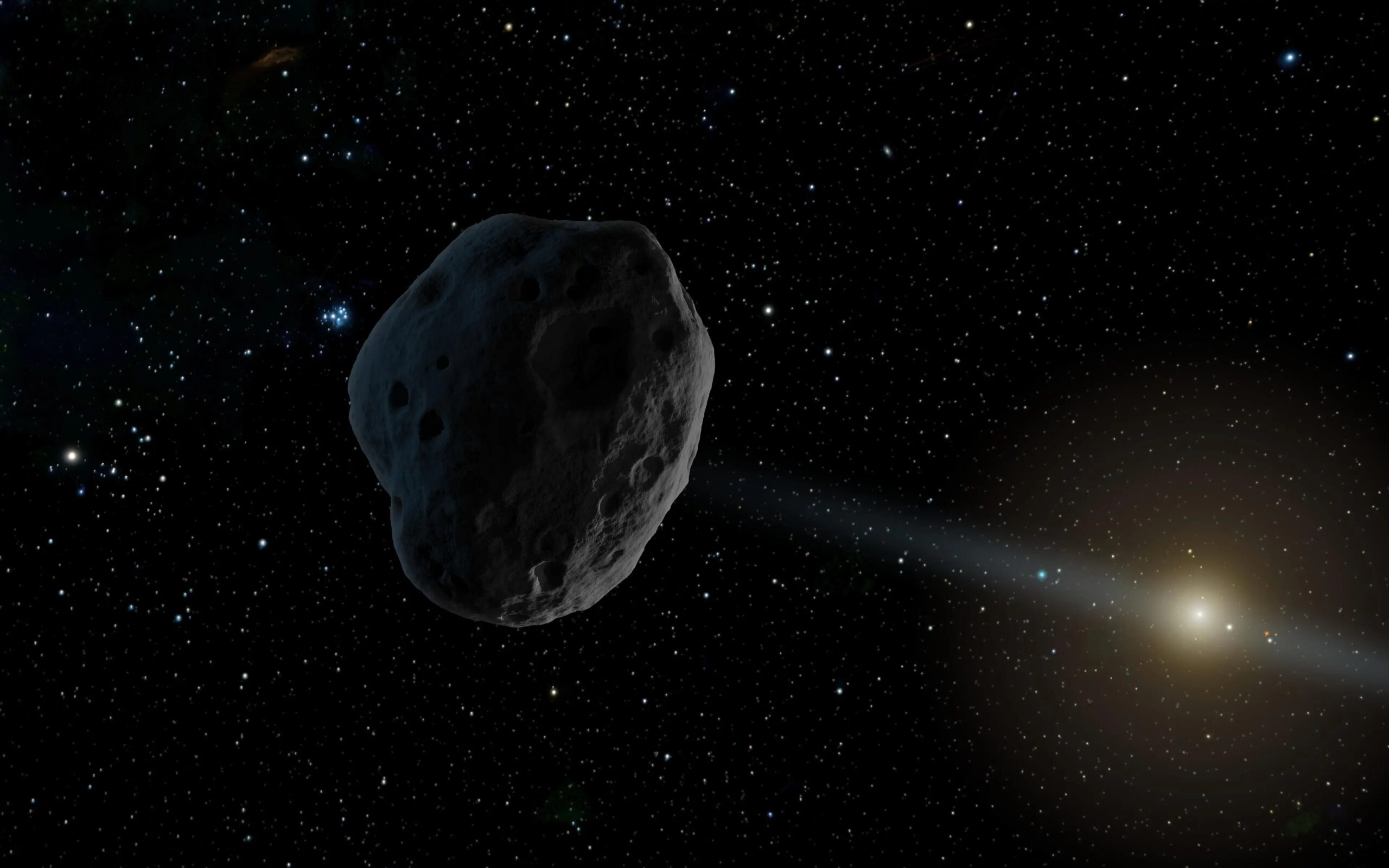
A groundbreaking study led by scientists at NASA’s Jet Propulsion Laboratory in Southern California has successfully identified a mysterious near-Earth object, utilizing advanced observatories adept at tracking its movement and imaging faint celestial bodies.
This enigmatic celestial body displays characteristics of both an asteroid and a comet. Previous observations suggested no comet-like activity, implying it was an asteroid; however, recent findings indicate irregular movement akin to that of a comet. The detailed research results have been published in *Nature Astronomy*.
The intrigue began on August 28, 2025, when the object, temporarily named Asteroid 1998 SH2, passed within 2 million miles (3 million kilometers) of Earth during its 4.5-year solar orbit. Researchers analyzing 1998 SH2 with NASA’s Deep Space Network (DSN) planetary radar system used past orbit data to calculate its trajectory, incorporating gravitational influences from the sun and planets. However, when 1998 SH2 did not appear as predicted, it indicated an anomaly affecting its motion.
Through precise optical measurements, researchers pinpointed the cause of this unexpected movement.
“After assessing the non-gravitational perturbations impacting 1998 SH2’s trajectory, we suspected it might be an active comet,” remarked Davide Farnocchia, a navigation engineer and lead investigator at NASA’s Near Earth Object Research Center at JPL.
Although 1998 SH2’s orbit around the Sun was meticulously tracked from 1998 to 2016, it completed two solar orbits without any observational data until the 2025 DSN assessment. By analyzing observations since its discovery in 1998, researchers uncovered perturbations in 1998 SH2’s motion, leading to the hypothesis that the object may be generating small thrust via gas ejection, resulting in deviations from its anticipated path.
This gas release occurs as sunlight warms ice mixed with rock, converting it into gas. In typical comets, this process results in the bright tail and coma surrounding the comet’s nucleus. However, if this object emits smaller quantities of gas or dust, it may elude detection by most observatories.
The approach of 1998 SH2 to Earth in August 2025 offered a unique opportunity to gather vital observational evidence of potential comet activity. Researchers collaborated with astronomers from the Canada-France-Hawaii Telescope, a 3.6-meter (12-foot) optical/infrared telescope atop Mauna Kea in Hawaii, and the Danish Telescope at the European Southern Observatory, a 1.5-meter (5-foot) telescope in La Silla, Chile, for observations. Additionally, astronomers at the 8.2-meter (27-foot) Very Large Telescope at the European Southern Observatory in Chile also tracked the object.
“The observations from these esteemed observatories revealed a faint yet distinct tail, affirming that 1998 SH2 is, in fact, a comet,” said Olivier Hainaut, an astronomer at the European Southern Observatory and co-author of the study. “Science continually evolves: we create hypotheses and rigorously test them. This data was crucial in validating our hypothesis that 1998 SH2 is a comet.”
Consequently, Comet 1998 SH2 received the additional provisional designation P/1998 SH2.
The study also identified another rare type of object known as a dark comet. Like 1998 SH2, the dark comet shows significant irregularities in its orbit without any visible signs of cometary activity. No comas, tails, or gas emissions are present. These enigmatic objects belong to two distinct populations, with one group sharing orbits typical of Jupiter-based comets (short-period comets), some exhibiting highly elliptical orbits, while others are smaller and orbit closely to the Sun. Since the first dark comet was identified in 2016, around a dozen more have been found.
The authors propose that many large dark comets with orbits similar to that of 1998 SH2 might eventually be classified as traditional comets, pending high-powered telescope observations that can detect faint celestial objects. Furthermore, by employing precise astronomical data to analyze the motion of nearby Earth objects, researchers may discover more comets previously misclassified as asteroids due to comet-like non-gravitational movements.
“This study underscores the critical nature of ongoing tracking of near-Earth objects,” Farnocchia emphasized. “Because gas release causes greater perturbation in comet motion compared to asteroids, detecting these deviations could be pivotal for planetary defense, enhancing our understanding of which objects are likely to be comets versus asteroids, how their orbits evolve, and the potential impact risks to Earth.”
NASA’s upcoming Near Earth Object (NEO) Surveyor mission will further enhance this initiative by collecting invaluable data. This first space telescope designed explicitly for planetary defense aims to explore some of the most elusive objects near Earth, including dark asteroids and comets emitting minimal visible light.
NASA’s Near Earth Object Research Center, Goldstone Solar System Radar Group, and NEO Surveyor operate under the auspices of JPL, supported by the agency’s Planetary Defense Coordination Office in Washington. JPL is managed by the California Institute of Technology in Pasadena, with program oversight from the SCaN (Space Communications and Navigation) Program Office at NASA Headquarters.
For more information about planetary radar, NASA’s Near-Earth Object Research Center, and near-Earth objects, please visit:
Media Contacts
Ian J. O’Neill
Jet Propulsion Laboratory, Pasadena, California
818-354-2649
[email protected]
Karen Fox / Molly Wasser
NASA Headquarters, Washington
202-358-1600
[email protected] / [email protected]
2026-046
Source: www.nasa.gov