


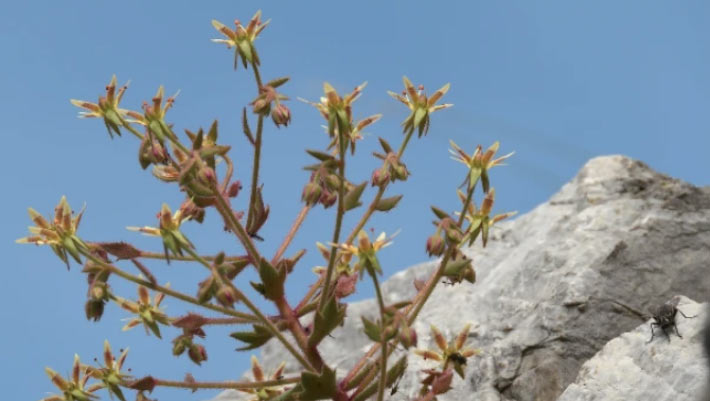
Scientists have confirmed that a sticky-leaved Saxifraga plant is carnivorous, solving a mystery first proposed by Charles Darwin more than 150 years ago. Researchers from the Kunming Institute of Botany found that Saxifraga candelabrum, a mountain plant native to southwestern China, attracts, captures, digests and absorbs nutrients from insects.
Morphology of the carnivorous plant Saxifraga candelabrum. Image credit: Zhang et al., doi: 10.1038/s41467-026-75288-y.
Carnivorous plants gain essential nutrients, particularly nitrogen, by attracting, trapping and digesting small animals. This adaptation has evolved independently several times in flowering plants and is currently known in members of 14 plant families.
Scientists have long studied how carnivory evolves in plants living under challenging environmental and nutritional conditions.
Plant carnivory is commonly classified according to the type of trap used. Major examples include pitfall traps in pitcher plants, snap traps in Venus flytraps, sticky flypaper traps in sundews, suction traps in bladderworts, and eel or lobster traps in corkscrew plants.
In his 1875 book Insectivorous Plants, Charles Darwin suggested that two European species in the genus Saxifraga might capture and benefit from insects because of their sticky, hair-covered leaves.
However, Darwin’s feeding experiments were inconclusive, and the possibility that Saxifraga plants were carnivorous remained unresolved for more than a century.
“Inspired by his work on carnivory in Drosera, Darwin proposed that two Saxifraga species — Saxifraga rotundifolia and Saxifraga umbrosa — might similarly exhibit carnivorous behavior,” Dr. Deng and his colleagues said.
“Darwin regarded these two species as representing one of the most intriguing cases among plants with glandular hairs.”
“Although Darwin attempted to test this hypothesis through feeding experiments, these early attempts did not yield conclusive results.”
“The lack of conclusive evidence has prevented researchers from classifying these Saxifraga species as true carnivorous plants.”
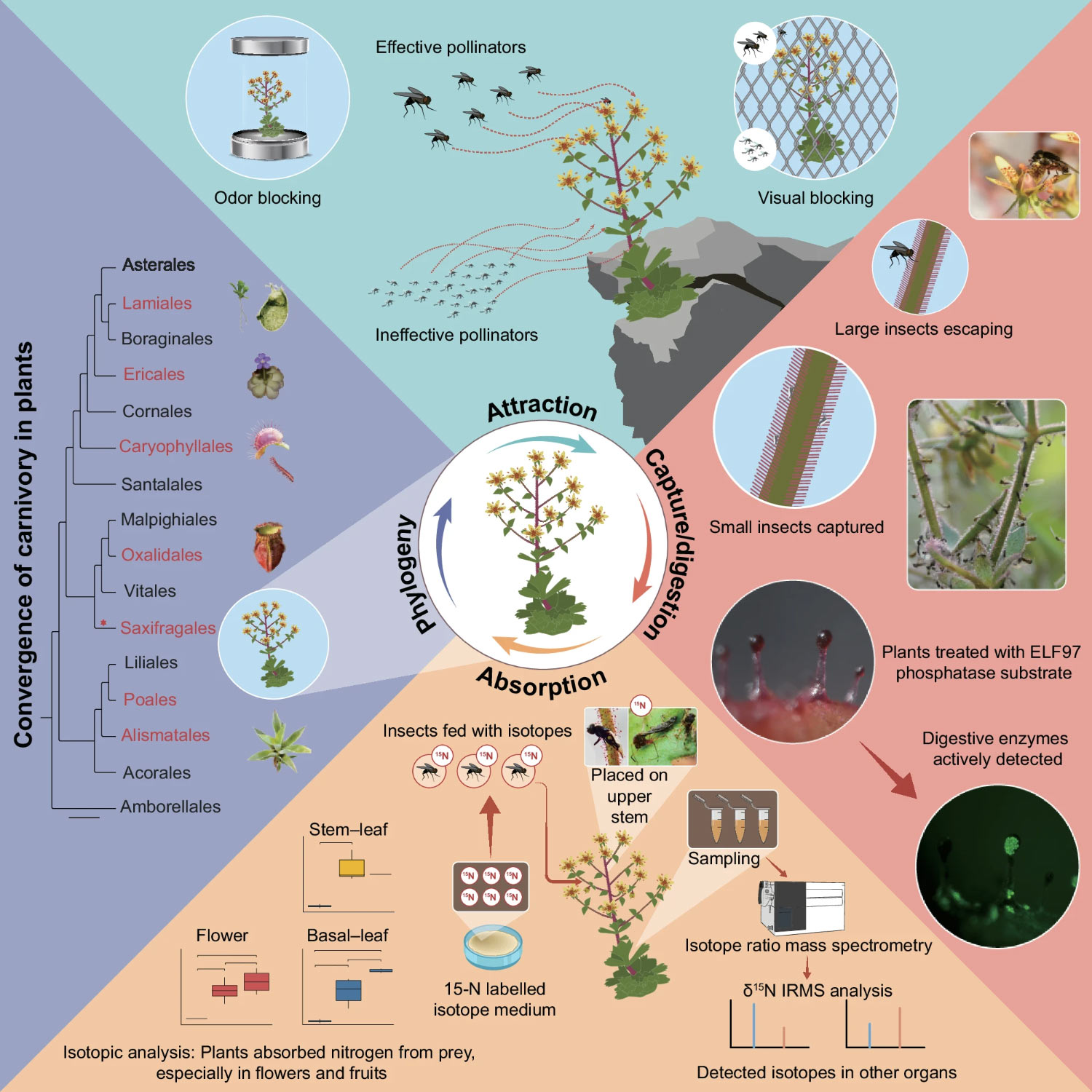
Multiple lines of evidence confirm carnivory in Saxifraga candelabrum. Image credit: Zhang et al., doi: 10.1038/s41467-026-75288-y.
For their study, the researchers examined Saxifraga candelabrum, a small perennial herb that grows on nutrient-poor cliffs across the Qinghai-Tibet Plateau and the Hengduan Mountains of southwestern China.
Field surveys and an analysis of 45 herbarium specimens collected from 1888 to 2016 revealed trapped insects on the plant’s glandular hairs in most samples. The results suggest that insect capture is a long-standing and widespread feature of the species rather than an accidental occurrence.
Additional experiments indicated that Saxifraga candelabrum attracts insects partly through scent. Plants enclosed in odor-blocking glass attracted fewer insects, while chemical analysis identified floral volatile compounds known to attract insects in other plant species.
Researchers also detected phosphatase, a digestive enzyme commonly associated with carnivorous plants, on the plant’s glandular hairs using a fluorescent marker. A related Saxifraga species that does not trap insects showed no comparable enzyme activity.
In the strongest test of carnivory, the scientists fed fruit flies a diet enriched with the nitrogen-15 isotope (15N) before placing the labeled insects on the plants.
Later analysis detected nitrogen from the insects inside the tissues of Saxifraga candelabrum, particularly in its flowers. Two nearby non-carnivorous control plants showed no comparable uptake.
This result demonstrates that the plant absorbs nutrients directly from captured prey rather than simply benefiting from insects decomposing in the surrounding soil.
The plant also appears to reduce the risk of harming its pollinators. It mainly trapped small, non-pollinating insects while largely avoiding the larger flies that visit its flowers and help with pollination.
The scientists further sequenced the genome of Saxifraga candelabrum and compared it with the genomes of other carnivorous plants that evolved trapping mechanisms independently, including sundews and the South African shrub Roridula.
The comparison revealed similar patterns of gene expansion and accelerated evolution in genes associated with prey attraction, digestion and nutrient absorption. These genetic similarities provide additional support for the plant’s carnivorous lifestyle.
“Our findings provide definitive evidence of carnivory in Saxifraga, addressing Charles Darwin’s long-standing hypothesis that some Saxifraga species may be capable of carnivory, and further suggest that carnivory may be more widespread among angiosperms than previously recognized,” the authors concluded.
The study was published in the journal Nature Communications.
_____
XJ. Zhang et al. 2026. Identification of carnivory in the flowering plant Saxifraga via multidisciplinary evidence. Nat Commun 17, 7557; doi: 10.1038/s41467-026-75288-y
Source: www.sci.news