


Magnetar Observations Offer First Direct Evidence of Vacuum Birefringence
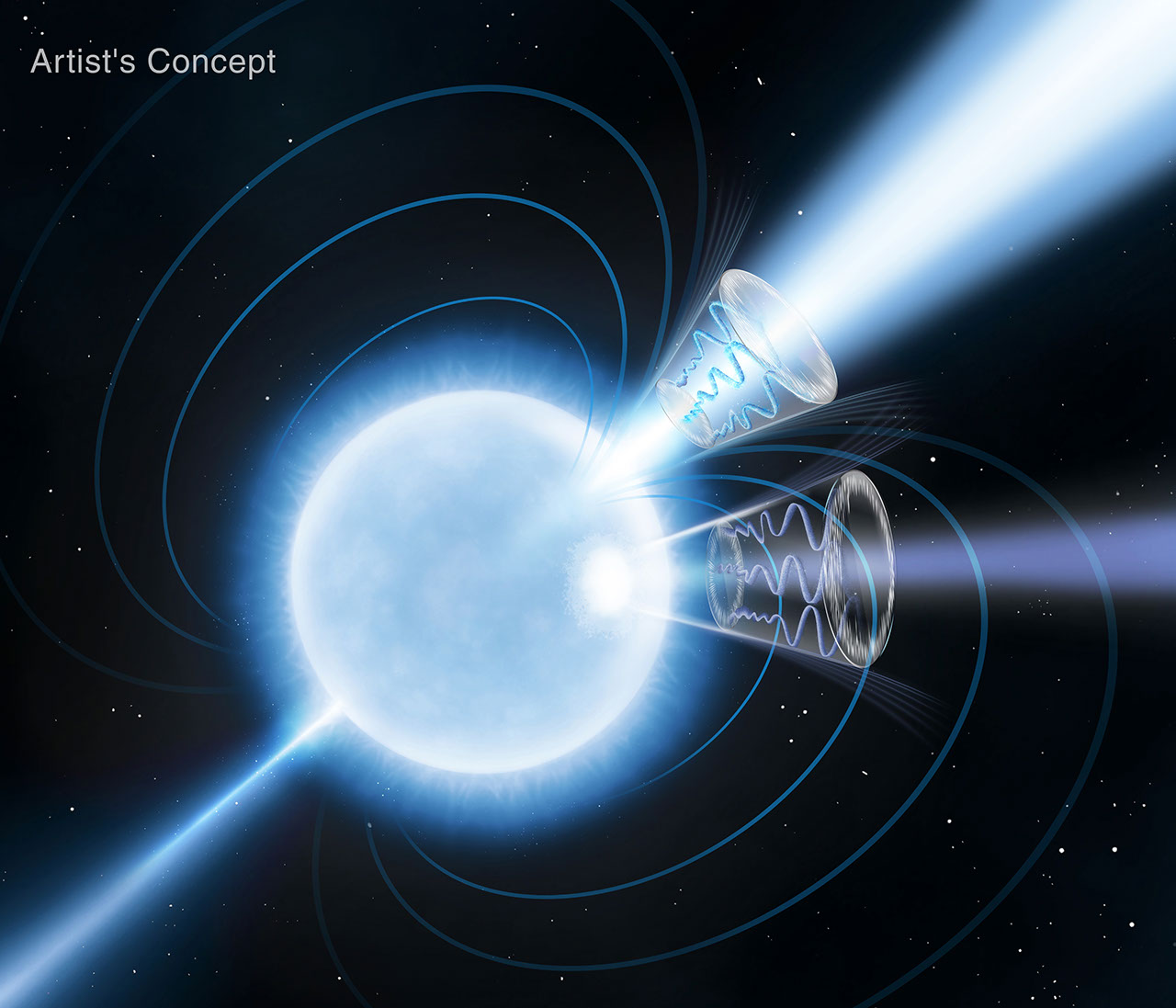
A groundbreaking observation of the magnetar 1E 1547-5408 may provide the first direct evidence that empty space can behave as physicists predicted nearly 90 years ago. The findings, published Wednesday in Nature, support the theory of vacuum birefringence—a quantum effect caused by extremely powerful magnetic fields.
- Magnetars are a rare type of neutron star with the strongest magnetic fields known in the universe—up to a trillion times more powerful than the strongest permanent magnets made on Earth. These extreme objects provide scientists with unique laboratories for studying physics under conditions impossible to recreate on our planet.
- Neutron stars are the compact remnants of massive stars that have exploded at the end of their life cycles. They can contain more mass than the Sun while measuring only about the size of a city, making them ideal environments for investigating extreme matter, gravity, and magnetic fields.
Using NASA’s IXPE (Imaging X-ray Polarimetry Explorer), researchers conducted more than 140 hours of observations of the magnetar 1E 1547-5408 between March and April 2025. The campaign also included NASA’s NICER (Neutron Star Interior Composition Explorer) and Murriyang, CSIRO’s Parkes radio telescope, operated by Australia’s national science agency.
The coordinated campaign marked the first simultaneous radio and X-ray polarization measurement of a magnetar. It focused on 1E 1547-5408, a distinctive magnetar that completes one rotation approximately every two seconds and continuously emits both bright radio waves and X-rays. Scientists are still working to determine why this object produces such persistent emissions.
The observations revealed that the X-ray polarization—the degree to which incoming photons are aligned—was nearly three times stronger than measurements from comparable sources. This result surprised researchers because models of the magnetar’s magnetic-field geometry predicted that the polarization should approach zero at certain points.
Standard models describing radiation from the magnetar’s surface also failed to explain the unusually high polarization. The findings therefore suggest that an additional physical process is amplifying the signal.
One possible explanation is vacuum birefringence, a prediction of quantum electrodynamics first proposed in 1936. The theory states that an extremely powerful magnetic field can change the properties of the vacuum of space. Under these conditions, empty space can act like a lens or prism, filtering light according to its direction of travel and increasing its polarization.
NASA’s IXPE was essential to the investigation because it is specifically designed to measure the polarization of X-rays from powerful cosmic sources. By combining IXPE’s data with radio observations, scientists were able to test how light behaves in the intense environment surrounding the magnetar.
Computer simulations conducted by the research team support the possibility that vacuum birefringence produced the unusual polarization signal. Hoa Dinh Thi, a postdoctoral associate at Rice University in Houston and co-lead author of the study, said:
“Our model suggests that reproducing the observed X-ray polarization signatures, while also satisfying the constraints set by radio observations, requires the presence of vacuum birefringence in the neutron star’s environment. This finding exemplifies how neutron stars enable us to test fundamental physics in environments not replicable in labs on Earth.”
The magnetar’s exceptionally high polarization provides strong support for the theoretical prediction and could represent the first direct observation of vacuum birefringence anywhere in the universe. However, additional observations will be needed to confirm the result.
“This result truly highlights the interdisciplinary power of the field of astrophysics,” said Rachael Stewart, a Ph.D. candidate at George Washington University and lead author of the Nature paper. “The information we obtained from looking at this distant star core also gives us clues about the nature of the fabric of reality as we know it, and I find that to be incredible.”
Future IXPE observations of 1E 1547-5408 and other magnetars could confirm the signal and reveal additional effects predicted by quantum electrodynamics. These studies may offer new insights into how strong magnetic fields influence light, space, and the fundamental structure of the universe.
More About NASA’s IXPE Mission
The IXPE mission continues to deliver detailed polarization measurements that are enabling new discoveries about neutron stars, black holes, supernova remnants, and other energetic objects across the universe. IXPE is a joint mission operated by NASA and the Italian Space Agency, with partners and scientific collaborators in 12 countries.
The mission is led by NASA’s Marshall Space Flight Center in Huntsville, Alabama. BAE Systems, Inc., headquartered in Falls Church, Virginia, manages spacecraft operations in partnership with the University of Colorado’s Laboratory for Atmospheric and Space Physics in Boulder.
Learn more about NASA’s IXPE mission at NASA.gov/IXPE.
Source: science.nasa.gov