


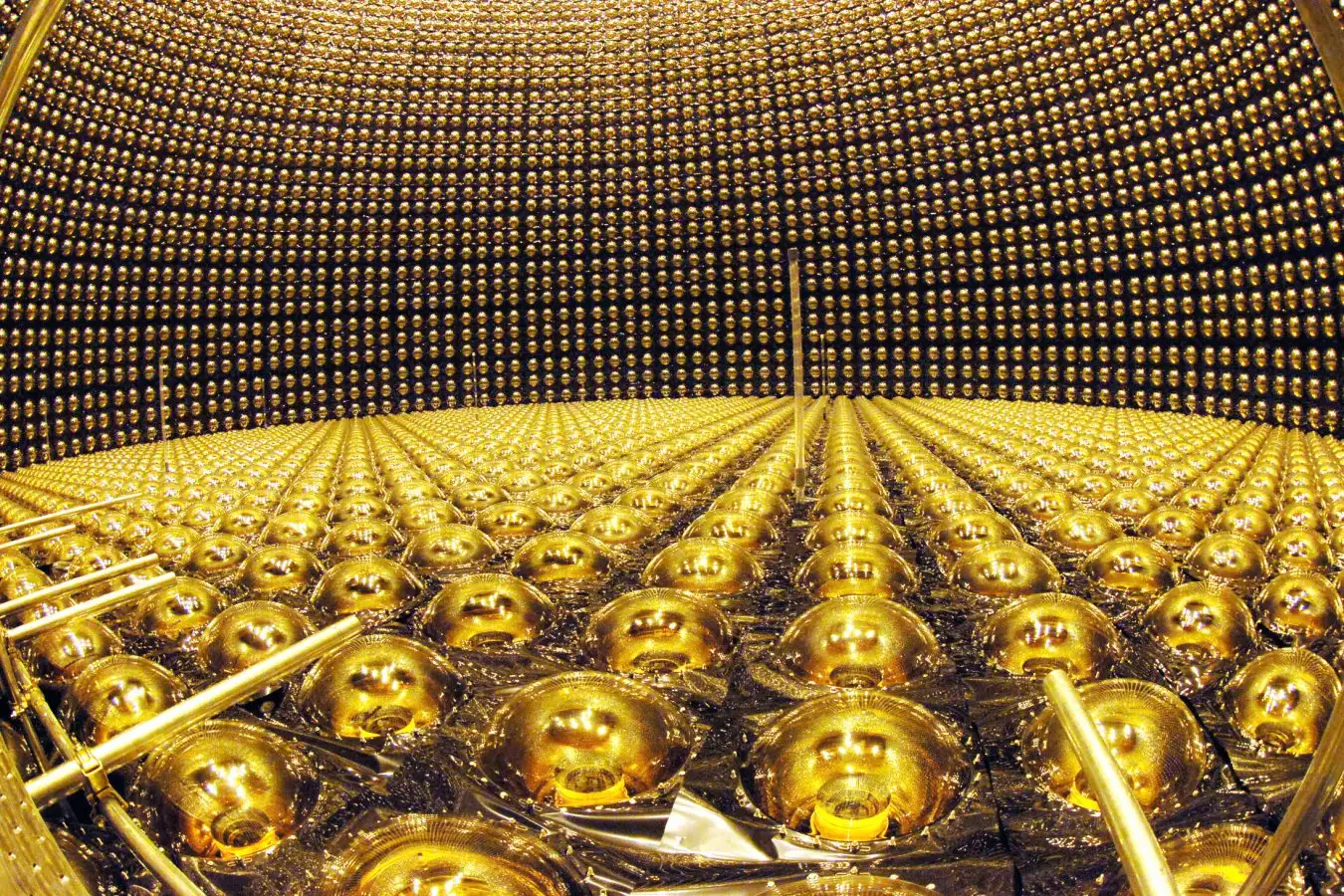

Japan’s Neutrino Detection Facility “Super-Kamiokande”
Asahi Shimbun via Getty Images
The standard model of particle physics may require significant philosophical re-evaluation, especially regarding the criteria for categorizing particles.
Particles are crucial, whether in matter formation or force transmission. Similar to the periodic table of elements, the Standard Model outlines the fundamental components of our universe. However, George Hobart, a professor at the University of Bristol, suggests this framework may need reevaluation for a more accurate physical representation.
Central to his argument are neutrinos—subatomic particles that are notoriously challenging to detect due to their weak interactions with matter. Their masses remain uncertain, and the Standard Model’s Higgs mechanism fails to explain these values, unlike other particles.
Moreover, the Standard Model identifies three distinct neutrinos: electron neutrinos, muon neutrinos, and tau neutrinos, each paired with a heavier particle. An electron can’t turn into a muon spontaneously, yet an electron neutrino can shift into a muon neutrino without any issue.
Hobart visualizes the Standard Model as a table: neutrinos occupy one row while their heavier counterparts occupy another. “There is no evidence suggesting these heavier particles can interact horizontally. Yet, neutrinos can,” he states.
This raises a philosophical query regarding particle classification. While numerous experiments confirm neutrinos’ existence and the properties of other particles, the interpretations of this data offer diverse ontological frameworks.
Currently, the Standard Model’s structure relies on individual particle properties like mass and “flavor,” the latter distinguishing the neutrinos. Neutrinos complicate this classification due to their ability to switch flavors and a lack of clarity about their mass acquisition. Hobart advocates for a revised Standard Model that emphasizes “families” or complete columns instead of individual particles, suggesting that the three neutrinos are quantum manifestations of a more fundamental entity.
Such a shift could alter researchers’ perspectives on neutrino exchanges by highlighting their shared characteristics. “This doesn’t change physics. Instead, it prompts us to interpret an existing theory in a more philosophical manner, potentially opening avenues for novel discoveries,” Hobart adds. He recently presented these insights at the Basics of Physics conference on June 17th in Irvine, California.
Noel Swanson, a researcher at the University of Delaware, notes that particle categorization within the Standard Model relies on theoretical ideals debated by philosophers. He sees Hobart’s proposals as stimulating and is skeptical that mass and flavor represent the most fundamental properties.
“At a deeper level, there may be something field-like, with particles as different excitations of that entity. While classifying these excitations is valid in the Standard Model, conceptualizing them as fundamental ‘junctions’ in nature may be misleading,” Swanson observes.
The philosophical discourse around particle definitions continues alongside neutrino research. Swanson suggests this intersection of philosophy and physics could be beneficial for shaping future research directions. “Our interpretation of these unique particles may influence the paths of future studies,” Hobart concludes.

CERN: Pioneering Particle Physics Research
Discover the wonders of CERN, Europe’s hub for particle physics, strategically situated near the picturesque city of Geneva. Home to the renowned Large Hadron Collider, CERN is at the forefront of groundbreaking research.
Topics:
- Philosophy/
- Particle Physics
Source: www.newscientist.com