


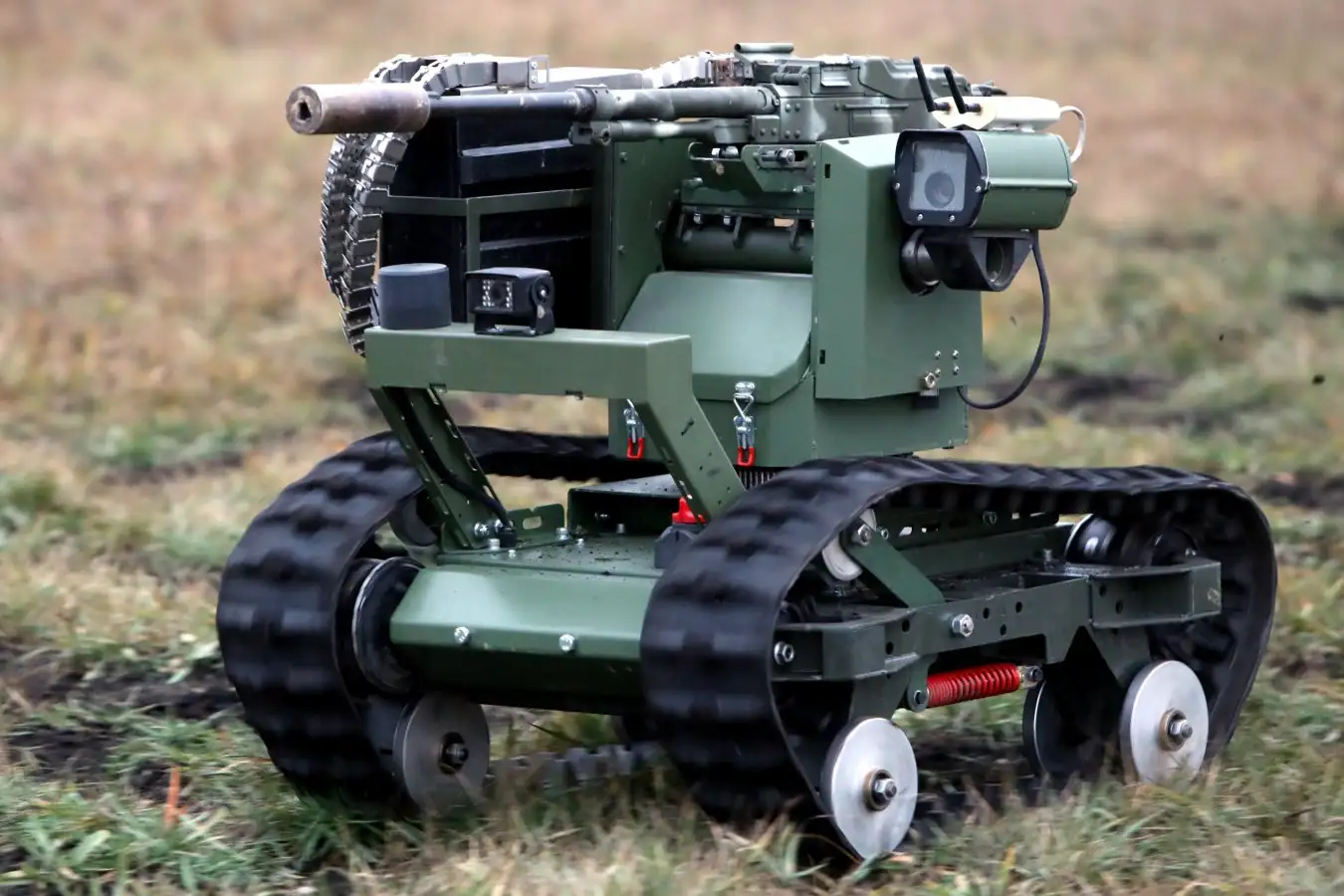

“Legit” Unmanned Ground Vehicles in Ukraine
Oleksandr Klimenko/Ukrinform/NurPhoto/Getty Images
<p>The prevailing notion among military leaders worldwide has long been that infantry remains the backbone of any army. This perspective was echoed by Field Marshal Archibald Wavell, who proclaimed after World War II that <a href="https://regimentalrogue.com/misc/in_praise_of_infantry.htm">"Every battle, every war, is ultimately won by the infantry."</a> However, this belief is rapidly evolving.</p>

<p>In Ukraine, the utilization of robots in combat is reaching a critical juncture. Recently, mass production commenced of an affordable robot named **Legit**, designed to carry a machine gun as part of the military’s evolving strategy.</p>

<p>“Even an imperfect system can be valuable if it absorbs risk on behalf of the soldier,” states <a href="https://www.unsw.edu.au/staff/oleksandra-molloy">Oleksandra Molloy</a> from the University of New South Wales, Australia.</p>

<p>The frontline in Ukraine serves as the primary testing ground for these robots. It’s here that casualties are most likely, making the deployment of machines over human soldiers a strategic advantage. Observers have noted that actual intelligence gathering is predominantly executed by drones, with one soldier remarking that ground troops were stationed merely due to requests from higher-ups.</p>

<p>Can robots fully defend the line? Ukrainian military commander Mykola Zinkevich argues they are already doing so. He shared that UGVs, comparable in size to quad bikes, could be remotely operated and maintained frontline positions for 45 days while combating Russian forces autonomously.</p>

<p>These UGVs return periodically for battery changes and ammunition replenishment, marking a shift from their initial use in supply transportation to armed engagement equipped with remote-controlled machine gun turrets.</p>

<p>The next challenge lies in offensive capabilities, especially considering their maneuverability limitations. Ukraine has planned in 2024 for the <a href="https://united24media.com/war-in-ukraine/ukraines-first-robot-only-assault-meet-the-fighters-who-pulled-it-off-6375">first-ever all-robot attack</a>. Despite some machines getting stuck, the mission succeeded in capturing strategic Russian positions.</p>

<p>Ukraine has continued small-scale UGV operations since, leading to tailored robotic tactics. Reports suggest these robotic assaults have significantly reduced casualties.</p>

<p>In April, President Volodymyr Zelenskiy announced ambitious plans to ramp up UGV production to **50,000 units by 2026**, emphasizing, "Everyone must understand: This is about saving lives."</p>

<p>Notably, the technology behind these vehicles does not involve groundbreaking advancements; UGVs are fundamentally simple and controlled remotely. While international forces like the US have explored similar machines, Ukraine faces unique pressures that necessitate rapid operational testing of these technologies.</p>

<p>Cost is another advantage: the **Legit** UGV is priced around $11,400—its affordability stemming from utilizing components originally designed for recreational vehicles. This allows for minimal risk to human life, as these machines can be deployed in high-risk scenarios.</p>

<p>“Grace is rarely rewarded on the battlefield,” Molloy points out, emphasizing that success favors survivability, redundancy, low cost, and mass.</p>

<p>Andriy Biletsky, commander of Ukraine's III Corps, foresees that robots could eventually constitute **80% of Ukraine's combat power**.</p>

<p>Although current wheeled and tracked UGVs struggle in urban settings, future innovations may change that. The US military is testing humanoid robots for infiltration operations, and experts believe agile, AI-driven humanoids could emerge within two years—pioneered by companies like Elon Musk's Tesla.</p>

<p>“UGVs won’t replace military personnel; they will augment their deployment and training,” notes Molloy.</p>

<p>However, the transition to fully autonomous AI machines poses ethical dilemmas alongside operational efficiencies.</p>

<p>While the success of Ukraine’s UGV initiative is not guaranteed—some argue trench warfare offers a more conducive environment for robotic deployment—the emergence of robot soldiers in Ukraine could herald a transformative phase in warfare.</p>

<section class="ArticleTopics" data-component-name="article-topics">
    <p class="ArticleTopics__Heading">Topic:</p>
</section>
Source: www.newscientist.com