


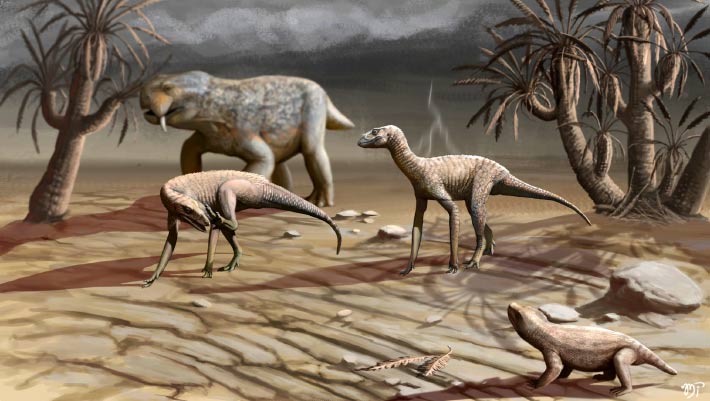
Two reddish-brown bones that had long been labeled “unknown” in a Brazilian fossil collection have been identified as belonging to Itaguyra occulta, a previously unknown Triassic species related to dinosaurs. The remains were found among fossils of cynodonts, an extinct group closely related to mammals, and provide evidence that these dinosaur relatives persisted in what is now southern Brazil for roughly 11 million years.
A dinosaur relative from the Triassic
Itaguyra occulta belonged to Silesauridae, an enigmatic group of Triassic animals closely related to dinosaurs. Some paleontologists regard silesaurids as dinosaurs’ sister group, while others classify them as early members of the dinosaur lineage, specifically within the ornithischian branch that later included animals such as Triceratops and Stegosaurus.
“The dawn of dinosaurs was marked by the appearance of the saurischian lineage in the fossil record during the Late Triassic period, about 230 million years ago,” said Dr. Voltaire Paes-Neto of the Federal University of Rio de Janeiro and his colleagues.
“The initial burst of diversification in this group is represented by late Carnian to early Norian sauropods and herrerasaurids, mainly from Brazil, Argentina, India and Zimbabwe.”
The researchers said that silesaurids are an older and more mysterious group of quadrupedal animals that some recent studies have interpreted as early ornithischian dinosaurs.
Under that interpretation, dinosaurs would have originated much earlier than the end of the Ladinian period, about 241 million years ago. By that time, silesaurids may already have been distributed across Gondwana.
Evidence from southern Brazil
The fossil remains of Itaguyra occulta were discovered at the Schoenstadt Reserve in Santa Cruz do Sul, Rio Grande do Sul, Brazil. The rocks that produced the fossils belong to the Santa Cruz sequence, which has a maximum depositional age of about 236 million years, during the Early Carnian.
Silesaurids were already known from older Middle Triassic rocks and from younger rocks in Brazil and Argentina, but fossils from the intervening period had not been identified.
The discovery of Itaguyra occulta indicates that silesaurids existed continuously in what is now southern Brazil for approximately 11 million years, from the Ladinian to the early Norian.
This interval included major changes in terrestrial ecosystems, including the disappearance of fanged dicynodonts and the rise of rhynchosaurs as dominant land animals. The persistence of silesaurids through these changes suggests that they could adapt to different ecosystems.
What the fossils reveal about dinosaur evolution
The research team’s phylogenetic analysis placed the new species among the earliest ornithischians. If that interpretation is correct, dinosaurs originated before the end of the Ladinian and spent millions of years as relatively inconspicuous members of ecosystems dominated by other animals.
“A number of studies support the hypothesis that ‘silesaurids’ may have been the first ornithischian dinosaurs,” the paleontologists said.
“Based on this scenario, early dinosaurs lived for millions of years as separate components in ecosystems dominated by other tetrapods, and the first significant expansion in their diversity occurred during the early Carnian, when saurischian dinosaurs diverged into three major lineages, including herrerasaurids, theropods and sauropods.”
The researchers also considered the alternative possibility that silesaurids were dinosaurs’ sister group.
“On the other hand, considering the scenario of ‘silesaurids’ as a sister group to dinosaurs, it is noteworthy that dinosaur precursors persisted for millions of years before and after the first dinosaur radiation,” they said.
“Despite the phylogenetic scenario, the new record from the Santa Cruz sequence provides convincing evidence of the adaptive capacity of ‘silesaurids’, as they were components of an ecosystem just before the faunal transition that witnessed the emergence of ‘typical’ dinosaurs.”
The study was published online in May 2025 in Scientific Reports.
VD Paes Neto et al. 2025. Dinosaur forms continued to exist in South America during the Middle to Late Triassic. Scientific Reports 15, 18498. doi: 10.1038/s41598-025-99362-5
Source: www.sci.news