


Close Menu
HitechubHitechub
    What's Hot
    Science

    Step-by-Step Guide to Artemis II Earth Reentry: Process and Insights

    Science

    The Surprising Truth Behind Why Carrots Come in Different Colors

    Space

    Space Perspective: A Journey to the Edge of Space

    Important Pages:
    • About Us
    • Privacy Policy
    • Terms & Conditions
    Facebook X (Twitter) Instagram Pinterest
    Facebook X (Twitter) Instagram
    HitechubHitechub
    Tuesday, June 23
    • Technology
      1. AI
      2. Gadgets
      3. View All

      This is the most popular CEO in the world

      Sectors in which “Chat-GPT” is most often used

      AI Pioneer Expresses Concern About Potential for AI to Surpass Humanity

      Artificial intelligence has begun to “swallow” professions

      What’s new in Android 14

      Europeans have about 700 million old mobile phones in their drawers

      Here’s how you can tell if your phone is being tapped

      “Sneaker X” – computer case in the shape of a sneaker

      Russian Gamers Unite to Prevent Nuclear War: Join the Fight Online

      Challenges of Space Travel: Why Journeying to Space is So Difficult

      NASA Astronaut Casts Historic Vote from Space

      Discover the Future of Comfort: What If You Could Wear a Chair?

    • Science
      1. Space
      2. Wheels
      3. View All

      Galaxies in the universe are growing more slowly than they should

      “Espace” presented the new lander “Apex 1.0”

      The largest asteroid sample ever collected has arrived on Earth

      (VIDEO) Incredible flight of the Parker Solar Probe

      Toyota wants to make a new generation battery with a range of up to 1,200 km

      Meet Toyota’s lunar “baby” that could make exploring the Moon easier

      Microlino – Is this the perfect city car?

      Alfa Romeo 4C gets an electric successor

      Fusive Neurosurgery Restores Mobility in Paralyzed Pigs – Could Humans Be Next?

      New Research Challenges Long-Standing Beliefs About Human Ancestors’ Growth Trends

      Discover the Simple Method to Slow Brain Decline That Most Haven’t Tried

      How Menopause Transforms Brain Function and What to Expect Post-Menopause

    HitechubHitechub
    Home » New Discoveries Indicate Interstellar Comet 3I/ATLAS Originated 12 Billion Years Ago
    Science

    New Discoveries Indicate Interstellar Comet 3I/ATLAS Originated 12 Billion Years Ago

    Share Facebook Twitter Pinterest WhatsApp
    Share
    Facebook Twitter LinkedIn Pinterest WhatsApp

    Interstellar comet 3I/ATLAS exhibits a unique chemical signature distinct from comets in our solar system and is believed to have formed 10 to 12 billion years ago, predating the Sun, according to two studies published in the journal Nature.


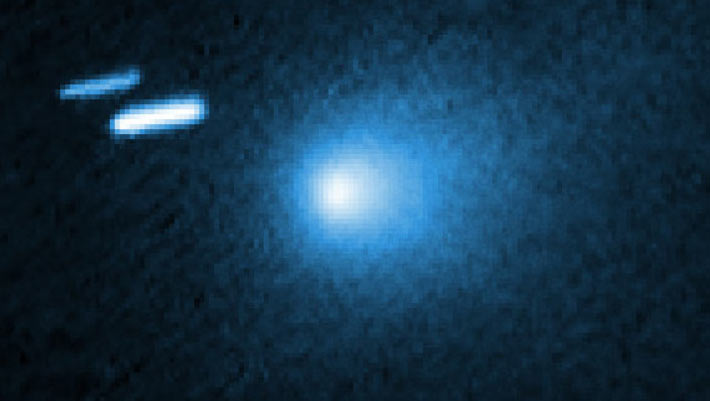
    Hubble captured this image of 3I/ATLAS on July 21, 2025. At that time, the comet was 446 million kilometers (277 million miles) from Earth. Image credits: NASA/ESA/David Jewitt, UCLA/Joseph DePasquale, STScI.

    Discovered in July 2025, 3I/ATLAS represents the third confirmed interstellar object to traverse the inner solar system.

    Despite extensive observations, the precise age, origin, and trajectory of 3I/ATLAS remain elusive.

    Its speed suggests an age estimate ranging from 3 billion to 10 billion years.

    Analyzing isotope ratios offers insights into the environmental conditions during the formation of 3I/ATLAS.

    “This was a once-in-a-lifetime opportunity to investigate an ancient celestial object, possibly older than our Sun or the solar system itself,” stated Dr. Martin Cordiner, an astronomer at NASA’s Goddard Space Flight Center.

    “We gain direct insights into distant epochs and locales, while also appreciating the uniqueness of our solar system.”

    As 3I/ATLAS started its journey away from the Sun in December 2025, Cordiner and his team utilized NASA/ESA/CSA’s James Webb Space Telescope to gather detailed measurements of its chemical composition.

    Webb’s NIRSpec (near-infrared spectrometer) revealed exceptionally high levels of deuterium, approximately 30 times greater than that found in solar system comets.

    This suggests that 3I/ATLAS may have originated during an earlier era in Milky Way history, likely in a frigid star system.

    During its formation, the materials within 3I/ATLAS were likely subjected to substantial radiation, yet not warm enough to transform heavy water ice into the familiar form of water ice found on Earth.

    Additionally, NIRSpec identified only minimal amounts of carbon-13 relative to lighter carbon-12, indicating an ancient origin for 3I/ATLAS.

    In contrast, higher carbon-13 levels are found in planetary systems around the Sun that formed more recently, a mere 4.5 billion years ago.

    Researchers propose that 3I/ATLAS formed between 10 and 12 billion years ago, at the “cosmic noon” of the universe’s history, a period marked by peak star formation.

    Its youthful formation might have occurred within a relatively cool, dense cloud.

    The high concentration of heavy water suggests that 3I/ATLAS spent its formative years in a deeply frozen state.
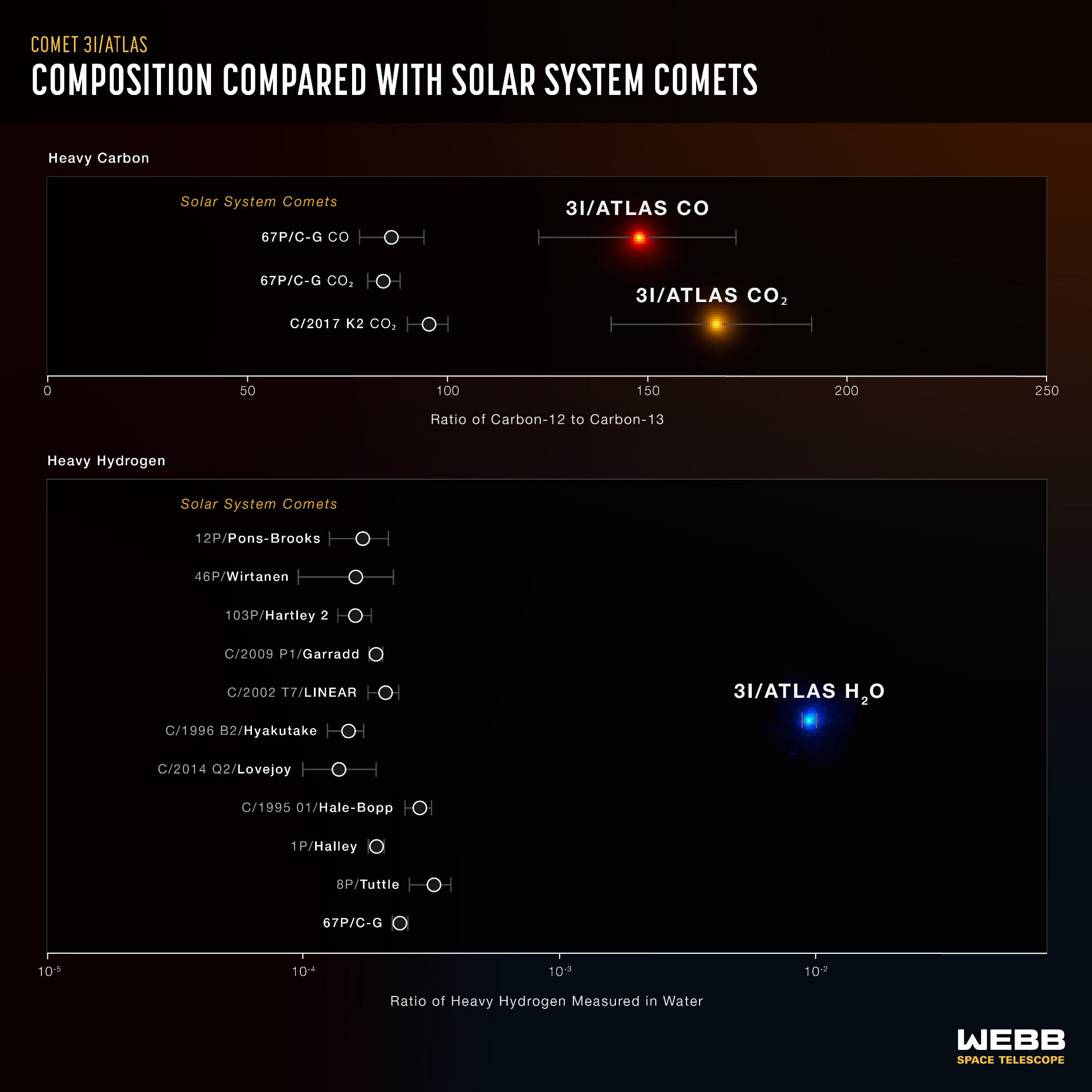

    This infographic showcases the discrepancies in heavy carbon to deuterium ratios between solar system comets and the interstellar comet 3I/ATLAS. Image credit: NASA / ESA / CSA / M. Cordiner / L. Hustak, STScI.

    This infographic illustrates the differences in heavy carbon to deuterium ratios between solar system comets and interstellar comet 3I/ATLAS. Image credit: NASA / ESA / CSA / M. Cordiner / L. Hustak, STScI.

    In a related study, astronomer Cyriel Opitum from the University of Edinburgh and colleagues conducted observations of interstellar visitors using the UV-Visual Echelle Spectrometer (UVES) at ESO’s Very Large Telescope from December 6 to 26, 2025.

    Their findings complement Webb’s results by analyzing the chemical forms of carbon and nitrogen in 3I/ATLAS.

    “While the discovery of these rare isotopes is exciting for us as scientists, the broader purpose is to explore the potential for prebiotic chemistry in other parts of the galaxy,” noted Dr. Stephanie Milam, also of NASA’s Goddard Space Flight Center.

    “Currently, Earth is the only known location in the vast universe where chemical components have led to life.”

    “Studying these interstellar objects is a significant step toward understanding how common or rare the conditions for life’s evolution are in the universe.”

    _____

    M. Cordiner et al. Isotopic evidence for the cold and distant origin of 3I/ATLAS. Nature published online June 22, 2026. doi: 10.1038/s41586-026-10771-6

    C. Opitom et al. 2026. High isotopic ratio of nitrogen and carbon in interstellar comet 3I/ATLAS. Nature in press. arXiv: 2603.07187

    Source: www.sci.news

    Share. Facebook Twitter Pinterest LinkedIn WhatsApp
    Previous ArticleBreakthrough: Woman with Alzheimer’s Disease Begins Speaking Again After Psilocybin Treatment
    Next Article How Menopause Transforms Brain Function and What to Expect Post-Menopause

    Related Posts

    Science

    Fusive Neurosurgery Restores Mobility in Paralyzed Pigs – Could Humans Be Next?

    Science

    New Research Challenges Long-Standing Beliefs About Human Ancestors’ Growth Trends

    Science

    Discover the Simple Method to Slow Brain Decline That Most Haven’t Tried

    Science

    How Menopause Transforms Brain Function and What to Expect Post-Menopause

    Science

    Breakthrough: Woman with Alzheimer’s Disease Begins Speaking Again After Psilocybin Treatment

    Science

    Discover How Pollen Could Unlock the Longevity Secrets of Heliconius Butterflies

    Science

    Revolutionary New Spider Species Develops Unique Trap Launching Ants Into the Air

    Science

    Asteroid Donald Johansson: Wobbly, Peanut-Shaped Object with a Watery Past, Scientists Discover

    Add A Comment
    Leave A Reply Cancel Reply

    Stay In Touch
    • Facebook
    • Twitter
    • Instagram
    • Pinterest
    Top Picks
    Science

    Hubble Discovers Active Spiral Galaxy Messier 88: A Breathtaking Cosmic Insight

    A stunning new Hubble image reveals Messier 88, a captivating spiral galaxy, actively pulled by…

    Sherp vehicle – still the best truck in the world

    “Sneaker X” – computer case in the shape of a sneaker

    Schrödinger’s Cat Unleashed: Physicists Reveal Groundbreaking Quantum State Discovery

    Discover the Truth: ‘Everyone is Lying to You for Money’ – An Essential Cryptocurrency Exposé

    Most Popular
    Science

    Iron Age Britons: The Practice of Removing Brains from the Deceased

    Technology

    NASA Astronaut Casts Historic Vote from Space

    Categories
    • AI (13)
    • Gadgets (10)
    • Science (320)
    • Space (9)
    • Technology (37)
    • Wheels (9)
    Our Picks
    Science

    Pigeons Utilize Superparamagnetic Immune Cells in Their Livers to Detect Earth’s Magnetic Field

    Science

    Breakthrough: First Images of Cozumel Dwarf Fox Captured by Scientists

    © 2026 Hitechub.
    • Home
    • About Us
    • Privacy Policy
    • Terms & Conditions

    Type above and press Enter to search. Press Esc to cancel.

    We are using cookies to give you the best experience on our website.

    You can find out more about which cookies we are using or switch them off in .

    Ad Blocker Enabled!
    Ad Blocker Enabled!
    Our website is made possible by displaying online advertisements to our visitors. Please support us by disabling your Ad Blocker.
    Hitechub
    Powered by  GDPR Cookie Compliance
    Privacy Overview

    This website uses cookies so that we can provide you with the best user experience possible. Cookie information is stored in your browser and performs functions such as recognising you when you return to our website and helping our team to understand which sections of the website you find most interesting and useful.

    Strictly Necessary Cookies

    Strictly Necessary Cookie should be enabled at all times so that we can save your preferences for cookie settings.