


Planetary scientists have meticulously analyzed a lunar meteorite known as North West Africa (NWA) 12593. Their findings provide crucial evidence of a significant asteroid impact on the moon that occurred approximately 3.5 billion years ago. This discovery aids in piecing together the tumultuous history of violent impacts which have shaped the inner solar system.
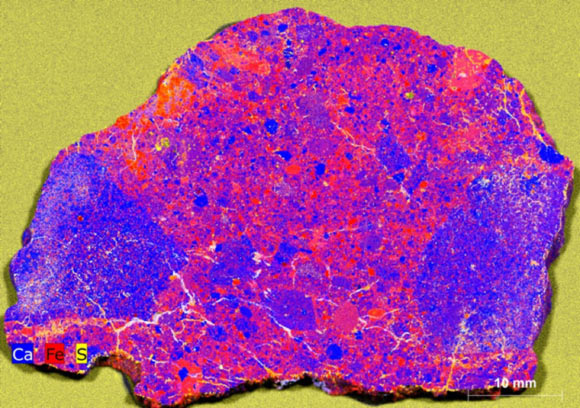
XRF map of a 7.53 g slice of NWA 12593, highlighting the diverse crust with Calcium (Ca) and Iron (Fe). Sulfur (S) indicates cracks and surface weathering. Image credit: Crow et al., doi: 10.1130/G54386.1.
The initial billions of years of Earth’s history laid the foundation for life, atmosphere, and oceans. However, this era remains enigmatic, as few geological records survive from those times. Factors such as erosion, subduction, and burial consistently reshape the Earth’s surface, making older rocks increasingly rare.
Understanding this epoch is vital for deciphering our origins and the effects of catastrophic events like asteroid impacts on early life. “The first fossil evidence of life on Earth dates back approximately 3.5 billion years, indicating that life evolved prior to this period,” explains Dr. Carolyn Crowe, a planetary scientist at the University of Colorado Boulder.
“One question we frequently explore is: what does the shock record reveal about the time when life began?”
“This understanding is pivotal for grasping how life establishes and emerges, making the cycle of catastrophic events a fundamental aspect of the equation.”
While scrutinizing the NWA 12593 meteorite, Dr. Crowe and colleagues identified evidence of three distinct impact events.
The first event, dating back roughly 3.5 billion years, was substantial enough to transform the lunar surface into molten material, generating a mineral called cubic zirconia, which only forms under extreme temperatures.
“Cubic zirconia is usually manufactured for jewelry; however, it cannot endure the lower temperatures found on Earth and the Moon unless its cooling is meticulously controlled in a laboratory,” noted the researchers.
“Nonetheless, we were able to detect traces of a mineral akin to cubic zirconia from our samples.”
The second impact event is illustrated by the meteorite itself, comprising a type of rock known as breccia, formed after a smaller impact disrupted the molten sheet created by the initial event.
“Breccia resembles what you’d see if you chipped away at a concrete block,” says Dr. Crowe. “You can observe small stones fused together as if by cement.”
“However, during the impact process, the meteorites merge together, creating chunks of various rock types.”
Evidence for the third impact comes from meteorites that have landed on Earth, suggesting a more recent impact that dislodged fragments of breccia from the moon towards our planet.
The timing of the initial major impact recorded by NWA 12593 aligns with known impacts involving Earth and Vesta, the fourth largest asteroid in the asteroid belt.
It’s rare for three simultaneous impact events of this age to be documented, offering invaluable insights into a period when the solar system was transitioning from frequent collisions during planet formation to sporadic impacts resulting from asteroid fragmentation.
“This finding is quite exceptional, and that’s why we are so thrilled about it,” Dr. Crowe stated.
“It’s notably uncommon to have all three records align like this.”
This groundbreaking research has been published in the Journal of Geology on May 12, 2026.
_____
Crowe, C.A., et al. “Three pieces of evidence of approximately 3.7 Ga to 3.2 Ga impact into the inner solar system.” Geology, published online on May 12, 2026. doi: 10.1130/G54386.1
Source: www.sci.news