


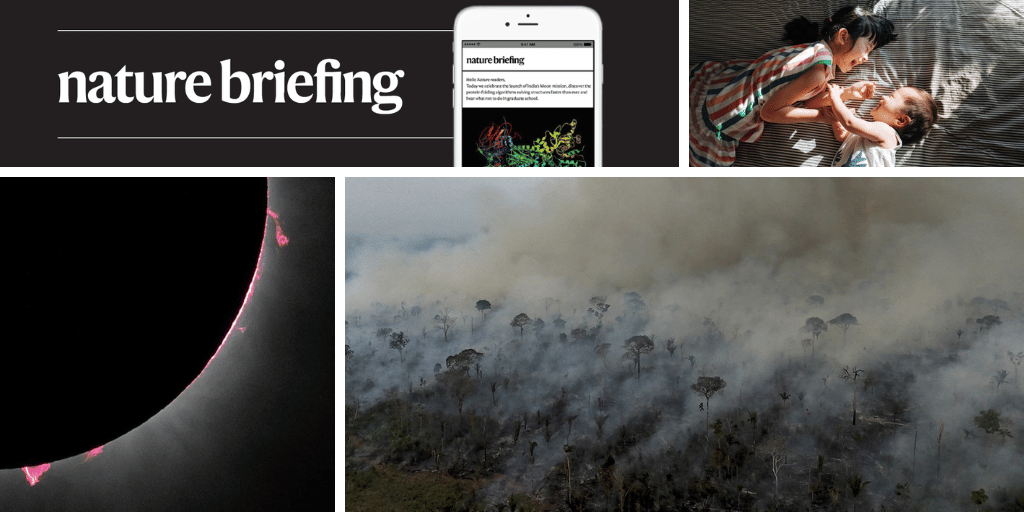
Hello Nature readers. Would you like to receive the latest science news and research updates free in your inbox every day? Sign up here.
A solar prominence extends from the Sun’s corona during a total solar eclipse in Dallas in 2024.Credit: NASA/Keegan Barber
On 12 August, scientists will have approximately two minutes to study the Sun’s outer atmosphere, known as the solar corona, during a total solar eclipse. Observations collected during the eclipse could help researchers explain why the corona is far hotter than the Sun’s visible surface and reveal how the Sun’s magnetic energy is generated and released. A clearer understanding of the solar corona could also improve space-weather forecasting, helping scientists assess risks to satellites, communications networks and power grids on Earth.
Nature | 6 min read

The path of the total solar eclipse on 12 August 2026.Source: ESA
People of Greek, Dutch and Chinese backgrounds appear to share the same “ticklish hot spots”, including the armpits and soles of the feet. The finding suggests that the way people experience tickling may be broadly consistent across cultures. Comparisons with maps of sensations such as pain and pleasure indicate that ticklishness is a distinct sensory experience. The study is among the first to systematically examine gargalesis, a form of playful tickling involving strong, repeated pressure that can trigger laughter.
Nature | 4 min read
Reference: Nature Human Behaviour paper
QED Science has launched a free artificial-intelligence tool designed to assess the originality and effectiveness of life-science research. The startup recently used the platform to identify the “top 1%” of preprints posted on bioRxiv between May 2025 and April 2026. The approach has prompted debate among researchers, some of whom question whether AI can evaluate scientific quality reliably, fairly and transparently. Researchers can use the platform to identify “what information and explanations to add”, said QED Science chief executive Niv Mastboim. “The goal is to produce good science.”
Nature | 5 min read
Reference: QED Science press release
Science features, analysis and expert perspectives
The 2023–2024 El Niño-driven drought triggered some of the Amazon rainforest’s most severe wildfires, and many affected areas have not fully recovered. Another El Niño event is developing, with some forecasters predicting that it could become the strongest in 150 years. Researchers warn that El Niño, combined with the warming and drying effects of climate change, could push tropical rainforests towards a dangerous tipping point. If that threshold is crossed, rainforest could gradually give way to savannah and degraded woodland, releasing carbon equivalent to several years of global emissions.
Nature | 8 min read
Three data scientists argue that researchers using artificial-intelligence tools should prioritize open-weight models that can run on personal computers. Local AI models could make scientific research more sustainable by reducing dependence on data centres that consume large amounts of energy and water. Educators can support this shift by teaching students when a locally hosted model is preferable to a cloud-based system and how to build applications that run efficiently on available hardware.
Nature | 8 min read
In 2024, publisher MDPI added warnings to some research papers after identifying signs of a “review mill” — an individual or group that reproduces peer-review reports, potentially to increase citations for its own papers or those of collaborators. Biophysical chemist Michael Bersch, whose paper was flagged, says his team conducted legitimate research but that fraudulent peer-review practices have contaminated some of its work. “It’s devastating for my PhD students to have their first papers branded like this,” he said.
Nature | 20 min read
Where I work: restoring mangrove forests in Mozambique

Celia Macamo and her colleagues are replanting mangrove seedlings.Credit: Diego Menjíbar Reynes Nature
Marine biologist Celia Macamo is helping to protect mangrove forests threatened by urban expansion in Maputo, Mozambique. Macamo and her team conduct ecological assessments to estimate how much carbon is stored in mangrove soils, information that can support the creation of carbon credits. Companies can purchase these credits to offset greenhouse-gas emissions, while landowners can receive financial incentives to protect local ecosystems. This approach could help conserve mangrove habitat and prevent land from being cleared for development or aquaculture. (Nature | Visual feature)
Today, I look down on the world through the Aerial Photographer of the Year Award entries. The competition does not prescribe what an image should look like, but it is no surprise that the natural world has proved to be an enduring source of inspiration.
To help us review this newsletter with fresh eyes, send your feedback to [email protected].
Thank you for reading,
Jacob Smith, Associate Editor, Nature Briefing
• Nature Briefing: Careers — practical insights, expert advice and award-winning journalism to help you improve your working life.
• Nature Briefing: Microbiology — the world’s most abundant life forms, microorganisms, and their roles in health, the environment and food systems.
• Nature Briefing: The Anthropocene — reporting on climate change, biodiversity, sustainability and geoengineering.
• Nature Briefing: AI and Robotics — the latest developments in artificial intelligence and robotics, written by humans.
• Nature Briefing: Cancer — a weekly newsletter created for cancer researchers and professionals.
• Nature Briefing: Translational Research — news and analysis covering biotechnology, drug discovery and pharmaceuticals.
Source: www.nature.com