


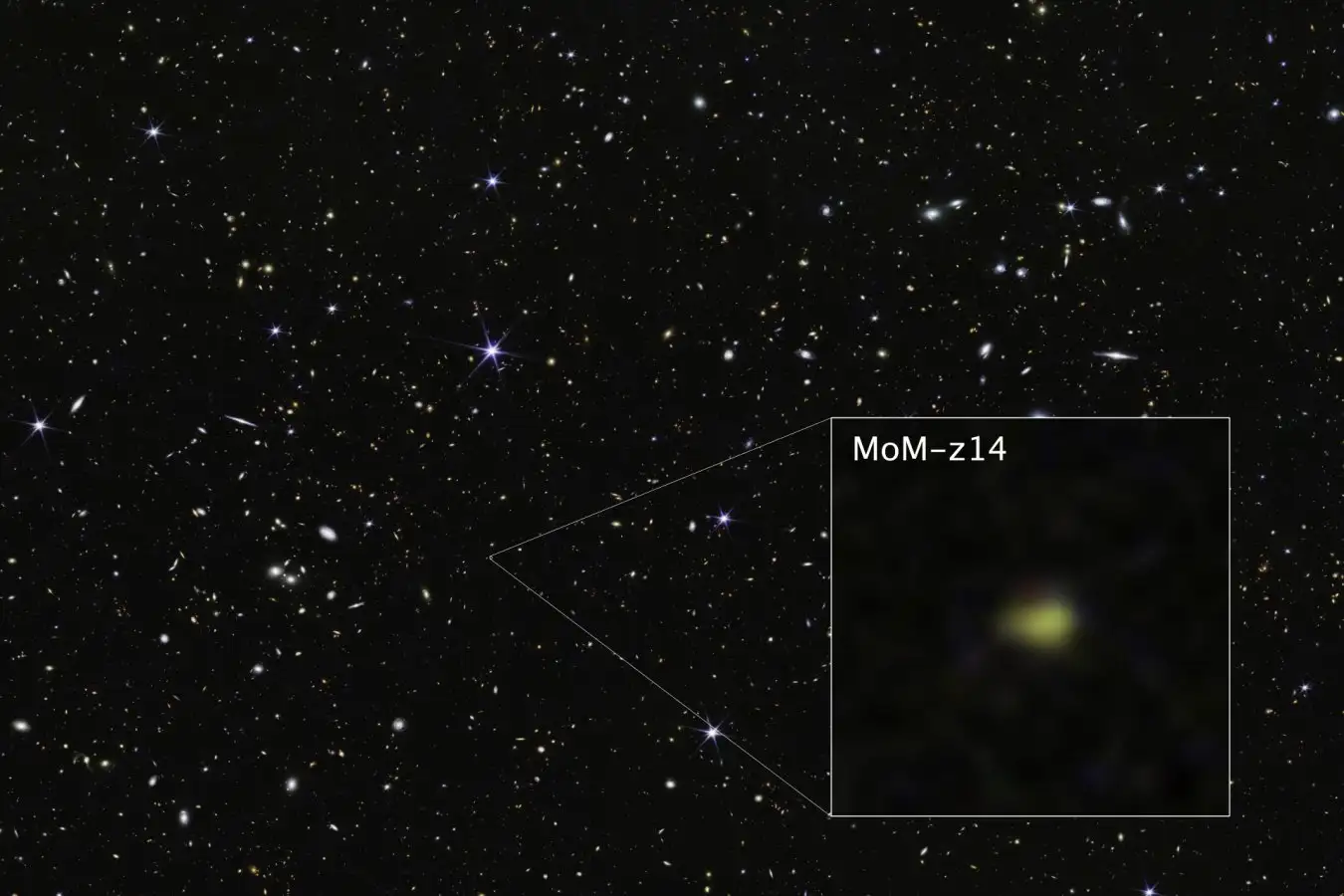

Galaxy MoM-z14: A “Cosmic Miracle”
J. DePasquale (STScI)
As a scientist observing today’s galaxy research landscape, I feel we are in remarkable times. Despite funding fluctuations in the US and UK, our cosmic knowledge is growing exponentially. The launch of the James Webb Space Telescope (JWST) on Christmas Day 2021 has transformed our understanding of early galaxies. These celestial structures were found to be both brighter and more densely packed with stars and hot gas than previously believed.
JWST’s groundbreaking observations have revealed galaxies existing just 300 million years post-Big Bang. While it may seem like a lengthy timeline, it’s just a tiny fraction (2.14%) of the universe’s near-14 billion-year history, comparable to my own experiences as a human.
Led by Rohan P. Naidu, researchers at MIT identified an extraordinary galaxy named MoM-z14 last year. Their study describes MoM-z14 as a “cosmic miracle,” exhibiting brightness surpassing theoretical expectations for its early cosmic epoch. This breakthrough was made possible by JWST’s unparalleled ability to detect such faint celestial entities.
Although the luminous characteristics of these galaxies excite researchers, they also introduce challenges. We must ask whether these discoveries are indeed galaxies. In April, Marcia Bradaci and a team from UC Davis scrutinized the JWST data, as detailed in a preliminary paper. They claim two bright objects in JWST’s findings are not galaxies but rather brown dwarfs within our Milky Way. These star-like objects are more compact than expansive galaxies filled with stellar populations.
This unexpected finding surprised me. Brown dwarfs, often viewed as the antipodes of galaxies, exist in a unique niche—too massive to evolve into gas giants like Jupiter, yet lacking the mass for nuclear fusion typical of stars. Future research will determine if Bradaci’s observations redefine our interpretation of other early galaxies.
Nevertheless, we are more than equipped to respond to these challenges. I anticipate that 2026 will be a landmark year for astronomy. Despite funding constraints, Chile’s Vera C. Rubin Observatory will initiate a decade-long survey mapping the Southern Hemisphere’s skies, capturing images of over 5 billion galaxies. Operating alongside JWST, the upcoming Nancy Grace Roman Space Telescope will enhance our understanding and work in tandem with the ESA’s Euclid mission, which aims to image hundreds of millions of galaxies. This collaboration may revolutionize our comprehension of galactic evolution, including our own Milky Way.
Topics:
This revision introduces SEO-friendly language while preserving the original structure and HTML tags.
Source: www.newscientist.com