


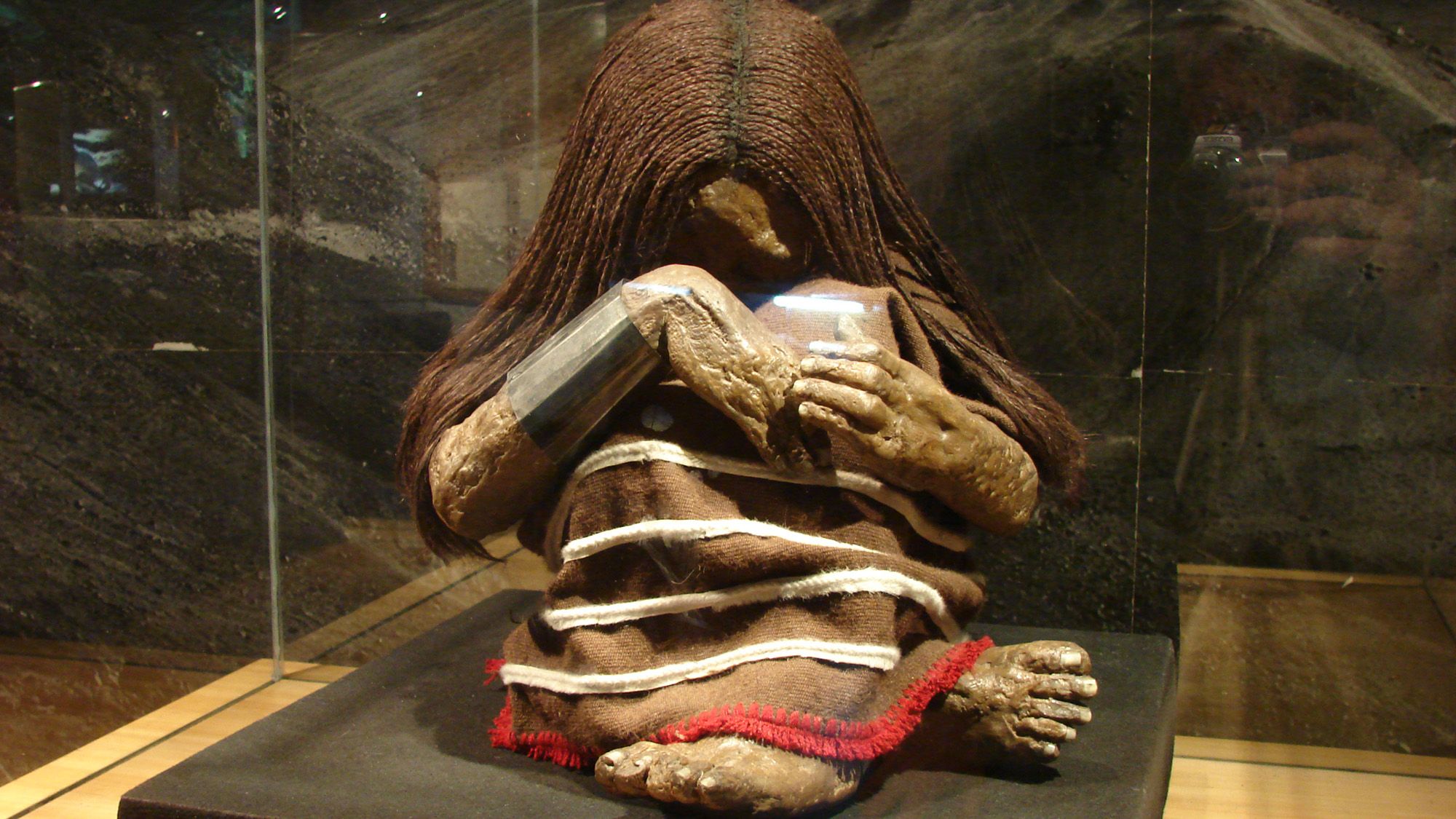
Inca children selected for human sacrifice embarked on sacred pilgrimages spanning thousands of miles through various Inca communities before their ritual deaths, primarily occurring near the majestic peaks of the Andes. Recent analyses of their mummies have unveiled new insights into these ancient practices.
The study examined their death circumstances and found that none of the three children had succumbed to fatalities beforehand. The ritual, termed Capacocha, slowly faded in ways that scientists had previously speculated.
“Capacocha was a ritual that extended beyond just the final offering on the mountain,” said study lead author Veronica Silva Pinto, an archaeologist at Universidad Diego Portales in Santiago, Chile. “It involved several months of rituals, which included movement, dietary changes, participation from different communities, and the curation of a sacred landscape.”
Latest videos from

However, some experts have expressed skepticism about certain aspects of the study.
The research focused on new examinations of three Capacocha mummies from two archaeological sites. This includes Niño de El Promo, or El Promo Boy, who was around 8 or 9 years old in the 15th century when he was sacrificed near the summit of Cerro El Promo, which stands at 17,700 feet (5,400 meters) in what is now central Chile. Two girls, aged approximately 9 and 18, were sacrificed about 30 years ago near the summit of modern-day Cerro Esmeralda located in the Atacama Desert in northern Chile.

Aerial view of El Promo mountain in the Chilean Andes, the site of El Promo Boy’s sacrifice around 1480.
(Image credit: Dreamextreme, via Getty Images)
Historically, the cause of El Promo’s death was attributed to hypothermia or sub-zero temperatures on high mountains, while the Cerro Esmeralda girls were believed to have died from strangulation. However, a new study published on July 15 in the journal Scientific Progress questions these earlier conclusions.
Human Sacrifice in the Inca Empire
The El Promo boy was discovered in 1954, with the two Cerro Esmeralda girls found in 1976. This study represents the first application of modern archaeological techniques to these mummies.
Receive the world’s most captivating discoveries directly to your inbox.
This research exemplifies that revisiting previously analyzed contexts using new technologies and ethical methods can yield significant insights,” said Silva-Pinto.
A CT scan and microscopic examination revealed that El Promo Boy had died from blunt force trauma to the head—this injury was overlooked by earlier investigators. The two Cerro Esmeralda girls, previously thought to have been strangled due to marks on their necks, were found to have non-fractured hyoid bones, a common indicator of strangulation, leading researchers to conclude that their cause of death remains “unknown” at present.

Recent research has found that El Promo Boy (depicted here during weighing) did not die from cold exposure but rather from blunt force trauma to the head.
(Image credit: FPG via Getty Images)
Silva-Pinto emphasized that forensic testing must be contextualized within the Andean worldview, which perceives death not as a conclusion but as a transition into divine realms.
“In the Inca belief system, death represented a transformation rather than an absolute end, allowing those sacrificed to gain a new ritual status—acting as intermediaries between the community, mountains, gods, and the nation,” she noted.
The Sacred Pilgrimage
Researchers conducted chemical analyses on tiny hair samples from the mummies, examining isotopes that reveal insights into their diets and geographical origins. Isotopes from consumed food and water integrate into hair, disclosing the inhabitants’ origins. Alongside isotopes, the study also utilized radiocarbon dating.
The isotopes indicated that these children traversed considerable distances between “ecologically distinct regions.” It is estimated that El Promo Boy traveled between 1,615 to 1,740 miles (2,600 to 2,800 km) in the nine months prior to his sacrifice, likely starting from Cusco, the heart of the Incan Empire. The Cerro Esmeralda girls likely covered 560 to 745 miles (900 to 1,200 km) in their last three months.
Silva-Pinto noted that the pilgrimage interconnected remote mountainous areas and other significant locales where rituals culminated. She stated, “Along the journey, local communities would have greeted the pilgrims, partaking in ceremonial offerings of food and drink.” This further sanctified the routes, allowing the central Incan state to reinforce its presence in the integrated regions.
Radiocarbon dating confirmed that these sacrifices occurred in the 15th century, with the Cerro Esmeralda girl around 1450 and El Promo Boy around 1480. Silva-Pinto pointed out that this timeline indicates these actions were not isolated incidents but part of recurring practices through time.
Bioarchaeologist Dagmara Soča, a professor at the University of Warsaw who specializes in Capacocha mummies, emphasized that the conclusions derived from isotope analyses could be problematic. “Isotope analysis alone does not definitively reconstruct the paths traveled during their journeys,” she explained in an email to Live Science. “In several instances, the identified isotopic changes lack statistical significance and may reflect seasonal dietary variations.”
The study is intriguing and possesses potential value; however, some interpretations drawn appear to stretch beyond what the available evidence clearly supports,” she concluded.
Archaeologist Pablo Mignone from the Argentine Institute of Social Sciences and Humanities expressed reservations regarding the study’s interpretative framework. “This paper appears to favor a centralized narrative, attributing children’s journeys as tools for ‘biopolitical conquest,'” he stated in an email to Live Science.
Nevertheless, previous findings indicate that Capacocha children sometimes initiated their travels from various Inca regions rather than solely from the capital. Mignone asserted that portraying Cusco as the singular catalyst for conquest is an interpretative decision unsupported by extensive evidence regarding Capacocha practices.
Silva-Pinto, V., Sepulveda, M., Gayo, E.M., Mendez-Quiroz, P., Castro, M., Menéndez, L.P., Rojas-Costa, G.M., Theron, M.L., Wilson, A.S., Catalunya, V., Silva, C., Stecher, X., Sofia, P., Salazar-Garcia, D.C. (2026). Pilgrimage to Sacrifice: Mechanisms, Causes, and Timing of Mortality in the Capacocha of the Western Andes of South Tahuantinsuyu. Scientific Progress, 12(29), eadz9055.
Test your knowledge about the first inhabitants of the Americas with our informative My First American Quiz!
Source: www.livescience.com