


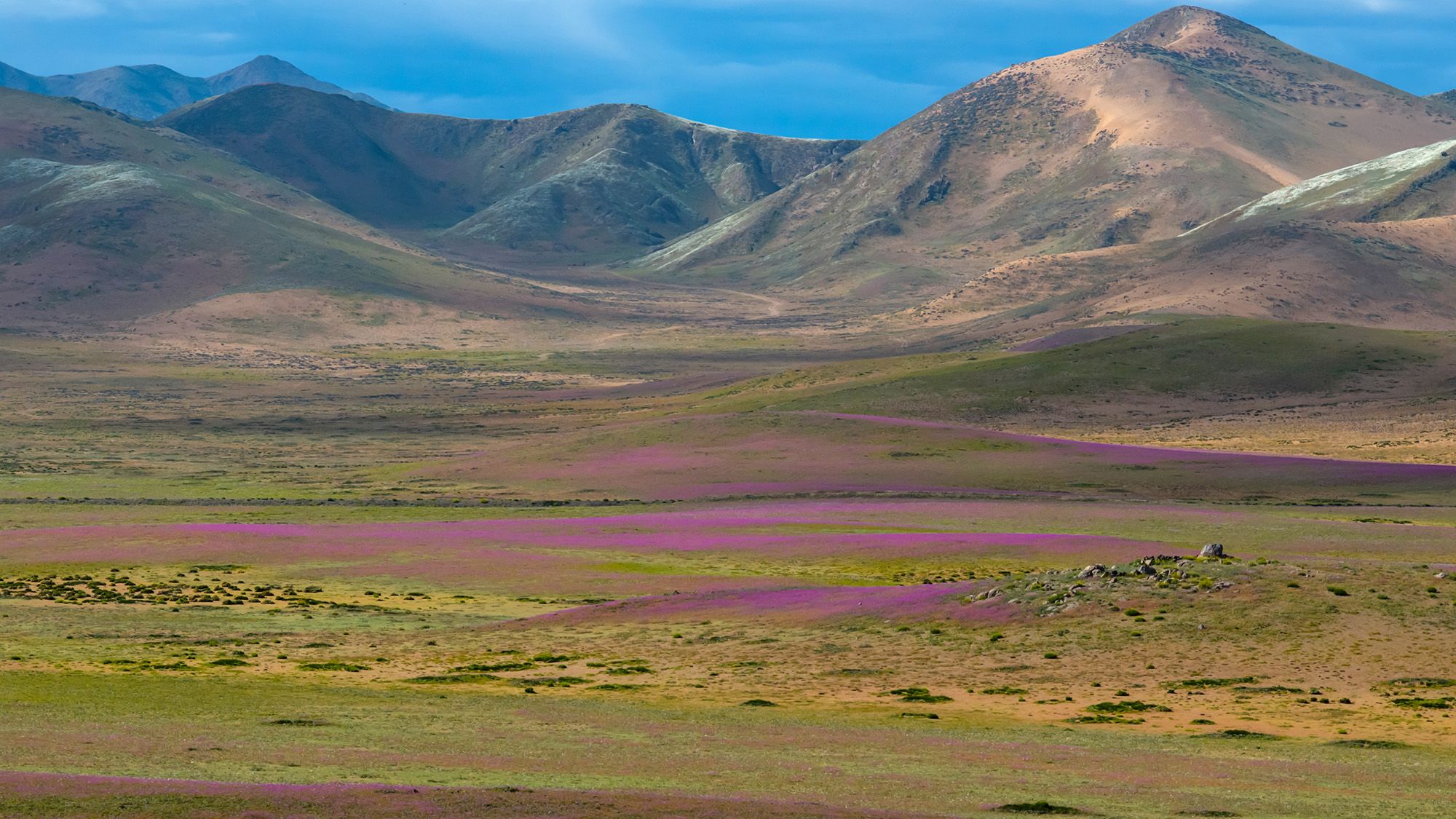
Chile’s Atacama Desert Bursts Into Color After Rare Rainfall
Rare rainfall linked to a strong El Niño event has transformed Chile’s Atacama Desert, one of the driest places on Earth. Millions of seeds and bulbs that remained dormant underground for years have awakened, covering parts of the desert in a spectacular carpet of purple, pink, white, red and yellow flowers.
Known locally as Desierto Florido, or “flowering desert,” the phenomenon is one of nature’s most remarkable transformations. Flowering plants now stretch across hillsides and plains that appear almost completely lifeless for much of the year.
Why did the Atacama Desert bloom?
“This is a unique phenomenon. There are more than 200 species of plants,” said Jorge Carabantes, director of protected areas at Chile’s National Forestry Corporation, or CONAF, according to the Associated Press. “This is clearly an unusual flowering event, and is very different from other flowering events that occur elsewhere on Earth.”
The Atacama typically receives only about 0.6 inches (15 millimeters) of rain each year. However, July and August brought record rainfall to several parts of Chile, including levels not seen since the 1950s. More than 7 inches (190 millimeters) of rain fell in some areas, Carabantes told the Associated Press.
Although the extreme rainfall caused flooding in parts of Chile, it also triggered flowers across approximately 17,000 square kilometers (6,560 square miles) of the Atacama Desert. CONAF representatives told the Associated Press that this is the most widespread desert bloom since 1997.
A fleeting natural spectacle
For photographers and tourists, the bright flowers create a striking contrast with the dark Atacama Mountains and the cloudless Chilean sky. But the bloom will not last long. By the end of spring in the Southern Hemisphere, many of the flowers will have disappeared, leaving behind seeds and bulbs that may remain dormant until the next period of extreme rainfall.
These five photographs by Getty Images photographer Javier Torres capture the extraordinary colors of Chile’s flowering desert.
Latest videos from Live Science
Image credit: Javier Torres via Getty Images

Image credit: Javier Torres via Getty Images

Image credit: Javier Torres via Getty Images

Image credit: Javier Torres via Getty Images

Image credit: Javier Torres via Getty Images
Source: www.livescience.com