


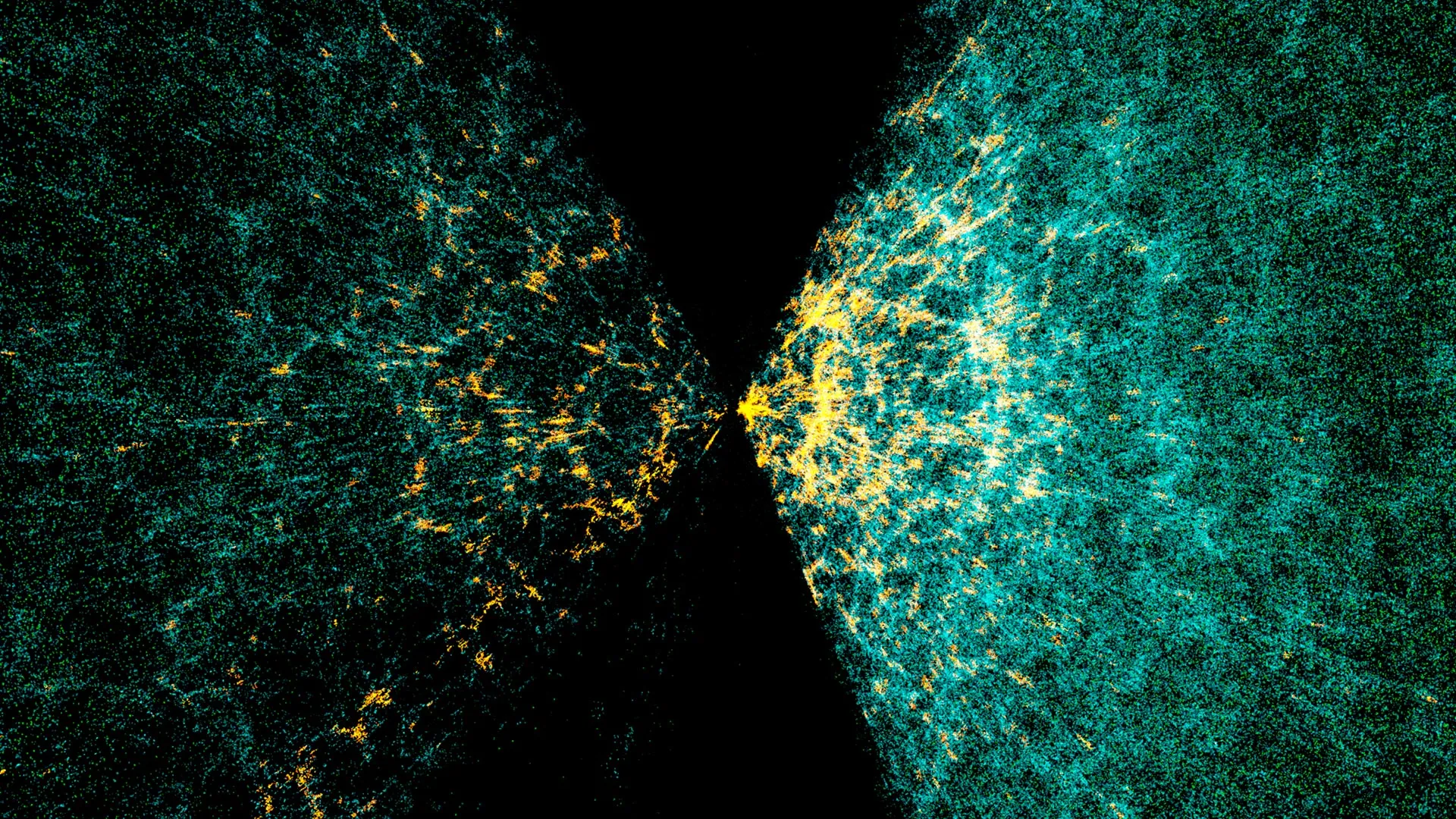
The Sloan Digital Sky Survey V (SDSS-V) has taken a major step toward creating a truly global map of the universe with Data Release 20 (DR20). The release includes the first optical BOSS spectra collected by SDSS-V in the Southern Hemisphere, significantly expanding the survey beyond the data featured in earlier releases.
By combining new southern observations with data from the Northern Hemisphere, SDSS-V is building a panoptic spectroscopic survey of the entire sky. This growing dataset gives astronomers a broader view of stars, interstellar gas, galaxies, and other cosmic objects across the universe. DR20 represents another major contribution to the comprehensive spectroscopic map being developed by the ongoing SDSS-V mission.
Observing both the nearby and distant universe is essential for understanding the physical processes that shape galaxies, stars, and the cosmos. SDSS-V Data Release 20 advances this goal by expanding access to multi-wavelength, multi-epoch optical and infrared observations.
What is included in SDSS-V Data Release 20?
DR20 provides a broad collection of resources for professional astronomers, students, educators, and astronomy enthusiasts. The release includes catalogs covering black holes, stars, and interstellar gas, along with new visualization platforms and scientific tools for exploring large astronomical datasets.
“DR20 represents a major leap forward in the scale of SDSS data products. Today, we are releasing spectra of more than 3 million stars and galaxies, along with 18 value-added catalogs,” said Dr. Emily Griffiths of the University of Colorado Boulder, spokesperson for the SDSS-V collaboration. “This is the result of years of research by a dedicated international team of astronomers. We are excited to share DR20 with the world and see what the community discovers with it.”
SDSS-V releases its first Southern Hemisphere BOSS spectra
For the first time, SDSS-V Data Release 20 includes stellar and extragalactic optical spectra collected in the Southern Hemisphere. These observations were obtained with the DuPont 2.5-meter telescope at Las Campanas Observatory (LCO) in Chile and combined with recent observations from the Sloan Foundation 2.5-meter telescope at Apache Point Observatory (APO).
By using observatories in both hemispheres, SDSS-V is significantly expanding the geographic reach of its survey and moving closer to mapping the sky on a truly global scale.
Connecting optical and X-ray observations of the universe
DR20 also delivers the first large-scale data stream from coordinated eROSITA-SDSS-V observations. This work is part of the ERosita Sources’ SPectroscope IDentification (SPIDERS) program and the eROSITA X-ray All-Sky Survey (eROSITA DR2).
These observations provide essential identifications and optical redshift measurements for active galactic nuclei (AGNs), galaxy clusters, and active stars that emit large amounts of X-ray radiation. Combining X-ray detections with detailed optical spectroscopy allows researchers to determine more accurately what these high-energy objects are and how far away they are.
Black Hole Mapper expands dramatically
Black Hole Mapper (BHM) DR20 contains three to four times more data than the previous DR19 release. It includes approximately 1.1 million optical BOSS spectra representing about 500,000 individual astronomical objects.
Alongside the SPIDERS program, this expanded dataset includes important contributions from the All-Quasar Multiepoch Spectroscopy (AQMES) program and the Reverberation Mapping (RM) program. These projects repeatedly observe quasars and other targets to investigate how supermassive black holes and their surrounding environments evolve over time.
Mapping 1.5 million stars across the Milky Way
Milky Way Mapper (MWM) has also grown substantially in DR20 through the addition of a large collection of optical stellar observations.
Across the BHM and MWM surveys, DR20 contains more than 3 million spectra covering approximately 1.5 million stars. The release includes the first carbon-enhanced metal-poor stars and intermediate-mass exfoliated stars identified in the Magellanic Clouds. These rare stellar populations have long attracted scientific interest because they can provide important clues about star formation and stellar evolution.
New spectroscopic maps of nebulae and nearby galaxies
Local Volume Mapper (LVM) has expanded well beyond the single-tile preview included in DR19. DR20 contains an integral field spectroscopic map covering 169 tiles and six additional target regions, representing approximately 300,000 spectra.
These maps capture galactic H II regions, planetary nebulae, and nearby galaxies at remarkable spatial resolution. They also provide a new way to study familiar objects, including the Rosette Nebula and Orion Nebula, using detailed spectroscopic data collected across broad regions of the sky.
New tools for exploring interstellar gas
To help users explore the expanding Local Volume Mapper dataset, the SDSS-V collaboration has introduced LVMvis. The interactive, browser-based visualization tool complements the next-generation Zora and Valis user interfaces, which have also been updated for DR20.
LVMvis features RGB HiPS emission-line maps that allow users to investigate the distribution, structure, and movement of glowing gas across the sky.
DR20 also includes 18 new or extensively updated Value Added Catalogs (VACs). These catalogs support professional astronomical research by organizing, processing, and enriching information derived from the survey’s primary data products.
Public access to SDSS-V data
Like previous SDSS data releases, DR20 is cumulative. It includes all newly reduced BOSS spectroscopic observations collected from both hemispheres through February 2, 2025, as well as spectroscopic data from the earlier phases of the Sloan Digital Sky Survey.
The complete dataset is available through the Science Archive Server (SAS), which also provides updated Python notebook tutorials. Cloud-based analysis through SciServer is available to professional astronomers, students, educators, and the general public under SDSS’s open-data policy.
“We want everyone to be able to take advantage of SDSS data products, whether they are professional astronomers conducting research, students learning how to work with data, teachers looking for classroom materials, or just anyone interested in astronomy in general,” said Dr. Anne-Marie Wymans, SDSS Data Product Coordinator at the University of St. Andrews. “That’s why we have a variety of platforms for people to work with data, and we take care to provide plenty of examples and tutorials for each platform. Data should not just be public, it should be publicly available.”
“This data release provides great SDSS-V data that we are confident people will take great advantage of,” said Carnegie Science’s Dr. Djuna Kollmeyer, SDSS-V director. “But we’re not stopping here. We just spent a week talking about what’s going to go into DR21 and DR22! We’re going to need a bigger computer!”
About the Sloan Digital Sky Survey
Funding for the Sloan Digital Sky Survey V is provided by the Alfred P. Sloan Foundation, the Heising-Simons Foundation, the National Science Foundation, and participating institutions. SDSS gratefully acknowledges support and computing resources from the University of Utah High Performance Computing Center.
The SDSS telescopes are located at Apache Point Observatory, funded by the Astrophysical Research Consortium and operated by New Mexico State University, and Las Campanas Observatory, operated by the Carnegie Institution for Science.
The SDSS is managed by the Astrophysics Research Consortium for participating institutions in the SDSS Collaboration, including the California Institute of Technology, the Carnegie Institution for Science, Chile’s National Time Allocation Commission (CNTAC) Certified Researchers, the Flatiron Institute, the Gotham Participating Group, Harvard University, Heidelberg University, Johns Hopkins University, École Polytechnique Fédérale de Lausanne (EPFL), the Potsdam Leibniz Institute for Astrophysics (AIP), the Max Planck Institute for Astronomy (MPIA Heidelberg), the Max Planck Institute for Extraterrestrial Physics (MPE), Nanjing University, the National Astronomical Observatory of China (NAOC), New Mexico State University, Ohio State University, Pennsylvania State University, the Smithsonian Astrophysical Observatory, the Space Telescope Science Institute (STScI), the Stellar Astrophysics Participating Group, the National Autonomous University of Mexico, the University of Arizona, the University of Colorado Boulder, the University of Illinois at Urbana-Champaign, the University of Toronto, the University of Utah, the University of Virginia, Yale University, and Yunnan University.
Source: www.sciencedaily.com