


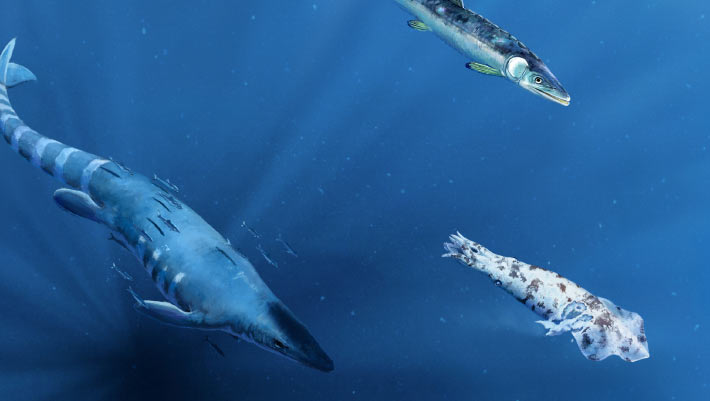
Paleontologists studying fossils from southern Manitoba, Canada, have identified two possible bite marks on the internal skeleton of a giant Cretaceous cephalopod. The discovery offers rare evidence of predator-prey interactions in the ancient Western Interior Seaway, which once covered central North America.
Reconstruction of mosasaurs and large predatory fish attacking an injured Enchoteuthis. The fossil damage may represent a bite from an octopod or another Cretaceous marine predator. Image credit: Caitlin Lindblad.
“During the Mesozoic Era, cephalopods were among the most abundant and diverse groups in marine ecosystems,” University of Manitoba paleontologist Melina Jobbins and her colleagues wrote in the study.
“Cephalopods, including coleoids and ammonites, provided an important food source for predators such as marine reptiles and fish.”
Evidence of these predator-prey relationships comes from fossils with preserved stomach contents, as well as injuries such as fractures and breaks that may represent bite marks. However, identifying the predator responsible for damage to a fossil is difficult when teeth or other diagnostic evidence are absent.
For their new study, the researchers examined the fossilized gladius of Enchoteuthis, a squid-like cephalopod that lived in the Cretaceous seas approximately 81 million years ago.
The specimen, catalogued as Q80.05.14, was collected from Manitoba’s Pierre Shale in 1980. It is now housed at the Canadian Fossil Discovery Centre.
“Q80.05.14 is approximately 49 centimeters (19 inches) long and consists of a gladius with an almost complete rachis and partial patella, lacking the leading and trailing edges,” the researchers wrote.
The gladius is estimated to have been approximately 60 centimeters (24 inches) long, while the animal’s total body length was probably less than 1 meter (39 inches).
Using three-dimensional scans and silicone casts, the scientists analyzed two preserved triangular defects in the Enchoteuthis gladius.
The first defect is located near the front of the structure and shows no evidence of healing. This makes it more likely to represent a bite inflicted shortly before, or around the time of, the animal’s death.
The second mark is located toward the rear and is less clearly defined. It may have resulted from a second bite during the same attack, damage from another encounter, or tearing along the gladius’ natural fibrous layers during the attack or after the carcass began to decay.
The scientists could not identify the predator with certainty. The marks do not contain embedded teeth or display the regular spacing that might point to a particular attacker.
Potential predators living alongside Enchoteuthis in the ancient seaway included mosasaurs such as Latoplatecarpus and predatory fish such as Cimolichthys. Sharks and larger mosasaurs, including Tylosaurus, were also considered, although the shape of the damage and the absence of clear tooth impressions make a firm identification impossible.
“Indirect evidence of predation, such as bite marks, is an important element in understanding predator-prey dynamics and contributes to our knowledge of the food web of the Western Interior Seaway during the Late Cretaceous,” the authors concluded.
Their paper was published online on August 28, 2026, in Cretaceous Research.
_____
Melina Jobbins et al. Fatally injured by a giant octopod? A bone-enclosed squid-like cephalopod, Enchoteuthis, from the Cretaceous Pierre Shale of Manitoba, Canada. Cretaceous Research, published online August 28, 2026. doi: 10.1016/j.cretres.2026.106480
Source: www.sci.news