


Hello Nature readers. Would you like to receive this science briefing free in your inbox every day? Sign up here.
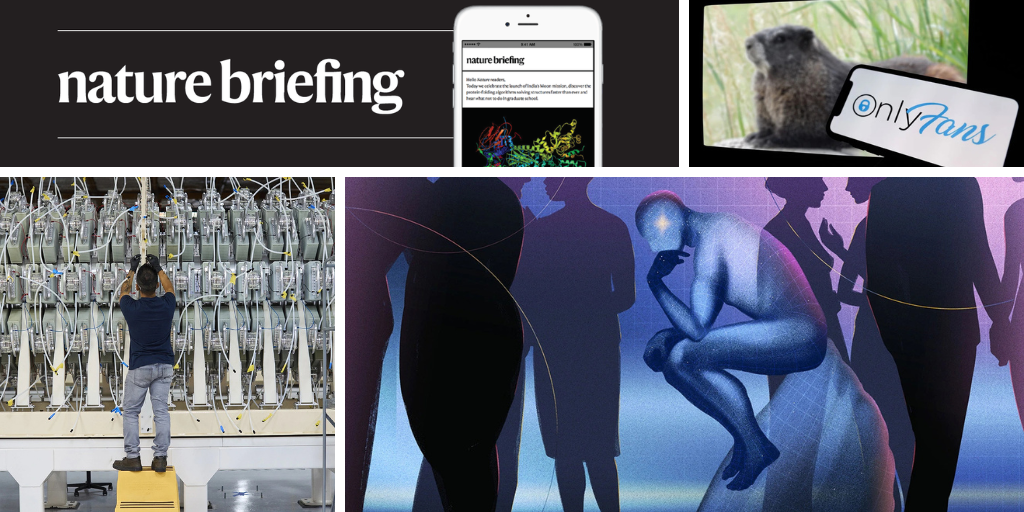
Workers are assembling a giant impedance-matched Marx generator, which will deliver powerful electrical pulses to the core of Pacific Fusion’s experimental fusion machine.
Credit: Pacific Fusion
Pacific Fusion has started building a nuclear fusion machine designed to produce more energy than it consumes. The system will compress a capsule of hydrogen fuel using powerful electrical pulses, creating the extreme conditions needed for fusion. The planned $1 billion facility is being built near the United States’ primary nuclear weapons laboratory and could also support research into the country’s aging nuclear warhead stockpile. Pacific Fusion is one of dozens of well-funded startups working to develop commercial fusion power plants capable of delivering virtually unlimited, low-carbon energy.
Nature | 9 min read
New research is shedding light on the origins of life and the Last Universal Common Ancestor, or LUCA—the ancient organism from which all modern life descended. Scientists propose that LUCA may have emerged from a chemically and energetically rich hydrothermal-vent environment involving a system that was partly organic and partly rock. The findings also suggest that Bacteria and Archaea, the two oldest single-celled domains of life, may have developed independently after this early origin.
Scientific American | 12 min read
Reference: Science Advances paper
Inspired by the television series Margo Is in Trouble with Money, a team at the Rocky Mountain Biological Institute has launched a safe-for-work OnlyFans account for marmots. The account features videos of wild marmots captured by remote cameras and currently generates about $100 a day in viewer tips. The project offers a creative way to fund wildlife research and raise awareness of marmot behavior and conservation.
Nature | 7 min read
Features and impressions
In Creatures That Intertwine, cognitive scientist Anthony Cemero examines common assumptions about artificial intelligence, cognition and consciousness. Reviewer Abeba Birhane argues that discussions of AI consciousness often rely on overly reductive ideas about how the human mind works. Both researchers challenge the notion that the brain is simply a computer, emphasizing instead the importance of relationships, environments and lived experience. Current AI systems do not exist in the world in the same way humans do, form social relationships or experience emotions, raising major questions about whether they can ever be conscious.
Nature | 8 min read
As countries including the United States reduce multilateral aid budgets, China is expanding bilateral partnerships and becoming a leading provider of healthcare support around the world. Ruby Wang, who advises on political, technical and clinical relationships between China and other countries, notes that these partnerships can provide affordable diagnostics and medicines. However, she argues that international institutions must also ensure that health collaborations build local capacity, protect regional sovereignty and strengthen long-term healthcare systems.
Nature | 7 min read
When people think about circulation, they often focus on the heart. But the heart can pump only the blood that returns to it, and the calf muscles play an important role in helping move blood upward from the lower legs. Physician and scientist Robert McBain compares the process to squeezing toothpaste through a tube. Poor calf-muscle pumping ability has been linked to higher mortality, ankle swelling and an increased risk of deep-vein thrombosis. Regular movement and calf-strengthening exercises may help support healthy circulation. Even simple actions, such as raising your heels while sitting and reading, can engage the calf muscles.
Source: www.nature.com